New York Savings Bank Building
81 8th Avenue | Chelsea | built 1897
Open on the map10 entries

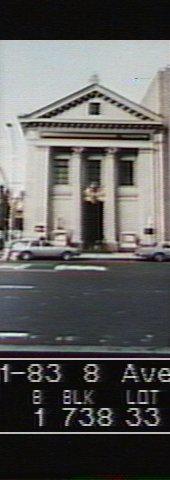
The city photographed every building for its tax records around 1940 and again in the 1980s. NYC Municipal Archives.
Written with AI from the source each entry cites, then fact-checked.
- 1857
The New York Savings Bank moves into the basement of a bank building on this corner
In 1857, three years after its 1854 founding at 21st Street and Third Avenue, the bank moved into the basement of the New York County Bank's four-story building at the northwest corner of 14th Street and Eighth Avenue. After the Civil War, as 14th Street grew into a commercial thoroughfare, the bank prospered, bought the building and moved upstairs to the first floor. It tore that building down in 1896-97 to make way for the present one.
- 1897
Depositors climb a temporary wooden staircase while the bank is built in two halves
To keep the bank open during construction, architect R. H. Robertson had it built in two campaigns, the administrative western part first and the public eastern part after. By May 1897, customers entered the western section by climbing a temporary wooden staircase from 14th Street through a window opening. Within a year they could use the broad steps and portico on Eighth Avenue.
“By May 1897, to enter the western section while the eastern was being constructed, depositors climbed a temporary wooden staircase from 14th Street…”
- 1897
Robert Henderson Robertson designs a marble 'temple' for thrift
The bank, chartered in 1854 as the Rose Hill Savings Bank, takes the name New York Savings Bank in 1862. In 1896 it commissions architect Robert Henderson Robertson to design a new building, finished in 1897 as a Roman temple of white Vermont marble with two Corinthian columns at the entrance and a copper dome ringed by twenty stained-glass windows. A bronze two-faced clock on the corner holds a beehive, a symbol of thrift, with bees circling the clock faces.
Source: Daytonian in Manhattan
- 1930
The bank remodels its Eighth Avenue facade
Architect George H. Provot alters the main facade on Eighth Avenue in 1930. The original stairs, which project onto the sidewalk, are replaced with a narrower recessed flight, and the four original doorways give way to a single door.
Source: Wikipedia
- 1931
The bank adds a night depository, the only one in New York City
In 1931 the New York Savings Bank installed a deposit box that let customers make deposits at night. Wikipedia notes that it was then the only night depository in New York City.
Source: Wikipedia
- 1953
The bank installs a closed-circuit television system to check customers' signatures
In 1953 the New York Savings Bank put in a closed-circuit television system that let staff verify account details and signatures on checks, with withdrawal times expected to be cut in half. The New York Times called it the first regular use of television in banking in the United States. The same year the bank opened its first branch, at Rockefeller Center.
“The system was expected to halve withdrawal times; The New York Times described it as "the nation's first regular use of television in the banking field".”
Source: Wikipedia
- 1987
The bank, renamed Goldome, closes its branch here when its five-year lease ends
The Buffalo Savings Bank acquired the New York Bank for Savings in 1981, and two years later the merged bank took the name Goldome. The Buffalo bank had sold the building to cut maintenance costs and taken a five-year lease from the new owner. That lease ran out in 1987, and the bank there was closed.
- 1987
The owner removes stained glass and bronze from the bank as a landmark hearing looms
In 1987 the Landmarks Preservation Commission notified the building's owner, Landmark Realty, of an upcoming designation hearing. Three days later the owner took out some stained-glass windows and bronze ornaments, and a member of a local preservation group said the owner had vandalized the building. A hole in the roof also raised concerns about damage to the interior.
Source: Wikipedia
- 1988
The city designates the bank building a landmark
New York City designates the former bank's facade and interior banking room as landmarks in June 1988. The building is added to the National Register of Historic Places on January 7, 2000.
Source: Wikipedia
- 1994
A carpet store and later Balducci's fill the vacant bank
The Buffalo Savings Bank moves out in July 1987, and the building stays vacant for several years. Central Carpet reopens it in 1994 after a renovation that ends up costing $8 million, partly because of preservation rules. Balducci's food market occupies it from 2005 to 2009, and a CVS pharmacy has been there since the 2010s.
Source: Wikipedia
Further reading
- New York Savings Bank BuildingWikipedia
Nearby
- New York County National Bank77 8th Avenue | 4 entries
- New York County National Bank Building75 8th Avenue | 7 entries
- The Cross Hotel73 8th Avenue | 5 entries
- 71 8th Avenue2 entries
- 69 8th Avenue1 entry
- 254 West 14th Street4 entries