81 Franklin Street
also 83 Franklin Street | Tribeca | built 1862
Open on the map5 entries

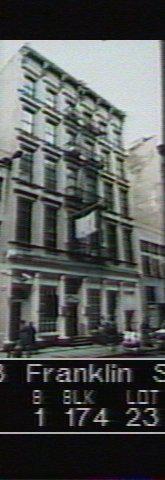
The city photographed every building for its tax records around 1940 and again in the 1980s. NYC Municipal Archives.
Written with AI from the source each entry cites, then fact-checked.
- 1840
Brasher family lives in an earlier house at 83 Franklin Street, where daughter Mary runs a charity
Before the current building, a brick house stood at 83 Franklin Street on what was then a quiet residential block. In the 1840s it was home to the Brasher family, whose unmarried daughter Mary spent much of her time managing the New-York Female Assistant Society. The land belonged to the Livingston family, and the dry goods district was already pushing into the street. Houses like this one were disappearing.
Source: Daytonian in Manhattan
- 1860
Builder John Sniffen leases Nos. 81 and 83 Franklin Street and promises a marble-fronted dry goods store
The two lots were leased to John Sniffen by Maturin Livingston. Sniffen agreed to put up a first-class dry goods store with an ornamental marble front within eight months, and he tore down the two brick houses. The Italianate building took until 1862 to finish, though a tenant was in by October 1861. Its designer's name has not survived.
Source: Daytonian in Manhattan
- 1866
A rival places fake ads mocking dry goods importer George A. Wicks & Co.
George A. Wicks & Co., the building's big dry goods firm, reported 1865 sales of $10 million. On March 24, 1866, a competitor planted bogus notices in three newspapers announcing a Wicks sale, with jokes about ladies queuing like boys at the post office. Wicks suspected William H. Lee of Lee, Bliss & Co. and exposed the prank in the New-York Daily Tribune. The firm itself went bankrupt in July 1867.
Source: Daytonian in Manhattan
- 1907
Otto Heinze & Co. is suspended from the stock exchange as brother's copper bets collapse
Otto Heinze & Co., an importing and commission house that had moved into 81-83 Franklin Street by 1883, was run by Otto C. Heinze, whose brother F. Augustus Heinze headed the Mercantile National Bank and speculated in copper. When copper prices collapsed in 1907, it was announced on October 18 that F. Augustus had stepped down from the bank, and the family firm agreed to a temporary suspension from the exchange. Otto filed for bankruptcy in 1913.
Source: Daytonian in Manhattan
- 1915
Buyer for a Franklin Street textile importer, Charles V. Mills, dies on the Lusitania
J. B. Locke & Potts, importers of white goods and damasks, occupied the building from about 1899. One of its buyers, 33-year-old Charles Veith Mills, sailed on the RMS Lusitania on May 1, 1915, and was among the 128 American civilians killed when a German U-boat sank her on May 7. The State Workmen's Compensation Commission received its first claim from his widow.
Source: Daytonian in Manhattan
Further reading
- The 1862 81-83 Franklin StreetDaytonian in Manhattan
Nearby
- 79 Franklin Street3 entries
- Campe Building85 Franklin Street | 5 entries
- 77 Franklin Street5 entries
- 87 Franklin Street2 entries
- 75 Franklin Street5 entries
- The Print Room89 Franklin Street | 2 entries