Former Mineshaft building
835 Washington Street | West Village | built 1927
Open on the map11 entries

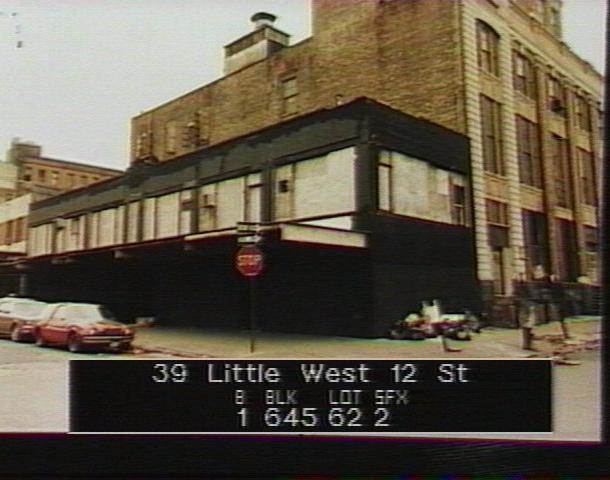
The city photographed every building for its tax records around 1940 and again in the 1980s. NYC Municipal Archives.
Written with AI from the source each entry cites, then fact-checked.
- 1926
The son of General William Wallace Wotherspoon has a market building put up on the block of the family's plaster mill
Read more
The market building at 835 Washington Street went up in 1926-27 for William Wallace Wotherspoon, son of the Army general of the same name. The family firm, Wotherspoon Brothers' Phoenix Plaster Mills, had stood at 426-428 West 13th Street from at least the years after the Civil War into the 1880s. The general entered the Army in 1873, became chief of the General Staff, and was president of the Army War College from 1907 to 1909.
“This market building was erected in 1926-27 for William Wallace Wotherspoon, son of Gen. William Wallace Wotherspoon (1851-1921).”
- 1929
Poultry trade associations and two telegraph companies rent space in the new market building
Within a couple of years of its opening, the building hosted the New York Live Poultry Commission Merchants Association and the New York Poultry Exchange, both listed from 1929 to 1936. Postal Telegraph Cable Co. was a tenant from 1929 to 1938, followed by Western Union from 1938 to 1959. Archie Restaurant ran here from 1937 to 1959.
“N.Y. Live Poultry Commission Merchants Assn. (1929-36); N.Y. Poultry Exchange (1929-36); Postal Telegraph Cable Co. (1929-38) ... Archie Restaurant (1937-59)…”
- 1976
The Mineshaft opens at 835 Washington Street as a members-only leather club for gay men
The Mineshaft opened on October 8, 1976, in a building that had earlier held a gay bar called Zodiac. It had no sign, and visitors climbed a flight of stairs to the second floor. No alcohol was sold, for legal reasons; the club soon spread to the floor below, and the upper level had a roof deck.
Source: Wikipedia
- 1976
A posted dress code bans cologne, suits and disco drag from the Mineshaft
A sign adopted by the club on October 1, 1976 set the dress code through 1978. It welcomed leather, Western gear, jeans, jocks, uniforms and plain shirts. It barred cologne, suits and ties, designer sweaters, tuxedos and disco drag, and a doorman turned away anyone in preppie clothes or cologne, which became part of the club's reputation.
Source: Wikipedia
- 1976
Jack Fritscher attends opening night, and his partner Robert Mapplethorpe later photographs the club
Author Jack Fritscher, who was present on opening night, went hundreds of times. His lover, the photographer Robert Mapplethorpe, photographed the club often and for a time served as its official photographer. Annie Sprinkle claimed to be one of only three women ever admitted, and manager Wally Wallace said he once refused Mick Jagger at the door.
“Jack Fritscher (who was present at its opening night and attended hundreds of times), Fritscher's lover Robert Mapplethorpe (who took many pictures of the Mineshaft, was at one point its official photographer…”
Source: Wikipedia
- 1980
Cruising, the Al Pacino film, borrows the Mineshaft's look but shoots at the Hellfire Club
The 1980 film Cruising was meant to depict the gay cruising scene of the Mineshaft, though the club is not named in it. The Mineshaft refused to allow filming, so scenes were shot at the Hellfire Club, which was dressed to resemble it, with Mineshaft regulars as extras. Al Pacino visited the real club while researching his role.
“Since the Mineshaft would not allow filming, scenes from the movie were filmed at the Hellfire Club, which was decorated to resemble the Mineshaft. Regulars from the Mineshaft appeared as extras.”
Source: Wikipedia
- 1984
Freddie Mercury is photographed in a Mineshaft T-shirt, and Michel Foucault is counted among its visitors
Photographer Richard Young pictured Freddie Mercury in a Mineshaft T-shirt in 1984. Village Preservation lists the philosopher Michel Foucault among the club's visitors. It also reports Jack Fritscher's claim that Jacques Morali drew the Village People's leatherman from the dress code, with Glenn Hughes, a frequent member, playing the part.
Source: Village Preservation
- 1985
The Gay Men's Health Crisis hands out condoms at the club before Mayor Koch moves to close such venues
As the AIDS crisis deepened, the Gay Men's Health Crisis used the Mineshaft to hand out condoms and information about sexually transmitted infections. Tim Sweeney, then the Lambda Legal Defense Fund's executive director, pressed Mayor Koch to make use of such clubs for public education. Instead, in October 1985 Koch told the state Public Health Council to shut any club where sex took place on the premises.
Source: Village Preservation
- 1985
City health officials shut the Mineshaft, the first gay club closed in the 1980s crackdown
The New York City Department of Health closed the Mineshaft on November 7, 1985, after it had operated for nine years, though tax problems also played a large part. It was the first gay club in New York to shut during the 1980s crackdown on clubs and bathhouses. Manager Wally Wallace later gave the club's records and artwork to the Leather Archives and Museum in Chicago.
“…closed by the New York City Department of Health on November 7, 1985, although tax problems played a significant role ... first gay club to close during the 1980s public health crackdown…”
Source: Wikipedia
- 1986
Six people tied to the Mine Shaft and Hell Fire clubs are indicted over liquor and tax evasion and witness tampering
Attorney General Robert Abrams announced that six former owners and employees of the Mine Shaft at 835 Washington Street and the Hell Fire at 26 Ninth Avenue were indicted. They were accused of evading liquor and tax laws and then conspiring to bribe and coerce witnesses. Both clubs had closed the previous fall. The suspected principals were Richard Bell, John Dobson and Vincenzio Caravello.
Source: Internet Archive
- 1986
A former police officer is convicted of bribery and tax fraud in running the Mine Shaft and Hell Fire
Richard Bell, a former New York City police officer, was convicted in State Supreme Court by Justice Myriam Altman after a five-hour trial without a jury. He was found guilty of bribery and tax fraud tied to how the Mine Shaft and Hell Fire clubs were run. Four of his five co-defendants had pleaded guilty the week before, and the fifth was believed to have fled to Ireland.
Source: Internet Archive
Nearby
- 837 Washington Street1 entry
- 833 Washington Street1 entry
- P. F. Collier & Son Building416 West 13th Street | 5 entries
- 36 Little West 12th Street2 entries
- 32 Little West 12th Street3 entries
- 831 Washington Street1 entry