84 Thomas Street
Tribeca | built 1910
Open on the map6 entries

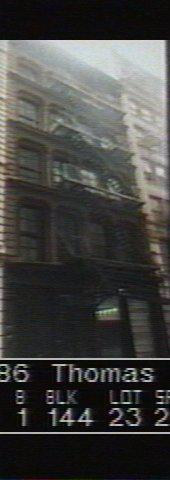
The city photographed every building for its tax records around 1940 and again in the 1980s. NYC Municipal Archives.
Written with AI from the source each entry cites, then fact-checked.
- 1836
Helen Jewett is killed in a brothel that stood on this site
An earlier house stood on the lot, at Nos. 41 and 41-1/2 Thomas Street, run as a brothel by Rosina Townsend. On the night of April 9, 1836, Helen Jewett was found dead there, struck three times with a hatchet and with her bed set on fire. Her client, 19-year-old clerk Richard P. Robinson, had fled around 3 a.m. and was acquitted after a sensational trial. The house was being torn down in late 1869.
Source: Daytonian in Manhattan
- 1870
Cracker merchant Erastus Titus has a cast-iron store and loft building erected
Erastus Titus, a cracker merchant, built a five-story Second Empire store and loft building here in 1870, designed by Youngs & Outcault. Its cast-iron facade has four bays of windows on each upper floor, flanked by rusticated end piers. The new building replaced two brick dwellings that had commercial bases.
“Built in 1870 for cracker merchant Erastus Titus, this building was designed by Youngs & Outcault.”
- 1886
A chemist for the Electrical Subway Commission tests asphaltic concrete at Fairbanks & Co.
Fairbanks & Co. ran a materials testing department here, and members of the American Society of Civil Engineers were invited to see its testing machines in 1884. On August 19, 1886, Dr. Albert R. Ledoux, chemist for the Electrical Subway Commission, tested samples of asphaltic concrete for tensile and crushing strength. The New York Times reported on it the next day, and Electrical World said Ledoux found the tests very satisfactory.
Source: Daytonian in Manhattan
- 1890
Rafael Guastavino's tile arch system is strength-tested in the building
The testing laboratory here, by then called Olsen, put Rafael Guastavino's interlocking tile arch system through a strength test on March 13, 1890. The Jewish Messenger reported that the tensile strength results were very satisfactory. Guastavino's tile arches still appear around the city, including in the Oyster Bar at Grand Central.
Source: Daytonian in Manhattan
- 1983
A falling 500-pound sculpture kills a worker in Beverly Pepper's studio
Sculptor Beverly Pepper, best known for monumental site-specific works, had a loft studio and gallery here from the early 1980s. On January 26, 1983, a 10-foot, 500-pound iron sculpture toppled over and crushed 25-year-old worker Susan Edmonson. She was pronounced dead at St. Vincent's Hospital.
Source: Daytonian in Manhattan
- 2001
Artist Todd Stone watches the World Trade Center fall from the roof and begins his Witness series
Todd Stone, who lived and painted on the top floor, spent most of September 11, 2001 on the roof sketching and taking pictures of the attack a few blocks away. When the towers fell, dust and ash came into his home through a skylight. He went on to paint a series of 16 works called Witness, rubbing ash into the paper, and the series is shown at the 9/11 Museum.
Source: Daytonian in Manhattan
Further reading
- Youngs & Outcolt's 1870 No. 84 Thomas StreetDaytonian in Manhattan
Nearby
- 86 Thomas Street1 entry
- 140 West Broadway2 entries
- 138 West Broadway1 entry
- 42 Hudson Street1 entry
- 50 Hudson Street2 entries
- Wood & Selick Building34 Hudson Street | 6 entries