P.S. 66, the Jacqueline Kennedy Onassis School
85-11 102nd Street | also 85-01 102nd Street | Richmond Hill | built 1900
Open on the map5 entries

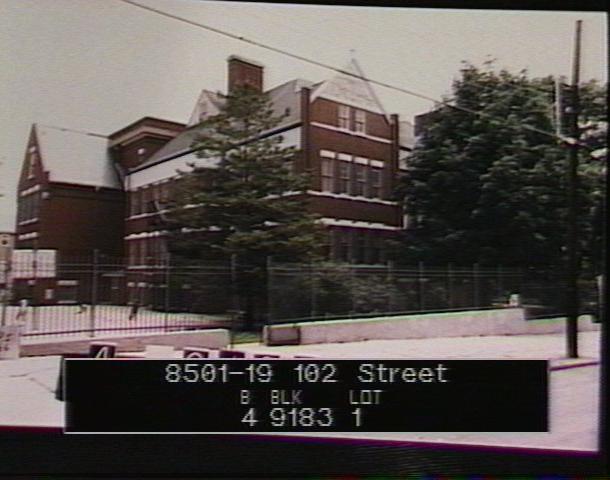
The city photographed every building for its tax records around 1940 and again in the 1980s. NYC Municipal Archives.
Written with AI from the source each entry cites, then fact-checked.
- 1899
Harry S. Chambers's Brooklyn Hills school is finished, its tower bell meant to call children from nearby farms
The school was one of three identical buildings drawn by Harry S. Chambers, architect for Jamaica's Union Free School District No. 7, and carpenter Thomas J. Clarke won the building contract with a bid of $24,290. Work began in early 1898 and ended on July 28, 1899. The red brick Victorian Eclectic building held eight classrooms around an octagonal lobby, and its six-story tower carried a bell meant to call pupils in from nearby farms and developments.
- 1899
Vandals break the windows of the empty new school and thieves strip its plumbing
Although finished, P.S. 66 did not open, because a shortage of city money after consolidation left it without a janitor, and the vacant building began to decay. In December 1899 neighborhood children reportedly smashed its windows and thieves took the plumbing, so the school was boarded up along with the still unused P.S. 65. Local children meanwhile went to P.S. 58 in Ozone Park on half-day schedules.
“In December 1899, the windows at P.S. 66 were reportedly broken by neighborhood children and the plumbing stripped by thieves.”
- 1902
P.S. 66 opens at last as the Brooklyn Hills School, nearly three years after completion
The school finally welcomed pupils on April 14, 1902, and locals called it the Brooklyn Hills School after the surrounding real estate development. Attendance climbed so fast that two more teachers were requested by May, and by 1905 the building held seven teachers and 278 students. A three-story addition credited to city school architect C.B.J. Snyder, built in 1905-6, doubled the classrooms and was occupied on September 9, 1907.
- 1967
Rotting wood forces removal of the bell tower's belfry, which is not rebuilt until 2001
In 1967 deteriorating wood in the tower required the belfry above the second story to be taken down, and the city's fiscal crisis of the 1970s kept the Department of Education from replacing it. By the 1990s the ornamental rinceaux had been covered in stucco and the slate roof swapped for asphalt shingles. An exterior modernization in 2001 restored many lost details and built a new bell tower.
“…in 1967, when wood deterioration in the distinctive bell tower required removal of the belfry above the second story.”
- 2010
P.S. 66 becomes a city landmark after Caroline Kennedy writes in support
In September 2003 P.S. 66 had been renamed the Jacqueline Kennedy Onassis School, honoring the former First Lady's devotion to literacy and historic preservation. At the Landmarks Preservation Commission hearing in December 2008, the commission read a supporting letter from Caroline Kennedy and received letters from the school's first graders, with no one speaking against. The commission designated the building a city landmark on January 12, 2010.
“The Commission read a letter in support of designation from Caroline Kennedy.”
Nearby
- All Saints Church (former St. Matthew's Episcopal Church)85-43 96th Street | 3 entries
- Queens Fire Alarm Telegraph Station83-98 Woodhaven Boulevard | 1 entry
- Daniel and Abbie B. Eldridge House87-61 111th Street | 4 entries
- Forest Park Carousel83-98 Forest Parkway | 9 entries
- Spear & Company Factory94-15 100th Street | 4 entries
- Richmond Hill High School89-30 114th Street | 4 entries