IRT Powerhouse
850 12th Avenue | also 840 Joe Dimaggio Highway | Lincoln Square | built 1905
Open on the map8 entries

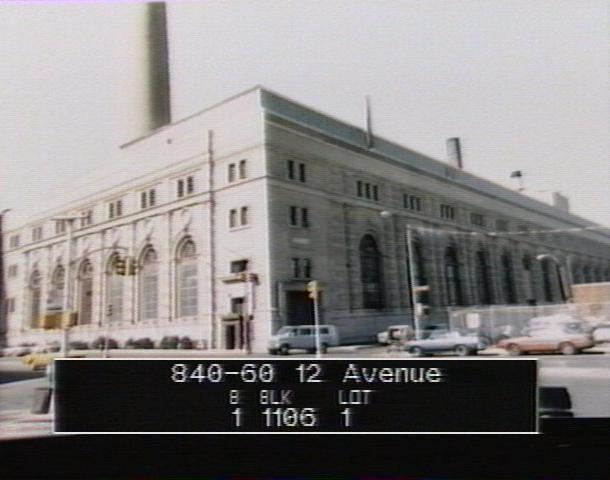
The city photographed every building for its tax records around 1940 and again in the 1980s. NYC Municipal Archives.
Written with AI from the source each entry cites, then fact-checked.
- 1901
The subway's builders buy a $900,000 West Side lot and order engines and boilers for a powerhouse
In mid-September 1901 the Rapid Transit Subway Construction Company signed a $1.5 million contract with Allis-Chalmers and Babcock & Wilcox for eight steam engines and 48 boilers. Later that month it announced it would pay $900,000 for a lot measuring 200 by 800 feet between West 58th and 59th Streets, running west from Eleventh Avenue, along with the shore property out to the Hudson's bulkhead line. The block became the site of the plant meant to power the city's first subway line.
- 1902
Stanford White is hired to design the powerhouse exterior, and S. L. F. Deyo is listed as architect of record
After the company's engineers settled the structure and basic form, Stanford White of McKim, Mead & White was commissioned to design the exterior, except for the west facade, which was treated as temporary because the plant was expected to grow westward. White had study elevations finished by February 1902, and plans reached the Department of Buildings that May with chief engineer S. L. F. Deyo listed as architect of record. The length grew from 586 to 694 feet during construction once Contract No. 2 extended the subway toward Brooklyn.
“…plans for the powerhouse were filed ... in early May of that year, with S. L. F. Deyo listed as architect of record…”
- 1904
The IRT Powerhouse starts feeding the subway on opening day, burning coal delivered by barge
The powerhouse opened with the rest of the subway on October 27, 1904. Its capacity of about 100,000 horsepower was enough to run 800 train cars at once. Coal arrived by barge at a 700-foot pier at West 58th Street, and conveyors lifted it 110 feet to attic bunkers that together held more than 30 million pounds. From the bunkers it dropped several stories to the boiler room, where it was shoveled by hand into the boilers, and the ash went down to the basement to be hauled to the pier in steel hopper cars.
“The IRT Powerhouse officially opened with the rest of the subway system on October 27, 1904.”
- 1904
A Times writer says the new powerhouse might pass for an art museum or library, were it not for its stacks
Three days after the subway opened, engineer J. C. Bayles wrote in The New York Times that the Interborough's management deserved credit for giving its powerhouse an ornamental design. He said the decoration added about $55,000 to the plant's cost but that the money was repaid, since the building improved the value of nearby property. Apart from its smokestacks, he added, the building might be taken for an art museum or a public library.
“But for its stacks, it might suggest an art museum or a public library rather than a powerhouse.”
- 1917
A coal shortage at the powerhouse causes a subway power failure and the state orders a reserve
In 1917 the powerhouse added three 35,000-kilowatt horizontal General Electric turbo-generators and superheaters on 30 of its boilers. Also that year, the subway suffered a power failure because the 59th Street plant ran short of coal. The state's Public Service Commission responded by requiring the IRT to keep a coal reserve there and at its 74th Street plant.
Source: Wikipedia
- 1951
Testing a new circuit at the powerhouse briefly cuts off subway service
The city's Board of Transportation decided in October 1946 to enlarge the plant westward to Twelfth Avenue, and a $655,000 construction contract went to Harris Structural Steel in January 1948. The annex added 62,500 kilowatts of capacity with a single boiler that needed about a third as much coal as the old ones. In 1951, testing one of the new circuits at the powerhouse briefly interrupted subway service.
“When one of the new circuits was tested at the powerhouse in 1951, it temporarily cut off service to the subway system.”
Source: Wikipedia
- 1959
Con Edison buys the aging IRT Powerhouse and two other transit plants for $125 million
A 1954 study by the J. G. White Engineering Company called the powerhouse an engineering museum piece, since much of its equipment dated from the opening, and the plant had a reputation for sooty black smoke from its stacks during the morning rush. The city estimated nearly $200 million to upgrade its three transit powerhouses. In 1959 Consolidated Edison bought all three for $125 million, on condition that it supply the transit system with their power at an agreed price.
“…in 1959, it purchased them for $125 million with a requirement to sell their electricity back to the City’s transit system…”
- 2017
The city designates the IRT Powerhouse a landmark after petitions and postcards from 2009 to 2017
The Landmarks Preservation Commission designated the powerhouse on December 5, 2017. Its report records 43 written submissions in favor, a petition with 548 signatures, and 521 postcards received between 2009 and 2017. Only two people spoke against the designation, both representatives of the owner.
Further reading
- IRT PowerhouseWikipedia
Nearby
- Via 57 West625 West 57th Street | 8 entries
- John Jay College New Building860 11th Avenue | 8 entries
- Abraham Joshua Heschel School30 West End Avenue | 6 entries
- Terminal 5610 West 56th Street | 5 entries
- CBS Broadcast Center530 West 57th Street | 3 entries
- CBS Broadcast Center524 West 57th Street | 10 entries