Bronx Borough Courthouse
878 Brook Avenue | also 513 East 161st Street | Morrisania | built 1915
Open on the map10 entries

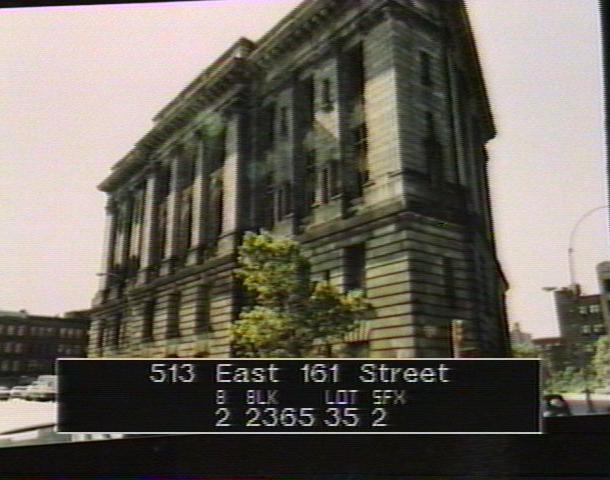
The city photographed every building for its tax records around 1940 and again in the 1980s. NYC Municipal Archives.
Written with AI from the source each entry cites, then fact-checked.
- 1903
Oscar Bluemner designs the courthouse for Michael Garvin, then sues over the credit
German-born Oscar Bluemner, trained at Berlin's Royal Academy of Design, came to New York in 1901. In 1903 architect Michael J. Garvin hired him to design the Bronx courthouse, promising to credit him and share the fee if it was approved. Garvin instead submitted the design under his own name, and Bluemner went to court. He won, but the episode drove him out of architecture.
“When Garvin submitted the design solely in his name and won the commission a dispute developed that lead to a lawsuit. Although Bluemner won…”
- 1905
Work begins on a Bronx courthouse expected to take two or three years
The city set aside $800,000 in 1904 for a courthouse to hold the Municipal and Magistrate's Courts and the Coroner's Office, replacing a small brick court building at 158th Street and Third Avenue that had proved inadequate. Construction started early in 1905 on a design by local architect Michael J. Garvin, and the building was expected to be finished within two or three years.
- 1913
An aldermen's inquiry clears Garvin over the courthouse's decade of delays
The courthouse took ten years and $2 million to build instead of the planned two or three years and $800,000. Historian Stephen Jenkins wrote in 1912 that he could not recall a time it was not under construction, and Borough President Louis F. Haffen was ousted amid corruption charges. A Board of Aldermen report on June 8, 1913, exonerated Garvin, blaming piecemeal contracts, inflation, redone work and fights over funding and granite.
- 1914
The unfinished courthouse opens as the seat of the new Bronx County
With its interior incomplete and little furniture, the courthouse opened on January 6, 1914, just as the Bronx became its own county. It housed the Supreme, Surrogate and County Courts and the District Attorney's Office. At the Supreme Court's first session, County Counselor Louis O. Van Doren wished that justice would radiate from the chamber.
- 1915
A granite Beaux-Arts courthouse fills a five-sided block, with an unblindfolded Justice
The four-story granite building covers an irregular five-sided block bounded by Third Avenue, Brook Avenue and East 161st Street, with a rusticated two-story base and two-story pilasters above. Over the 161st Street front stands a Tennessee marble figure of Justice by French sculptor J.E. Roine, holding a sword and tablet but left without a blindfold after some debate. Roine won the job after the American sculptor Louis Richards was repeatedly turned down.
“There seems to have been some discussion as to whether or not Justice should be blind-folded. She was completed without the blind-fold.”
- 1934
The county courts move to a new courthouse, leaving a police court behind
By 1930 the Bronx had 1.25 million residents, and the city spent $8 million on a larger Bronx County Courthouse, completed in 1934. Most of the courts moved there, and only a police court stayed on at the old Third Avenue building, which had been the borough's main courthouse for about twenty years.
“The majority of the departments moved to the spacious facility, leaving only a police court at the Third Avenue site until 1977…”
Source: Wikipedia
- 1977
The city closes the old courthouse and seals its doors and windows
The city officially closed the building in 1977. The Third Avenue El, its only direct rapid transit link, had been torn down by 1973. Vandals stripped metalwork and broke irreplaceable features, the city sealed the doorways and windows with concrete blocks, and the building sat empty and covered in graffiti while some officials suggested demolishing it.
“…leaving only a police court at the Third Avenue site until 1977, when the building was officially closed by the city.”
Source: Wikipedia
- 1981
The Landmarks Preservation Commission designates the Bronx Borough Courthouse
After a public hearing on July 12, 1979, at which two witnesses supported the proposal and nobody opposed it, the commission designated the courthouse a landmark on July 28, 1981. Its report called the building a fine Beaux-Arts civic structure by Michael J. Garvin that had come to stand for the county status the Bronx won in 1914.
“Two witnesses spoke in favor of designation. There were no speakers in opposition to designation.”
- 1996
The city auctions the old courthouse for $130,000
The landmark proved too costly for Bronx community groups to reuse, and in 1996 it sold for $130,000 at an auction at One Police Plaza to Gus Kitkas, owner of Five Borough Electrical Supply in Astoria. In 1998 it went up for auction again and sold for $300,000 to developer Henry Weinstein, whose group later cleaned the exterior and won approval for plans for offices or community use.
“In 1996 it was sold for $130,000 at a 1 Police Plaza auction to Gus Kitkas…”
Source: Wikipedia
- 2016
The courthouse is considered as a home for the Universal Hip Hop Museum
After an art show was staged in the building during May and June 2015, the building was considered in mid-2016 as a site for the Universal Hip Hop Museum, an idea later abandoned. The next year a plan was announced to house Success Academy High School of the Liberal Arts there, with 1,200 seats, but that also fell through.
“In mid-2016, the old courthouse was considered as a location for the Universal Hip Hop Museum, though this was later dropped.”
Source: Wikipedia
Further reading
- Bronx Borough CourthouseWikipedia
Nearby
- Church of Saints Peter and Paul833 St Anns Avenue | 1 entry
- Woodstock Library761 East 160th Street | 4 entries
- Trinity Episcopal Church of Morrisania690 East 166th Street | 3 entries
- Church of St. Anselm and St. Roch683 Tinton Avenue | 3 entries
- Church of St. Angela Merici266 East 163rd Street | 1 entry
- Bronx County Hall of Justice265 East 161st Street | 2 entries