Chauncey L. Norton House
9 Charles Street | West Village | built 1848
Open on the map5 entries

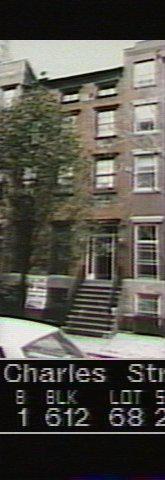
The city photographed every building for its tax records around 1940 and again in the 1980s. NYC Municipal Archives.
Written with AI from the source each entry cites, then fact-checked.
- 1819
Eagle Mills, with the Eagle Distillery on part of the site, is sold at auction to Najah Taylor and Nathaniel Richards
Before the Greek Revival houses went up, the north side of this block, between Waverly Place and Greenwich Avenue, was occupied by Eagle Mills. In 1819 Najah Taylor and Nathaniel Richards bought it at auction, and their Eagle Distillery stood on part of the property. In 1847, as the Village spread west, the pair sold seven lots to men in the building trades, and they built the row that includes this house. This entry describes an earlier use of the site.
Source: Daytonian in Manhattan
- 1847
Abraham Riker Lawrence buys the house for his daughter Margaret and her husband, Chauncey L. Norton
On September 22, 1847, about when construction began, Lawrence bought what was then 5 Warren Place for his daughter Margaret and her husband, Chauncey L. Norton. Norton worked at the Bank of the Union at Broadway and Howard Street and was elected its president in 1854. Until 1879 the family gave either 5 Warren Place or 5 Charles Street as its address; that year the block was officially made part of Charles Street and the house became No. 9.
Source: Daytonian in Manhattan
- 1848
One of four 1847-48 houses with Gothic drip moldings over the doors, rare in the Village
Nos. 5-11 form a row of four brick houses built in 1847-48 in a plain version of the Gothic Revival, a style the Landmarks Preservation Commission calls rare in the Village. The label moldings over the doors are the clue. No. 9 comes closest to its original look, with a rusticated basement, a stoop up to the original doorway, low casement windows in the attic story and windows that shrink in height on the way up. Its stoop railing is more ornate than one would expect.
“These four brick houses, built in 1847-48, are a simple version of the Gothic Revival, a style rare in The Village.”
- 1865
A surrogate court rules against a contested will and the house passes to the Norton children
Abraham Riker Lawrence, who still owned the house, died on August 3, 1863. A nephew produced a handwritten 1839 will leaving everything to Lawrence's siblings and nephew and omitting the Norton grandchildren, and Chauncey Norton went to court suggesting it was a forgery. Lawyers on the other side argued that Lawrence never married and Margaret was illegitimate. After months of trial, the court ruled on April 29, 1865 that the Norton children were Lawrence's heirs, so Abraham and Cecilia inherited the house their family lived in.
Source: Daytonian in Manhattan
- 1900
Owner and neighbors petition the Aldermen to end the Van Nest Place name that sends deliveries astray
Henry Schlobohm, a milk dealer who bought the house in 1894, kept receiving mail and packages meant for 9 Van Nest Place, a stretch of Charles Street with its own set of numbers. On October 2, 1900 he and his neighbors signed a petition to the Board of Aldermen asking that the name be dropped and the block renumbered, because Charles Street carried two sets of numbers from 1 to 18 and deliveries often went to the wrong house. The change did not take effect until 1936.
Source: Daytonian in Manhattan
Further reading
- The 1848 Chauncey L. Norton House - 9 Charles StreetDaytonian in Manhattan
- Then & Now photos: 9 Charles StreetVillage Preservation: Greenwich Village Then & Now
Nearby
- 11 Charles Street1 entry
- 7 Charles Street1 entry
- 5 Charles Street1 entry
- 15 Charles Street3 entries
- 43 Greenwich Avenue2 entries
- 41 Greenwich Avenue1 entry