Bloody Angle (9 Doyers Street)
9 Doyers Street | Chinatown | built 1920
Open on the map7 entries

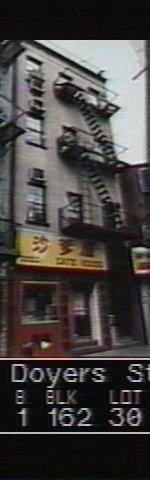
The city photographed every building for its tax records around 1940 and again in the 1980s. NYC Municipal Archives.
Written with AI from the source each entry cites, then fact-checked.
- 1885
The Sanitary Aid Society opens a ten-cent lodging house at 9 Doyers Street
The Sanitary Aid Society for the Tenth Ward opened a lodging house at 9 Doyers on April 1, 1885, in a four-story brick building that had once been a tobacco factory. People forced out of overcrowded tenements paid 10 cents for a bath and a bed. The house took in over 22,000 lodgers in its first year and 61,000 the next, which pushed the society to open a second location.
Source: bedfordandbowery.com
- 1894
Tea and rice seller Wong I Gong of 9 Doyers is quoted in the Herald on the China-Japan war
As tong rivalries built nearby, Wong I Gong, a tea and rice seller at 9 Doyers Street, spoke to the New York Herald in August 1894. He was asked not about neighborhood gangs but about the war between China and Japan, which had stirred excitement across the city's Chinese community. The paper headlined its piece on Chinatown's reaction to war news.
Source: bedfordandbowery.com
- 1920
Real-estate man and charity worker Charles Salomone buys the Doyers Street lot
In 1920 the lot at 9 Doyers was sold by Charles Horton to Charles Salomone, an Italian immigrant known for his work in real estate and charity. City Register conveyance records show it went back to Wong Gong in 1925. It returned to Salomone in 1940, and after his death in 1943 it passed to his wife Antoinette.
Source: bedfordandbowery.com
- 1928
Herbert Asbury describes the sharp bend at 9 Doyers as the Bloody Angle of the tong wars
In The Gangs of New York (1928), Herbert Asbury called the abrupt turn in Doyers Street, where No. 9 stands, an ideal place for ambush. He wrote that police believed more men had been murdered there than anywhere of comparable size in the world. The fighting pitted the On Leong tong, led by Tom Lee, against the Hip Sing tong, which came under Sai Wing Mock, known as Mock Duck.
Source: bedfordandbowery.com
- 1994
Officials say the Bloody Angle saw more violent deaths than any other intersection in the US
By 1994 the bend in Doyers Street, where the tong gangs of Chinatown fought in the early 1900s, carried a grim claim. Law enforcement officials said more people had died violently there than at any other crossing in the country. The killings had run into the 1930s, and the frequent use of hatchets is credited with giving rise to the phrase "hatchet man."
“In 1994, law enforcement officials said that more people had died violently at the "Bloody Angle" than at any other intersection in the United States.”
Source: Wikipedia
- 2017
The Chinatown Partnership closes the Bloody Angle to cars for a month-long pedestrian plaza
In September 2017 the Chinatown Partnership sealed Doyers Street to traffic from 10 a.m. to 8:30 p.m. daily until October 9 as a pilot. It laid artificial turf along the curved block and set out umbrellas, tables and chairs. A spokesperson said the aim was to honor the historic birthplace of Chinatown, while one passerby grumbled that the street looked like a miniature golf course.
Source: Internet Archive
- 2021
Artist Dasic Fernandez paints the Rice Terraces mural on the roadway of Doyers Street
In June 2021 the city unveiled Rice Terraces, a 4,800-square-foot asphalt mural by Dasic Fernandez, along the bending block between Pell Street and the Bowery. The Department of Transportation and the Chinatown BID created it in 44 colors, using a distorted-perspective technique so the shapes seem to rise into volumes from the corners. It was meant to draw visitors back after the pandemic and to stay up for up to 11 months.
Source: amny.com
Further reading
- Doyers StreetWikipedia
Nearby
- Nom Wah Tea Parlor11 Doyers Street | 7 entries
- Former Chinese Theater5 Doyers Street | 6 entries
- 3 Doyers Street2 entries
- 10-14 Doyers Street10 Doyers Street | 1 entry
- Chung Wah Gong Shaw (former CCBA headquarters)16 Mott Street | 4 entries
- 15 Doyers Street4 entries