Matthew Anderson House
9 Leroy Street | West Village | built 1915
Open on the map5 entries

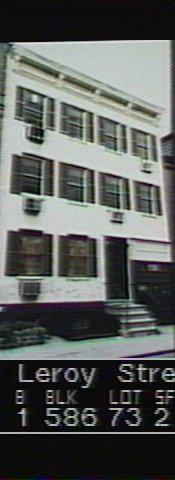
The city photographed every building for its tax records around 1940 and again in the 1980s. NYC Municipal Archives.
Written with AI from the source each entry cites, then fact-checked.
- 1831
Matthew Anderson builds a Federal house three feet wider than its neighbors
The house was built in 1830-31 for Matthew Anderson, and it was three feet wider than a standard row house of the time. A passageway to the right of the main entry led to a rear-yard stable, which was in place by the early 1850s. Later it was raised to a full third story, and the stable became a five-car garage in 1957.
- 1849
Investor James Sherwood buys the house and holds it until his death in 1907
James D. Sherwood, a broker from Putnam County who began as a carpenter, bought No. 9 in 1849 and leased it out. He also built two other houses on Leroy Street and one on Bedford Street, and kept all four until he died. In 1880 he hired the carpenter Charles E. Hadden to raise the house to a full three stories.
- 1872
Cartman Robert Carpenter joins policyholders protesting Mutual Life's new premium plan
Robert R. Carpenter, a cartman who rented rooms at No. 9 for many years, was a visible local figure, serving as an election inspector in 1865. In 1872 he joined other policyholders objecting when Mutual Life offered lower premiums to new customers but kept existing policies at the old price. A Chicago paper reported their protest on December 12.
Source: Daytonian in Manhattan
- 1908
Sherwood's estate sells the house, and it is split into a tenement for six families
After Sherwood's death in 1907, his estate sold No. 9 to Elizabeth A. French the next year. She converted it into a tenement housing six families, in a neighborhood that had by then filled with immigrant households.
Source: Daytonian in Manhattan
- 1920
The Paccione family buys the house and keeps it for decades
Giuseppe and Francesa Paccione bought No. 9 in 1920 and before long added a rear extension for bathrooms. In the 1930s the horse walk was widened into a garage-door-sized opening to the rear yard. The family kept the property for decades, and in 1990 it was converted into two residences, an apartment and a duplex.
Source: Daytonian in Manhattan
Further reading
- The 1831 Matthew Anderson House - 9 Leroy StreetDaytonian in Manhattan
Nearby
- 11 Leroy Street3 entries
- 13 Leroy Street2 entries
- Jacob Romaine House7 Leroy Street | 5 entries
- Murray's Cheese building1 Leroy Street | 8 entries
- 15 Leroy Street2 entries
- 12 Leroy Street3 entries