Solow Building
9 West 57th Street | Midtown | built 1971
Open on the map12 entries

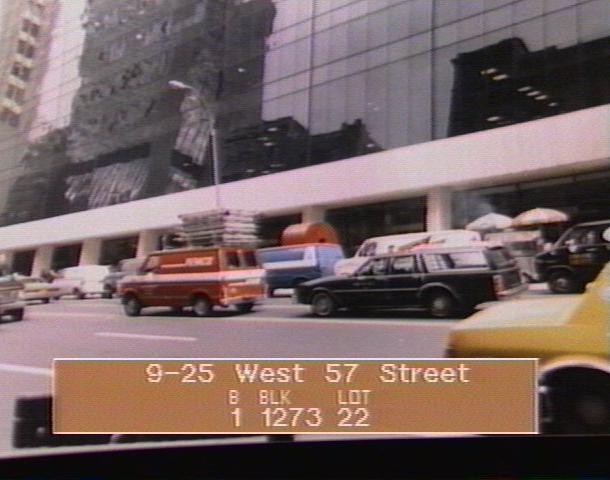
The city photographed every building for its tax records around 1940 and again in the 1980s. NYC Municipal Archives.
Written with AI from the source each entry cites, then fact-checked.
- 1895
Ernest Gunther gives a stage dinner for a Russian prince at 9 West 57th Street
A dinner that Ernest Rudolph Gunther gave on March 29, 1895, was described by The New York Times as a very pretty stage dinner, with Russian Prince Lubecki as guest of honor and covers laid for ten. Gunther's four-story brownstone at 9 West 57th Street was known for such entertainments and frequent musicales. His furrier father had bought the house new in 1875 for $100,000. It stood on the site later covered by the Solow Building.
Source: Daytonian in Manhattan
- 1899
Clara Lewisohn marries Alfred Rossin in her father's remodeled mansion at 9 West 57th Street
Adolph Lewisohn bought the Gunther house in 1897 and had Brunner & Tryon rebuild it with a white limestone front. On April 25, 1899, his daughter Clara married Alfred Rossin in the drawing room, beneath a canopy of white roses, in what The New York Times called one of the most beautiful of the city's newer houses. The mansion stood where the Solow Building now rises.
Source: Daytonian in Manhattan
- 1917
Milliner Herman Tappe leases the Lewisohn mansion and throws an 1830s costume ball
After his wife Emma died in 1916, Adolph Lewisohn leased the 57th Street mansion in April 1917 for 21 years to Tappe, Inc., milliners. Before remodeling the interiors, Herman Patrick Tappe gave his workers a ball at which the women wore gowns of the 1830s, and officers off a French warship moored in the Hudson were among the guests. This earlier building on the lot was later demolished for the Solow Building.
Source: Daytonian in Manhattan
- 1919
Augustus D. Juilliard dies at 11 West 57th Street and leaves $15 million for music
The dry goods merchant Augustus D. Juilliard died of pneumonia on April 25, 1919, at the age of 83 in his five-story mansion at 11 West 57th Street, now the western part of the Solow Building's site. His will set aside about $15 million for a fund to advance music in the United States. That bequest led to the Juilliard Foundation in 1920 and then the Juilliard School of Music.
Source: Daytonian in Manhattan
- 1927
Peter Evergood has his first solo show at the Dudensing Gallery in the old Juilliard mansion
After Augustus Juilliard's death, the mansion at 11 West 57th Street was converted to business use on the ground floor, with apartments upstairs. The Dudensing Gallery took space at street level and gave exposure to young American painters. Peter Evergood held his first solo exhibition there in 1927. The building survived until 1974, when it was demolished with neighboring buildings for the Solow Building.
Source: Daytonian in Manhattan
- 1941
A German railroads office at 11 West 57th Street, exposed as a Nazi propaganda outlet, is ordered out
In the late 1930s the former Juilliard house held the German Railroads Information Office under director Ernst Schmitz. A congressional investigation later found it was mainly a Nazi propaganda outlet, citing a November 1939 letter inviting guests to a dinner of the so-called Rome-Berlin Axis intelligence service in Schmitz's third-floor apartment. The office was ordered to leave the United States on June 16, 1941.
Source: Daytonian in Manhattan
- 1965
Sheldon Solow quietly begins buying up parcels on 57th and 58th Streets
Starting in 1965, Sheldon Solow hired several brokers so that no one would guess he was assembling a large site. He ended up buying 17 parcels, including the lots the Latter-day Saints church had gathered for its own skyscraper, to make a 54,000-square-foot site between 57th and 58th Streets. He could not buy 4 West 58th Street outright, so he took a leasehold on it and its air rights. Andrew Goodman, president of Bergdorf Goodman, refused to sell his store building or its air rights.
Source: Wikipedia
- 1969
Avon abruptly drops its Rockefeller Center plans and leases 20 stories from Solow
In June 1969 Avon Products agreed to lease 20 floors of Solow's tower, and finalized the deal that November. In doing so it abruptly canceled a planned move to Rockefeller Center, even though the Solow rent was higher and Solow would not let the company put its name on the building. By April 1970 Avon had enlarged its space to 700,000 square feet across 25 floors.
“Avon abruptly canceled plans to relocate to Rockefeller Center, even though rent at the Solow Building was higher than that at Rockefeller Center…”
Source: Wikipedia
- 1971
The tower tops out with a pair of seven-story arrowheads designed by Anne Healy
The tower reached its full height in June 1971, and a topping-out event marked the milestone. The artist Anne Healy designed a pair of arrowheads for the occasion, each seven stories tall. Sheldon Solow had hired Gordon Bunshaft in August 1968 to design the building.
Source: Wikipedia
- 1972
Sheldon Solow's tapered glass tower opens on West 57th Street
Sheldon Solow began buying parcels on 57th and 58th Streets in 1965 and ended up with 17, which he assembled into the site for a 50-story, 689-foot tower by Gordon Bunshaft of Skidmore, Owings & Merrill. Its north and south facades curve inward from street level to the 18th floor, and the building was the first major structure in the city developed with a sloped facade. Avon Products, which took about a third of the space, opened its offices on the 9th to 34th floors in August 1972.
Source: Wikipedia
- 1994
Sheldon Solow installs Joan Miró's bronze Moonbird on the 58th Street plaza
In 1994 Solow placed Joan Miró's 14-foot bronze sculpture Moonbird, first commissioned in 1966, on the 58th Street side of the plaza. The spot had held a 12-foot Alexander Calder mobile, which Solow removed after realizing it could fall onto pedestrians in the wind. The 57th Street side already had Ivan Chermayeff's red sculpture of the digit 9.
Source: Wikipedia
- 2000
Brasserie 8 1/2 opens in the Solow Building's basement after three decades empty
The basement retail space, about 45,000 square feet, stayed empty for thirty years after the tower was completed. In 2000 the 230-seat Brasserie 8 1/2 opened there, in a design by Hardy Holzman Pfeiffer Associates.
Source: Wikipedia
Further reading
- Solow BuildingWikipedia
Nearby
- Paris Theatre4 West 58th Street | 8 entries
- 35 West 57th Street2 entries
- The Plaza Hotel768 5th Avenue | 20 entries
- Bergdorf Goodman Building754 5th Avenue | 16 entries
- Crown Building730 5th Avenue | 10 entries
- Park Lane Hotel36 Central Park South | 10 entries