La Casina
90-33 160th Street | Jamaica | built 1933
Open on the map8 entries

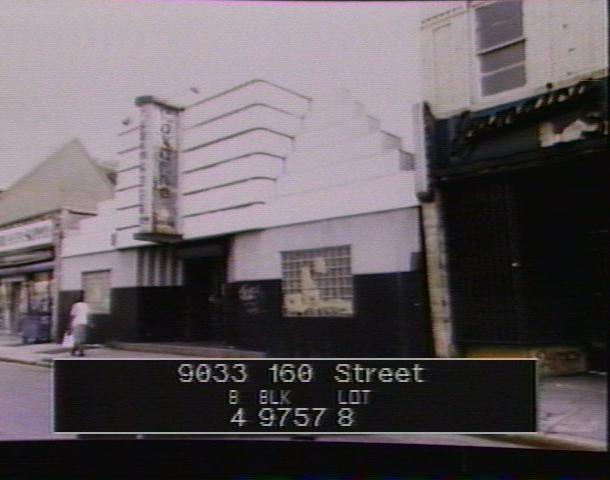
The city photographed every building for its tax records around 1940 and again in the 1980s. NYC Municipal Archives.
Written with AI from the source each entry cites, then fact-checked.
- 1907
A Queens real estate exchange puts up a brick and limestone office building on 160th Street
The Queens Borough Real Estate Exchange built a neo-Classical office building here in 1907 to plans by the architects Tuthill & Higgins. Arnold Behrer Jr. and Clarence Behrer bought it in 1918. The nightclub front that now faces 160th Street was later made by altering this same structure rather than replacing it.
- 1932
The Behrers lease the building to Bernard Levy for a cabaret and dance hall
Arnold Behrer Jr. and Clarence Behrer leased the property for four years to Bernard Levy and La Casino, Inc. The lease allowed only a restaurant, cabaret, dance hall, beer garden or casino on the premises, and any changes by the tenant needed the owners' approval. Rent started at $1,800 for the first year and climbed to $3,000 by the fourth.
- 1933
La Casino Supper Club opens behind a stepped, streamlined metal and stucco front
The supper club first appeared in the Queens phone book for winter 1933-34. Its facade, a two-tier ziggurat of stucco and galvanized sheet metal around a recessed doorway, is one of the city's rare Streamlined Moderne designs, and a projecting vertical neon sign drew eyes from busy Jamaica Avenue. The club seems to have closed within a year, then reopened by May 1936.
“The La Casino Supper Club opened in 1933. It first appeared in the Queens telephone directory for winter 1933-34.”
- 1936
La Casina's house newsletter promotes three nightly shows and an old-clothes Bowery Night
The club's weekly La Casina Journal advertised dinner, dancing and three shows a night, staged by two house troupes called the La Casina Adorables and La Casina Swing Melo-Dears, with guests such as Broadway performer Maureen Rio. There was no cover charge and parking was free. Theme evenings included Democratic and Republican nights to meet primary candidates, and a Bowery Night where guests wore old clothes and men were asked to come unshaven.
“According to the La Casina Journal, La Casina offered three shows a night performed by the La Casina Adorables and the La Casina Swing Melo-Dears.”
- 1940
Arnold Behrer Jr. loses the shuttered club to an Episcopal missionary society
La Casina's last phone listing was for winter 1937-38. In 1940 a court case cost Arnold Behrer Jr. the property, which passed to the mortgage holder, an Episcopal Church body called the Domestic and Foreign Missionary Society, and a city tax photo that year caught For Rent signs in the windows. The Church of God of Greater New York bought it in 1942 but apparently never worshipped there.
“In 1940, Arnold Behrer, Jr., lost the property in a legal proceeding to the mortgagor, the Domestic and Foreign Missionary Society of the Protestant Episcopal Church…”
- 1946
The former nightclub becomes a factory for Ladyform bras, then Roxanne swimsuits
Polly Foundations, Inc. bought the building in 1946 and turned it into a plant making Ladyform bras. The Ellen Howard Corporation purchased it in 1952 and produced Roxanne swim suits here until about 1987. The original vertical sign out front still carries the words Ladyform Bras and Roxanne Swim Suits along with the La Casina name.
- 1995
Restoration strips the aluminum siding and reopens the club as a business center
After the factory left, the empty building decayed until the Greater Jamaica Development Corporation acquired it in 1989. Li-Saltzman Architects led a 1994-95 restoration that removed aluminum siding, remade the ziggurat bands in aluminum, returned the stucco to its gray and coral colors and swapped glass block for plate glass. The original vertical sign was encased in a new aluminum sleeve bearing the neon initials JBRC, for the Jamaica Business Resource Center that now occupies the building.
“In 1989, the Greater Jamaica Development Corporation acquired the former home of La Casina. A restoration was undertaken in 1994-95 under the guidance of the architectural firm of Li-Saltzman.”
- 1996
The Landmarks Preservation Commission designates La Casina a city landmark
Six people, including a representative of the owner, the Greater Jamaica Development Corporation, spoke for designation at a November 1995 hearing, and nobody spoke against it. The commission called the building a rare New York example of the Streamlined Moderne and a reminder of the many entertainment venues built when Jamaica was the commercial hub of Queens County.
Further reading
- La CasinaWikipedia
Nearby
- Suffolk Title and Guarantee Company Building90-01 160th Street | 4 entries
- Jamaica Center for Arts & Learning (former Queens Register)161-04 Jamaica Avenue | 3 entries
- Jamaica Chamber of Commerce Building89-31 161st Street | 8 entries
- Grace Episcopal Church155-15 Jamaica Avenue | 3 entries
- J. Kurtz & Sons Store Building162-22 Jamaica Avenue | 4 entries
- First Presbyterian Church in Jamaica89-60 164th Street | 3 entries