90-94 Maiden Lane Building
90 Maiden Lane | Financial District | built 1830
Open on the map4 entries

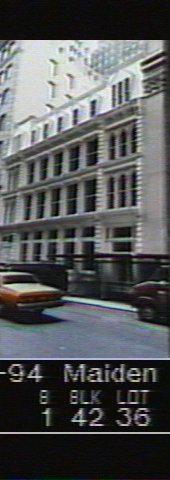
The city photographed every building for its tax records around 1940 and again in the 1980s. NYC Municipal Archives.
Written with AI from the source each entry cites, then fact-checked.
- 1792
The Roosevelt family's hardware business takes root at 94 Maiden Lane
John Roosevelt had set up shop at 94 Maiden Lane by 1786, but money troubles forced him to sell in 1792 to his wealthy second cousin Isaac Roosevelt. Isaac gave the store to James J. Roosevelt, who opened a hardware business that supplied mostly Dutch imports to the building trade. James bought the property in 1797 and put up a new store in 1809-10.
- 1868
Cornelius V. S. Roosevelt turns a plate-glass importing firm into a fortune
Under James's son Cornelius Van Schaack Roosevelt, the family firm became the country's leading importer of British and French plate glass and mirrors. Its profits let him invest heavily in real estate after the Panic of 1837, and by 1868 he ranked among the ten wealthiest landowners in New York. His son Theodore, father of the future president, joined the firm in the 1850s.
- 1870
Roosevelt & Son joins four buildings behind a new cast-iron front on Maiden Lane
The firm had outgrown its cramped quarters, so in 1869 James A. Roosevelt bought the neighboring buildings at 90-92 Maiden Lane and 9-11 Cedar Street. Plans filed in April 1870 joined them and added a Second Empire cast-iron front with a mansard roof on Maiden Lane. Roosevelt & Son was then the nation's leading plate-glass and mirror importer.
- 1870
Charles Wright and the Grosz foundry design the Second Empire cast-iron front
The 1870-71 Maiden Lane front is attributed to the architect Charles Wright, whose office was at the Greene Street foundry of Michael Grosz & Son. The iron elements are credited to Daniel Badger's Architectural Ironworks of New York. The result is the Financial District's only surviving mansarded Second Empire commercial building of its era and the southernmost cast-iron building in Manhattan.
Further reading
- This building is one of the last cast-iron structures in the Financial District, and it hides an unusual backstoryEphemeral New York
Nearby
- Cities Service Building70 Pine Street | 22 entries
- Down Town Association Building60 Pine Street | 4 entries
- 211 Pearl Street2 entries
- The Wallace Building56 Pine Street | 4 entries
- Sun Fire Insurance Building54 Pine Street | 4 entries
- Caledonian Insurance Building50 Pine Street | 5 entries