West Street Building
90 West Street | Financial District | built 1908
Open on the map12 entries

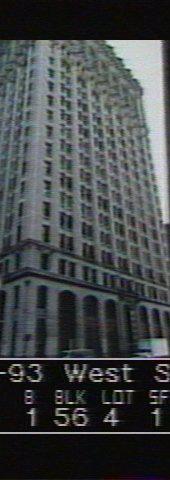
The city photographed every building for its tax records around 1940 and again in the 1980s. NYC Municipal Archives.
Written with AI from the source each entry cites, then fact-checked.
- 1905
Howard Carroll commissions Cass Gilbert to design a skyscraper for the shipping trade
Howard Carroll, a former New York Times journalist who rose to vice-president of the Starin Transportation Company, owned by his father-in-law, formed the West Street Improvement Company in 1905. The syndicate of downtown business interests included contractor John Peirce, and it aimed at a high-class office building for shipping and railroad firms. In April 1905 Carroll commissioned Cass Gilbert to design it, directly across West Street from the Hudson River docks.
“Carroll commissioned a design for the West Street Building in April 1905 from architect Cass Gilbert.”
- 1906
A pile load test persuades the insurer to back the West Street Building's foundation
Construction began in April 1906, but the bedrock lay about 50 feet down under clay, sand and silt. Engineer Gunvald Aus chose pilings over pneumatic caissons. Metropolitan Life, the underwriter for contractor John Peirce, at first declined to insure the job for fear of uneven settling. It agreed after a test in which a pile loaded with 35 tons of pig iron sank only 3/8 inch.
“Metropolitan Life finally agreed to insure the project after Aus performed a test, which found that a pile would settle 3⁄8 inch when loaded with 35 short tons…”
Source: Wikipedia
- 1907
Railroad and shipping firms fill the West Street Building, and a top-floor restaurant claims the highest table in town
The new building soon drew the Delaware, Lackawanna & Western Railroad, which owned a pier near Cortlandt Street and a rail and ferry terminal at Hoboken that opened the same year. Executives could watch traffic between the two from their windows. The tenant mix earned it the nicknames "Railroad and Iron Exchange Building" and "Coal and Iron Building". The top floor held the Garret Restaurant, which advertised itself as the world's highest.
“…because of the nature of its tenants, the building was soon known as the "Railroad and Iron Exchange Building" or the "Coal and Iron Building.”
- 1907
Cass Gilbert's Gothic-style West Street Building opens
Architect Cass Gilbert designed the 23-story West Street Building for the West Street Improvement Corporation, completed in 1907 with a neo-Gothic terracotta facade inspired by Belgian civic and religious architecture. Its top floors housed The Garret, a restaurant marketed as the highest in the world and later seen as a forerunner of the World Trade Center's Windows on the World.
Source: Wikipedia
- 1923
The Brady Security and Realty Corporation buys the tower
The Brady Security and Realty Corporation bought the former West Street Building from the American Sugar Refining Company in 1923, and the tower became known as the Brady Building. During the early 1930s its elevators, lobby, office space, and mechanical systems were refurbished. That work removed the original first-floor arches and groin vaults that Cass Gilbert had designed.
Source: Wikipedia
- 1933
Cass Gilbert, 74, is hired back to modernize the lobby of the Brady Building
During the Depression, the Brady Security and Realty Corporation put in new elevators, rehabilitated the offices and upgraded the mechanical systems. It also retained Cass Gilbert, by then 74, to modernize the first-floor interiors he had designed with arches, groin vaults and elaborate terra-cotta. At the time the work was said to improve an outdated lobby crusted with ornamental ironwork. The exterior was left largely intact.
“…the company retained Cass Gilbert (now age 74) to modernize the first floor interiors of what was then called the Brady Building.”
- 1998
The Landmarks Commission designates the West Street Building after five speakers back it and none object
At the Landmarks Preservation Commission hearing on March 10, 1998, five speakers favored designation, among them an owner's representative and delegates from the New York Landmarks Conservancy and the Municipal Art Society. No one opposed it, and Council Member Kathryn Freed sent a statement of support. The report noted that the building's exterior survived largely intact.
“Five persons, including a representative of the owner and representatives of the New York Landmarks Conservancy and the Municipal Art Society, spoke in favor of designation.”
- 2001
Falling debris from the World Trade Center kills two people and badly damages the tower
When the South Tower of the World Trade Center collapsed 300 feet to the north on September 11, 2001, debris tore large gashes in 90 West Street's northern facade and killed two office workers trapped in an elevator. A fire raged for several days, and remains of attack victims that landed on the scaffolding were not retrieved until 2003.
Source: Wikipedia
- 2005
Restoration adds gargoyles modeled on the owner's family and a friend killed on September 11
When 90 West Street reopened in 2005, replacing its damaged terra cotta meant making close to 100 new gargoyles, which Boston Valley Terra Cotta of Buffalo produced. Charles Kibel of the Kibel Company had some made with the faces of his father, a cousin and the cousin's daughters. Another bears the likeness of his friend Doug Gardner, who died in the World Trade Center, so that he would look over the site.
Source: today.umd.edu
- 2005
The fire-damaged tower reopens as 410 apartments
After a renovation financed with $106.5 million in federal bonds, the badly damaged 90 West Street reopened in mid-2005 as a 410-unit residential building. The work revealed some of Cass Gilbert's original terracotta, replaced the copper roof, and added replica terracotta tiles. The project received a National Preservation Honor Award from the National Trust for Historic Preservation the next year.
Source: Wikipedia
- 2007
A burst sewer pipe from the World Trade Center site floods the basement and empties the building for two weeks
In November 2007 a large sewer pipe at the World Trade Center construction site burst open and flooded the basement of 90 West Street. The building was slightly damaged, and it was evacuated for two weeks. It had reopened as a 410-unit apartment house only two years earlier.
Source: Wikipedia
- 2019
A court rules that tenants of 90 West Street are entitled to rent-stabilized leases
Because the residential conversion received a 421-g tax exemption, some apartments were rent-stabilized. In the mid-2010s tenants sued the owner, the Kibel Company, for wrongly ending rent regulation. The New York Supreme Court sided with the tenants in 2019, and the next year it limited the back rent owed to four years instead of six.
Source: Wikipedia
Further reading
- 90 West StreetWikipedia
Nearby
- 130 Cedar Street (Club Quarters World Trade Center)140 Washington Street | 6 entries
- St. Nicholas Greek Orthodox Church and National Shrine130 Liberty Street | 14 entries
- W Hotel Downtown123 Washington Street | 4 entries
- New York Evening Post Building71 West Street | 6 entries
- One World Financial Center200 Liberty Street | 7 entries
- The Ten House124 Liberty Street | 9 entries