Fanelli Cafe
94 Prince Street | also 137 Mercer Street | SoHo | built 1858
Open on the map11 entries

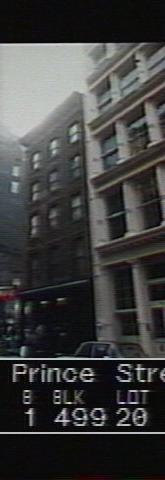
The city photographed every building for its tax records around 1940 and again in the 1980s. NYC Municipal Archives.
Written with AI from the source each entry cites, then fact-checked.
- 1847
A grocery opens on the Prince and Mercer corner, starting a run of continuous service
German immigrant Herman Gerken leases a small wooden building at Prince and Mercer Streets in 1847 and opens a grocery, living upstairs with his wife Anna. The corner keeps housing food and drink businesses under a series of owners for decades afterward.
Source: Daytonian in Manhattan
- 1858
Herman Gerken replaces the wooden building with the current structure
Herman Gerken, who bought the Prince Street property in 1853, tears down the original wooden building and completes a five-story Italianate brick building in 1858, adding brownstone details and a cast-metal cornice. The ground floor keeps operating as a grocery and saloon under Gerken.
Source: Daytonian in Manhattan
- 1863
Counterfeit $5 notes passed at the Gerken saloon expose a forgery ring
On the evening of March 3, 1863, three men stopped in at the Gerken saloon and paid with a $5 note that claimed to come from the Highland Bank of Hudson City, New Jersey. It was a fake. The New York Times reported on March 6 that a well-organized counterfeit ring had been broken, with about thirty such notes passed on shopkeepers around Greene, Spring, Prince and Broome Streets. The ringleader, George McDougal, faced four complainants, including saloon worker John Gerken, at Jefferson Market Police Court on March 5.
Source: Daytonian in Manhattan
- 1865
A family quarrel above the saloon ends with Henry Gerken shooting his mother
On the night of October 13, 1865, an argument in the Gerken apartment above the saloon turned violent. A pistol in the pocket of George Hillon, the son of the saloon's lessee, went off and wounded him in the thigh. Henry Gerken then drew the weapon and shot his mother, Anna, in the face and grazed Hillon's cheek. Henry was held on $1,500 bail on a charge of felonious assault, while Anna lay in a dangerous condition at New York Hospital.
Source: Daytonian in Manhattan
- 1878
Nicholas Gerdes installs the etched-glass door panels still used today
When Nicholas Gerdes takes over the ground-floor saloon in 1878, he installs Victorian etched and cut-glass door panels that survive more than a century later. Upper floors of the building house artificial-flower makers and milliners through the 1880s and 1890s.
Source: Daytonian in Manhattan
- 1893
Fire guts the upper floors of a flower factory above the saloon
Soon after Frederick Oppenheimer's artificial flower factory in the building closed on August 19, 1893, smoke was seen at an upper window on the Prince Street side. Fire engines from the nearby Mercer Street station ran out of water, so a second alarm was sounded. Once a full supply arrived, firefighters controlled the blaze in about five minutes, but the roof was destroyed and the fourth and fifth floors burned out. Oppenheimer's losses were put at $20,000 to $25,000, and damage to the building at $4,000.
Source: Daytonian in Manhattan
- 1899
A cloak maker's divorce fight over a model and bedbugs plays out in the press
In July 1899 Bessie Neadel sued her husband Henry, a cloak manufacturer based in the building, for a limited divorce, $8 a week in alimony and legal fees. She said he had grown infatuated with a model he employed and took her to theaters. Henry denied it and countered with complaints about his wife's temper and housekeeping, including a bed he said was infested with bedbugs and meals of a roll, cheese and soda water from a delicatessen.
Source: Daytonian in Manhattan
- 1922
Michael Fanelli buys the Prince Street saloon and gives it his name
The corner at 94 Prince Street held a grocery from 1847 and, with a short break, a saloon from the 1860s on; from 1905 to 1922 Harry Green ran it as the Prince Cafe. In 1922 Michael Fanelli bought it and renamed it Fanelli Cafe, and it ran as a speakeasy during Prohibition. As SoHo turned from factories to studios it became an artists' hangout, and Hans Noë took it over in 1982.
Source: Wikipedia
- 1928
An employee is fined for liquor during Prohibition
In 1928, six years after Michael Fanelli takes over the bar, an employee named Harry Bruns is caught with liquor on the premises and fined $250. The judge overseeing the case stresses that Prohibition laws will be strictly enforced, but the bar keeps pouring regardless.
Source: Daytonian in Manhattan
- 1982
The Fanelli family sells the bar to Hans Noe
Hans Noe bought the business from the Fanelli family in 1982, and his family still ran the bar when Daytonian in Manhattan told its story in 2017. By then SoHo had been reinvented as a district of artists' lofts, galleries and shops, and the old saloon front had survived the century untouched. Daytonian notes that a bar once frequented by immigrant workers now hosted artists, musicians and tourists.
Source: Daytonian in Manhattan
- 1990
Bartender Bob Bozic becomes one of Fanelli's attractions
From 1990 until he retired in 2016, the bartender Bob Bozic was one of Fanelli's attractions. The Village Sun reports that he said the bar is what people expect a New York bar to be, and that he fit the expected bartender to match. The paper adds, citing The New York Times's Alex Vadukul, that he was often rude and refused cocktails needing more than two ingredients, yet poured a free drink for answering his trivia questions.
Source: thevillagesun.com
Further reading
- Fanelli CafeWikipedia
- Fanelli Cafe - No. 94 Prince StreetDaytonian in Manhattan
Nearby
- 135 Mercer Street1 entry
- 96 Prince Street2 entries
- 133 Mercer Street1 entry
- 100 Prince Street2 entries
- 131 Mercer Street2 entries
- 90 Prince Street1 entry