Litchfield Villa
95 Prospect Park West | Prospect Park | built 1855
Open on the map9 entries

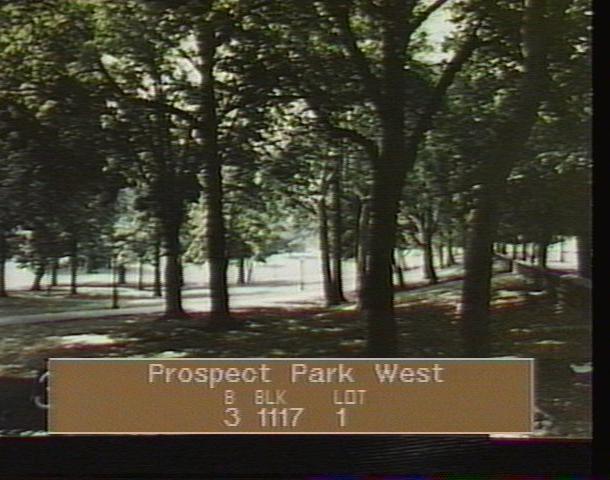
The city photographed every building for its tax records around 1940 and again in the 1980s. NYC Municipal Archives.
Written with AI from the source each entry cites, then fact-checked.
- 1853
Alexander Jackson Davis starts designing a mansion for Edwin and Grace Litchfield
Architect Alexander Jackson Davis began work on the design for the Litchfields' Italianate villa late in 1853, and construction started in 1854. The couple spent most of the building period traveling in Europe and sent Davis letters about the details. Davis often just handed drawings to local builders, but here he took a closer part in overseeing the work, and his journals, specifications and plans survive.
Source: brownstoner.com
- 1857
The Litchfield family moves into the villa and calls it Grace Hill
The Litchfields settled into the finished house in the fall of 1857. Davis had referred to it as Ridgewood, but the family chose the name Grace Hill, after Grace Hill Hubbard Litchfield. Edwin Litchfield was a lawyer by training who made his money investing in and managing railroads, and who then began buying Brooklyn land in the 1850s.
Source: brownstoner.com
- 1857
Davis builds the villa around a circular hall with more than 30 rooms
Davis laid out the house as a set of circles and octagons, producing more than 30 rooms with unusual angles, nooks and bays. They radiate from a two-story circular hall under a skylight. His notes say the hall walls were painted to resemble granite, the doors to look like bronze, and the ribbed ceiling was sky blue. Minton encaustic tiles were added to the entry in the 1850s.
Source: brownstoner.com
- 1868
The city buys the Litchfield estate for Prospect Park
Early plans for Prospect Park called for building it around the villa, because Edwin Litchfield did not want to sell. The Parks Commission nonetheless acquired the plot in 1868 for $1.7 million. That was 42 percent of the park's land spending, even though the plot made up just over five percent of its acreage.
“The New York City Parks Commission ultimately acquired the Litchfield plot in 1868 for $1.7 million, representing 42% of the overall land expenditure for the park…”
Source: Wikipedia
- 1883
The Brooklyn Park Commission makes the villa its headquarters
The Litchfield family rented the property from the city through 1882. In 1883 the Brooklyn Park Commission moved in and used the house as its headquarters. The building is today the Brooklyn borough headquarters of the city's Department of Parks and Recreation.
Source: Wikipedia
- 1885
Edwin Litchfield dies, ending his family's residence at the villa
After the city took the property for Prospect Park, the Litchfields were allowed to stay on as tenants. Grace Litchfield died in 1881 and Edwin followed in 1885, which ended the family's time in the house. The house, turned into park offices, became better known as Litchfield Villa or Litchfield's Castle.
Source: brownstoner.com
- 1892
A newspaper claims the villa's tower room imitates Mary Queen of Scots' cell
The Evening World ran an article claiming that the little room at the summit of the tower was fitted out like the cell where Mary Queen of Scots was held in a tower before her execution. A Brownstoner history of the house calls the claim whimsical and notes that Davis's own notes do not back it up.
Source: brownstoner.com
- 1966
The Landmarks Preservation Commission designates Litchfield Villa a city landmark
After a public hearing on February 8, 1966, at which eight speakers backed designation and none opposed it, the commission designated the villa a landmark on March 15. Its report called the house one of the last remaining palatial Italianate mansions in the city. It also singled out the colonnade columns, whose tops carry corn and wheat in place of classical ornament.
“Eight speakers spoke in favor of designation. There were no speakers in opposition to designation.”
- 2008
A Litchfield descendant pays for a renovation of the villa, finished in 2008
After years of neglect, an anonymous descendant of the Litchfield family funded an extensive renovation led by architect Ralph Carmosino. Work was completed in 2008. Many interior details, including painted ceiling murals, were lost.
“…an extensive renovation was funded by an anonymous descendant of the Litchfield family. The renovation, under the direction of architect Ralph Carmosino, was completed in 2008.”
Source: Wikipedia
Further reading
- Litchfield VillaWikipedia
Nearby
- Prospect Park Picnic House40 West Drive | 1 entry
- Prospect Park Tennis House52 West Drive | 2 entries
- Beth Elohim Temple House274 Garfield Place | 7 entries
- Prospect Park Bandshell62 West Drive | 4 entries
- NewYork-Presbyterian Brooklyn Methodist Hospital506 6th Street | 3 entries
- John Jay Educational Campus237 7th Avenue | 2 entries