Physical Graffiti building
96 St Marks Place | East Village | built 1900
Open on the map3 entries

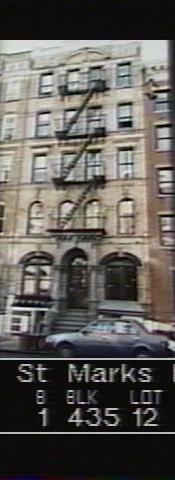
The city photographed every building for its tax records around 1940 and again in the 1980s. NYC Municipal Archives.
Written with AI from the source each entry cites, then fact-checked.
- 1890
Charles Ruff commissions twin tenements at 96 and 98 St. Mark's Place
Charles Ruff is the original owner of this five-story old-law tenement and its neighbor at 98 St. Mark's Place, both designed by Schneider & Herter to hold 21 families in all. The two facades are almost identical, with round-arched entrance porticos on columns and keystones carved with faces. Decades later the pair would become famous worldwide as a Led Zeppelin album cover.
- 1975
Led Zeppelin's Physical Graffiti is released with these tenements on its cover
Designer Peter Corriston built Led Zeppelin's double album sleeve around a photograph of the five-story tenements at 96 and 98 St. Marks Place, with die-cut windows showing changing images of figures from W. C. Fields to Buzz Aldrin. One floor was cropped out to fit the square format. The album came out in the U.S. on February 24, 1975.
Source: Wikipedia
- 1981
The Rolling Stones film Waiting on a Friend on the stoop of No. 96
The Rolling Stones used the front doorway and stoop of 96 St. Marks Place in the music video for Waiting on a Friend, a single from their 1981 album Tattoo You. The same building had appeared, with its neighbor at No. 98, on Led Zeppelin's Physical Graffiti cover in 1975.
Source: Wikipedia
Nearby
- 95 East 7th Street1 entry
- 97 East 7th Street1 entry
- 122 1st Avenue1 entry
- 99 East 7th Street2 entries
- St. Stanislaus Rectory101 East 7th Street | 3 entries
- 120 1st Avenue1 entry