97 Bowery
Chinatown | built 1869
Open on the map3 entries

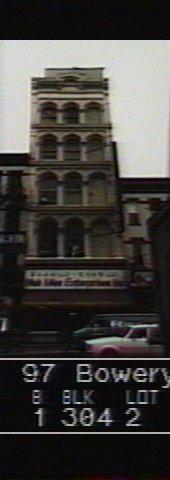
The city photographed every building for its tax records around 1940 and again in the 1980s. NYC Municipal Archives.
Written with AI from the source each entry cites, then fact-checked.
- 1869
John P. Jube builds a cast-iron factory for his carriage-hardware business
Carriage-hardware dealer John Prosser Jube pays $40,000 for the lot and its older building, then hires architect Peter L. P. Tostevin to design a modern factory and store. Tostevin's Italianate design uses a prefabricated cast-iron facade bolted onto the masonry walls, allowing fast, affordable construction. John P. Jube & Co. moves in when the building is finished in 1869 and, later renamed for wagon and automobile supplies, stays until 1931.
Source: Daytonian in Manhattan
- 1931
The Gorbaty brothers lease 97 Bowery to sell office fixtures
After John P. Jube & Co. moves out, the building is sold and then leased on June 20, 1931 to brothers Benny and Louis Gorbaty for $5,000 a year. The five-year lease turns into half a century of selling store fixtures and display items from the building. The family moves the business to Queens in 1981.
Source: Daytonian in Manhattan
- 2010
The city designates 97 Bowery an individual landmark
The New York City Landmarks Preservation Commission designates 97 Bowery an individual landmark on September 14, 2010. Its cast-iron Italianate facade is described as a rare survivor in an area where the Bowery was once the main commercial street of the Lower East Side. In 2013 the building is also listed on the National Register of Historic Places as a contributing property in the Bowery Historic District.
Source: Wikipedia
Further reading
- 97 BoweryWikipedia
Nearby
- 101 Bowery (New World Hotel)101 Bowery | 5 entries
- Owney Geoghegan's Bowery dive103 Bowery | 3 entries
- Wyndham Garden Hotel Chinatown93 Bowery | 4 entries
- 126 Hester Street3 entries
- 94 Bowery1 entry
- Victoria House96 Bowery | 1 entry