Tenement Museum (97 Orchard Street)
97 Orchard Street | Lower East Side | built 1863
Open on the map12 entries

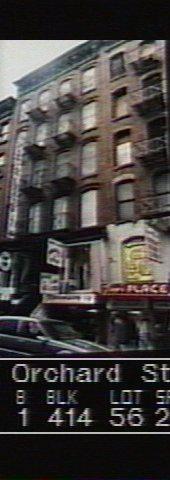
The city photographed every building for its tax records around 1940 and again in the 1980s. NYC Municipal Archives.
Written with AI from the source each entry cites, then fact-checked.
- 1863
Lukas Glockner builds a tenement at 97 Orchard Street
Prussian-born immigrant Lukas Glockner contracted for this tenement in 1863. It was built with 22 apartments and a saloon at basement level. Over the following decades, alterations reduced the number of apartments to 16. Today the building is the heart of the Lower East Side Tenement Museum.
Source: Wikipedia
- 1864
John and Caroline Schneider open a lager beer saloon in the tenement
German immigrants John and Caroline Schneider ran Schneider's Lager Beer Saloon at 97 Orchard Street from 1864 to 1886, living in an adjoining apartment. They served lager, then little known in America, along with food, in a neighborhood called Little Germany. Saloons like theirs were family gathering places and sites of lively political debate, and the museum has restored this one for visitors.
Source: tenement.org
- 1874
Nathalie Gumpertz becomes a dressmaker after her husband walks out and never returns
Nathalie and Julius Gumpertz, East Prussian immigrants, lived at 97 Orchard Street during the Panic of 1873. One morning in 1874 Julius left for work and never came back, leaving Nathalie with four young children and no public assistance to turn to. She became a full-time dressmaker in the apartment and supported the family for about a decade. Julius was declared legally dead in 1883, and in 1886 she moved the family to Yorkville.
Source: tenement.org
- 1891
Future film actor Sam Jaffe is born at 97 Orchard Street
The actor Sam Jaffe was born in 1891 at 97 Orchard Street. He went on to appear in Hollywood films including Gunga Din, Ben-Hur and The Day the Earth Stood Still, and he was nominated for an Emmy for playing Doctor David Zorba on the television series Ben Casey.
Source: Untapped New York
- 1892
Harris and Jennie Levine turn their front room into a garment shop
Harris and Jennie Levine, who arrived from Poland in 1890, moved into 97 Orchard Street around 1892 with their first child. To support what grew to five children, Harris converted the front room of the 325-square-foot apartment into a small garment factory with three workers. The shop ran long days, closing only on Saturday, and as many as ten people lived and worked there at once. By 1905 the Levines had saved enough to move to Brooklyn.
Source: tenement.org
- 1913
The Sephardic Confino family arrives from Kastoria and settles on the fifth floor
Rachel and Abraham Confino and their children left Kastoria, now part of Greece, in 1913 and took a fifth-floor apartment at 97 Orchard Street. As Sephardic Jews who spoke Ladino rather than Yiddish, they were shunned by some in the neighborhood's Eastern European Jewish community. They left in 1917 and by 1921 had moved uptown to East Harlem, where a Sephardic community thrived. Their daughter Victoria's life here is the basis of a museum tour set in 1916.
Source: tenement.org
- 1918
Abraham Rogarshevsky dies of tuberculosis, and his widow Fanny becomes the building's janitress
Abraham and Fanny Rogarshevsky moved into 97 Orchard Street in 1908 with six children, and Abraham worked as a garment presser for fifteen years. He died of tuberculosis in 1918, and the Lithuanian community helped Fanny with the burial and shiva. To keep her apartment she took the job of janitress. She held it until the building was condemned and was its last resident, leaving in 1941.
Source: tenement.org
- 1928
The Baldizzi family from Sicily moves in and relies on Home Relief through the Depression
Adolfo Baldizzi came from Sicily in 1923 and his wife Rosaria in 1925. After starting out on Elizabeth Street, where their children Josephine and Johnny were born, the family moved to 97 Orchard Street in 1928. Adolfo, a trained woodworker, struggled to find steady work during the Great Depression, and the family depended on Home Relief benefits during those years.
Source: tenement.org
- 1935
The landlord evicts the tenants and seals the upper floors
In 1935, rather than keep altering the building to meet housing rules, the landlord evicted the residents, boarded up the upper windows and sealed the upper floors. Only the stoop-level and basement storefronts stayed open for business.
Source: Wikipedia
- 1988
Ruth Abram and Anita Jacobson found the Tenement Museum
Ruth J. Abram and Anita Jacobson founded the Tenement Museum in 1988 and began working with 97 Orchard Street that same year, restoring apartments to tell the stories of the immigrant families who lived in them. The building was designated a National Historic Landmark on April 19, 1994, and a National Historic Site was authorized on November 12, 1998.
Source: Wikipedia
- 1994
97 Orchard Street becomes a National Historic Landmark
The federal government designates the tenement a National Historic Landmark, two years after it was added to the National Register of Historic Places. The recognition affirms the building's value for interpreting the lives of the immigrant families who filled its 22 apartments after Lukas Glockner built it in 1863.
Source: Wikipedia
- 2015
The museum's historic site grows to include 103 Orchard Street
A federal defense authorization act expands the museum's National Historic Site designation to include the tenement at 103 Orchard Street, letting it trace immigrant life further into the 20th century. Restoration architects Perkins Eastman and Li/Saltzman Architects had already spent years on preservation work at 97 Orchard Street, including a 2000 Save America's Treasures grant of $250,000.
Source: Wikipedia
Further reading
- Lower East Side Tenement MuseumWikipedia
Nearby
- Lower East Side Tenement Museum81 Delancey Street | 6 entries
- Former Engine Company 17 firehouse91 Ludlow Street | 5 entries
- Kehila Kedosha Janina Synagogue280 Broome Street | 8 entries
- 61 Delancey Street1 entry
- Dirt Candy81 Orchard Street | 7 entries
- Woodward Gallery130 Eldridge Street | 1 entry