Kingsbrook Jewish Medical Center
East Flatbush | built 1927
Open on the map4 entries

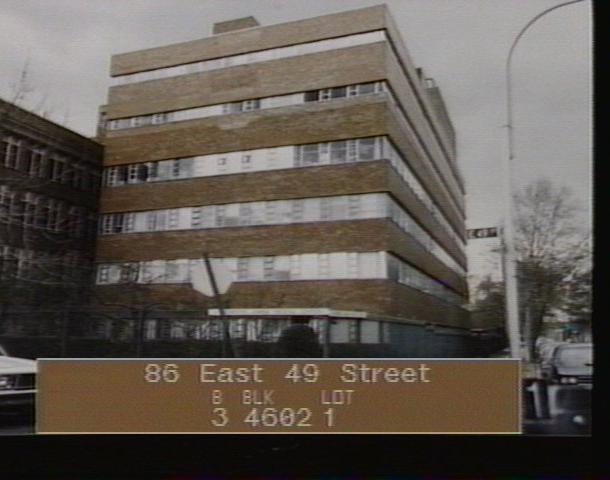
The city photographed every building for its tax records around 1940 and again in the 1980s. NYC Municipal Archives.
Written with AI from the source each entry cites, then fact-checked.
- 1928
2,000 people attend the dedication of the Jewish Sanitarium for Incurables building on Rutland Road
Max Blumberg's group, then called The Jewish Sanitarium For Incurables, broke ground on September 9, 1926 at Rutland Road and East 49th Street. A five-story building meant for 250 beds stood in shell form by February 1928, and about 2,000 people came to its dedication on October 14, 1928. It is now known as the Lefrak building.
“On October 14, 1928, a dedication ceremony was attended by 2,000 people to mark the completion of the building which today is called the Lefrak building.”
Source: Wikipedia
- 1929
The sanitarium admits its first 52 patients, brought from Kings County Hospital Center
Money problems kept the finished building empty until spring 1929. On opening day, April 24, 1929, fifty-two men and women were driven and wheeled over from Kings County Hospital Center. The wards soon filled to the capacity of 300 patients, and a wing with physiotherapy and dental laboratories was added in April 1930.
Source: Wikipedia
- 1936
The hospital drops "incurables" from its name, becoming the Jewish Hospital and Sanitarium for Chronic Diseases
Vice president Bernard Lebovitz announced the change during the dedication of a new 40-bed ward on May 17, 1936, arguing that medicine no longer gave up on patients. In 1954 the institution became the Jewish Chronic Disease Hospital, and by the mid-1950s it had 810 beds. It was renamed Kingsbrook Jewish Medical Center in 1968.
“…on May 17, 1936, the hospital changed its name to the Jewish Hospital and Sanitarium for Chronic Diseases.”
Source: Wikipedia
- 1963
Three doctors at the Jewish Chronic Disease Hospital object to cancer-cell injections given without consent
The cancer researcher Chester M. Southam injected HeLa cancer cells into patients without their informed consent, including long-term care patients at the Jewish Chronic Disease Hospital. In 1963 the hospital doctors Avir Kagan, David Leichter and Perry Fersko objected and reported him to the state Board of Regents. The Regents found Southam guilty of fraud, deceit and unprofessional conduct and put him on probation for a year.
Source: Wikipedia
Further reading
- Kingsbrook Jewish Medical CenterWikipedia
Nearby
- ABC Building, Kings County Hospital451 Clarkson Avenue | 3 entries
- Congregation Beth Israel203 East 37th Street | 3 entries
- East New York Savings Bank Building1117 Eastern Parkway | 6 entries
- Jewish Children's Museum792 Eastern Parkway | 4 entries
- Chevra Ahavas Yisroel306 Albany Avenue | 1 entry
- 770 Eastern Parkway6 entries