Ellis Island Main Building
1 Ellis Island | Ellis Island | built 1900
Open on the map18 entries

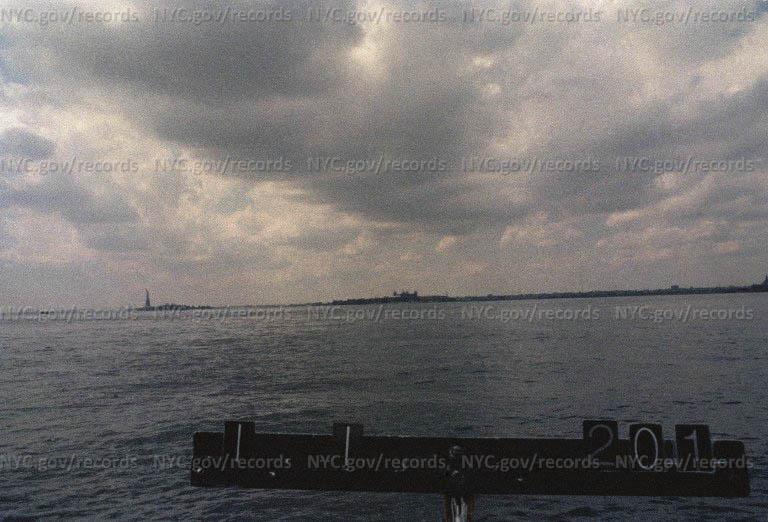
The city photographed every building for its tax records around 1940 and again in the 1980s. NYC Municipal Archives.
Written with AI from the source each entry cites, then fact-checked.
- 1808
The federal government acquires Ellis Island and builds a 14-gun battery, later named Fort Gibson
The United States took the island on June 30, 1808, paying $10,000 once the rest of it had been acquired by condemnation. The War Department then built a circular stone battery of 14 guns, plus a mortar battery, a magazine and barracks, to defend New York Harbor. By the end of the War of 1812 the post was called Fort Gibson, after a colonel killed at Fort Erie. It saw no combat but housed the 11th Regiment and held British prisoners, and low remnants of its walls still lie outside the Main Building.
Source: Wikipedia
- 1892
Seventeen-year-old Annie Moore becomes the first immigrant registered at Ellis Island
Annie Moore sailed from Queenstown, Ireland, on December 20, 1891, aboard the steamship Nevada with her two younger brothers, and spent 12 days in steerage. On January 1, 1892 she was the first of the ship's 107 steerage passengers to be processed. Federal superintendent John B. Weber handed her a ten-dollar gold piece, and Charles Hendley, a former Treasury Department official, inked her name in the station's first registry book.
Source: history.com
- 1897
Fire destroys Ellis Island's first wooden immigration station
The first federal immigration station on Ellis Island opened on January 1, 1892, when a 17-year-old from County Cork, Annie Moore, became the first immigrant processed. On June 15, 1897, a fire of unknown origin burned its wooden buildings to the ground. No one was killed, but immigration records dating back to 1855 were lost. About 1.5 million people had passed through in five years.
Source: Wikipedia
- 1900
The fireproof Main Building opens and processes 2,251 immigrants on its first day
To replace the burned station, architects William A. Boring and Edward Lippincott Tilton designed a fireproof building of red brick with limestone trim in a French Renaissance style. It opened on December 17, 1900, and 2,251 immigrants were processed that day. Expansion continued until 1906, when landfill had created three connected islands.
Source: Wikipedia
- 1907
Fiorello La Guardia starts work as an Ellis Island interpreter
La Guardia began working as an interpreter for the immigration service at Ellis Island on November 6, 1907, and stayed until 1910. He translated Croatian, Italian and German for arriving immigrants. Felix Frankfurter, who met him during this period, called him a gifted interpreter. La Guardia was admitted to the bar in 1910, the year he left the island.
“…worked as an interpreter for the immigration services at Ellis Island from November 6, 1907, to 1910. He was a Croatian, Italian, and German interpreter.”
Source: Wikipedia
- 1916
The Black Tom explosion cracks Ellis Island's roof and windows
German saboteurs detonate a massive cache of munitions bound for Russia at the Black Tom terminal across the harbor in Jersey City. The shockwave collapses part of the Main Building's roof and shatters its windows during World War I. Two years later, workers rebuild the roof with a Guastavino-tiled arched ceiling that still covers the Registry Room.
Source: Wikipedia
- 1917
Federal agents hold about 1,100 German and Austrian seamen at Ellis Island
After the United States entered World War I, roughly 1,100 German and Austrian naval officers and crewmen, seized at New York and New London, were held in the island's baggage and dormitory building. A stockade was built for the officers, and a 1917 New York Times article portrayed the detention as relatively hospitable. Meanwhile, immigrant processing fell from 878,000 a year in 1914 to 26,000 in 1919.
Source: Wikipedia
- 1919
Anarchist Emma Goldman is held at Ellis Island and then deported to Russia
Emma Goldman and fellow anarchist Alexander Berkman were detained at Ellis Island in December 1919. On December 8 they were allowed out to appear in federal court. On December 21, after more than two weeks in detention, Goldman was deported with 248 other people the government called radical aliens, on a ship bound for Russia.
Source: home.nps.gov
- 1953
Ellis Island employs about 250 people to watch 237 detainees
By 1953 Ellis Island held only 237 detainees, yet roughly 250 employees still staffed it. The Internal Security Act of 1950 had set off a flurry of detentions, but the Public Health Service closed the hospital in 1951 and the Coast Guard temporarily took over the buildings. The last detainees were removed the following year, in November 1954.
Source: National Park Service
- 1954
Seaman Arne Petterssen becomes Ellis Island's last detainee as the station closes
Arne Petterssen, a Norwegian seaman from Larvik, had overstayed his shore leave at least four times. His last overstay made him the final detainee on November 12, 1954, the day Ellis Island closed. He was given extensions until December 24, but two months later he was still in the city when he was found. He was deported on the M.S. Stockholm on February 16, 1955.
Source: history.com
- 1956
Jersey City's mayor commandeers a Coast Guard cutter to claim Ellis Island for New Jersey
Two years after the immigration station closed, Jersey City Mayor Bernard J. Berry took over a U.S. Coast Guard cutter and led a party of New Jersey officials to the island to stake the state's claim. New Jersey argued that the landfill added around the original islet lay outside New York's border. The jurisdiction fight flared again in the 1980s and 1990s and ended at the Supreme Court in 1998.
“…the Mayor of Jersey City Bernard J. Berry commandeered a U.S. Coast Guard cutter and led a contingent of New Jersey officials on an expedition to claim the island…”
Source: Wikipedia
- 1959
A $55 million resort bid and a Frank Lloyd Wright scheme both fail to remake Ellis Island
In 1959 developer Sol Atlas made an unsuccessful bid for the abandoned island, planning a $55 million resort that would have had a hotel, a marina, a music shell and skating rinks. Also in 1959, Frank Lloyd Wright drew up a $100 million Key Project of housing, hotels and large domes, but he died before presenting it. Other ideas, among them a college, a retirement home, a rehabilitation center for alcoholics and a world trade center, never materialized.
“…real estate developer Sol Atlas unsuccessfully bid for the island, with plans to turn it into a $55 million resort…”
Source: Wikipedia
- 1965
Ellis Island becomes part of the Statue of Liberty National Monument
The federal government folds the closed immigration station into the Statue of Liberty National Monument, placing the vacant Main Building under National Park Service protection. The designation follows years of the complex sitting empty and deteriorating after immigration processing wound down. It sets the stage for a long restoration campaign before the building reopens to the public in 1990.
Source: Wikipedia
- 1970
Squatters try to turn Ellis Island into an addiction center and are evicted within two weeks
In 1970 a group calling itself the National Economic Growth and Reconstruction Organization began refurbishing the empty buildings, hoping to turn the island into an addiction rehabilitation center. It was evicted in under two weeks. Its permit to renovate the island was formally ended in 1973.
“…were evicted after less than two weeks. NEGRO's permit to renovate the island were ultimately terminated in 1973.”
Source: Wikipedia
- 1982
Reagan launches a commission to fund Ellis Island's restoration
President Reagan sets up the Statue of Liberty–Ellis Island Centennial Commission, tasked with raising private money to restore both landmarks before the statue's 1986 centennial. Public tours of the derelict Main Building stop in 1984, and major restoration work begins the following year. The campaign eventually funds the building's transformation into the Ellis Island Immigration Museum.
Source: Wikipedia
- 1990
The restored Main Building reopens as the Ellis Island Immigration Museum
After strict immigration quotas took effect in 1924, arrivals dwindled, and the station closed on November 12, 1954; its last detainee was a Norwegian merchant seaman. The island became part of the Statue of Liberty National Monument in 1965. Following restoration, the Main Building reopened as an immigration museum on September 10, 1990.
Source: Wikipedia
- 1998
The Supreme Court rules that New Jersey has authority over the filled land around Ellis Island
In New Jersey v. New York, decided May 26, 1998, the Supreme Court ruled that New Jersey, not New York, has sovereign authority over the land filled in around the original island, which the 1834 compact had described as about three acres. The federal government had added roughly 24.5 acres, some nine times the original size.
Source: law.cornell.edu
- 2012
Hurricane Sandy wrecks Ellis Island's electrical, communications and climate systems
Hurricane Sandy struck on October 29, 2012. The first floor of the Main Immigration Building stayed dry, but the storm surge wiped out its electrical, communications and heating and cooling systems. The Park Service later awarded a $34.9 million task order for repairs, with work scheduled to begin in mid-May and to finish in December 2015.
“…no water entered the first floor of the Main Immigration Building ... destroyed electrical, communications, and heating and cooling systems…”
Source: National Park Service
Further reading
- Ellis IslandWikipedia
Nearby
- Statue of Liberty Museum1 Liberty Island | 9 entries
- Statue of Liberty1 Liberty Island | 20 entries