Statue of Liberty
1 Liberty Island | Liberty Island | built 1900
Open on the map20 entries

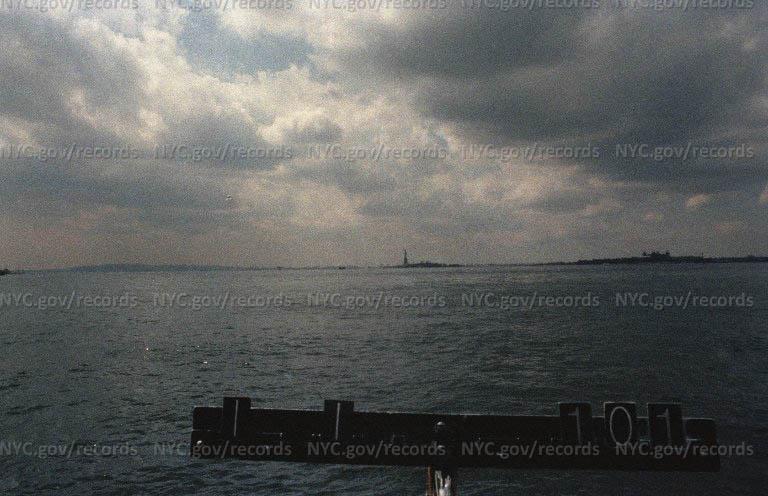
The city photographed every building for its tax records around 1940 and again in the 1980s. NYC Municipal Archives.
Written with AI from the source each entry cites, then fact-checked.
- 1811
Fort Wood, an eleven-point star fort, is completed on Bedloe's Island
Long before the statue, this spot held a fortification: a land battery shaped like an eleven-pointed star, built between 1806 and 1811 as part of New York's defenses for the War of 1812. It was later named Fort Wood for Colonel Eleazer D. Wood, a war hero. The War Department controlled the fort and the island until the statue project began, and the pedestal was then built on top of the fort.
“…constructed between 1806 and 1811 ... named in honor of the war hero Colonel Eleazer D. Wood…”
- 1871
Sculptor Bartholdi sails for America and picks Bedloe's Island for his statue
In June 1871 Frédéric Auguste Bartholdi sailed to America on the Pereira, carrying letters of introduction and a plan to gauge American feeling about a giant monument. He traveled as far west as San Francisco and met President Ulysses S. Grant, Senator Charles Sumner and the poet Henry Wadsworth Longfellow. By the time he returned to France that fall, he had chosen Bedloe's Island in New York harbor as the statue's site.
“He sailed in June on the Pereira, armed with instructions and letters of introduction…”
- 1883
Crews begin digging the foundation for Richard Morris Hunt's pedestal
Excavation inside Fort Wood began in April 1883 and went slower than planned, because the fort was built more solidly than old drawings suggested. At the center, workers poured a tapering concrete block 53 feet deep and 91 feet square to carry the pedestal. The cornerstone was laid in August 1884, but money ran out and construction stopped until Joseph Pulitzer's 1885 appeal revived it. General Charles Stone served as chief engineer, and Hunt donated his architectural services.
- 1885
Joseph Pulitzer's newspaper drive reaches its goal for the statue's pedestal
The statue arrived from France in crates aboard the steamer Isère on June 17, 1885, but there was not yet money to finish its pedestal. Joseph Pulitzer's New York World campaigned for $100,000, and by August 11 it had raised $102,000 from about 120,000 donors, most of it in gifts of less than a dollar. Richard Morris Hunt designed the 89-foot pedestal.
Source: Wikipedia
- 1886
President Grover Cleveland dedicates the Statue of Liberty
President Grover Cleveland presided over the dedication of Liberty Enlightening the World on what was then Bedloe's Island on October 28, 1886. The celebrations in Manhattan that day included the city's first ticker-tape parade. President Calvin Coolidge made the statue a national monument on October 15, 1924.
Source: Wikipedia
- 1886
Suffragists charter a boat to protest the ban on most women at the dedication
Officials reserved the island for dignitaries on dedication day, October 28, 1886, and admitted just two women, Bartholdi's wife and Lesseps's granddaughter, saying a crush might hurt them. Suffragists took offense, hired a boat and steered as close to the island as they could. From the water their leaders made speeches praising the statue for showing Liberty as a woman and urging votes for women.
“The restriction offended area suffragists, who chartered a boat and got as close as they could to the island.”
Source: Wikipedia
- 1886
The torch is lit for the first time and is mocked as a glowworm, not a beacon
On the evening of the dedication the torch was lit, but it gave off only a faint gleam that Manhattan could barely see, and the New York World likened it to a glowworm. Bartholdi suggested gilding the statue to catch more light, which proved too expensive. The Lighthouse Board took charge in 1887 and promised better equipment, yet the figure stayed nearly invisible at night.
Source: Wikipedia
- 1903
Emma Lazarus's poem The New Colossus is mounted on a plaque in the pedestal
Emma Lazarus wrote her sonnet The New Colossus in 1883 for an art auction held to raise money for the pedestal, and it was largely forgotten after the 1886 dedication. Her friend Georgina Schuyler began a campaign in 1901 to memorialize it, and in 1903 a bronze plaque bearing the poem was mounted on an inner wall of the pedestal, where it still hangs.
Source: Wikipedia
- 1906
Congress funds repainting the statue until protests save its green patina
A green patina began spreading over the statue's copper shortly after 1900 and covered it entirely by 1906. Taking it for corrosion, Congress authorized $62,800 for repairs and for painting the statue inside and out. The public protested the plan for the exterior, and the Army Corps of Engineers studied the patina and concluded it shielded the metal and softened the figure's outlines. In the end, only the interior was painted.
Source: Wikipedia
- 1916
President Wilson presses a telegraph key to floodlight the statue at night
In 1916 Ralph Pulitzer, publisher of the World like his father Joseph before him, launched a $30,000 fundraising drive to light the statue's exterior. It fell short, and a wealthy donor quietly covered the difference, which did not come out until 1936. An underwater cable carried power from the mainland and floodlights lined the walls of Fort Wood. On December 2, 1916, President Woodrow Wilson pressed a telegraph key to switch them on.
“On December 2, 1916, President Woodrow Wilson pressed the telegraph key that turned on the lights…”
Source: Wikipedia
- 1916
The Black Tom explosion damages the statue's torch arm
German saboteurs detonate a massive cache of munitions bound for Russia at the Black Tom terminal in nearby Jersey City. The blast damages the statue's torch-bearing arm and closes the statue for ten days, with repairs costing about $100,000. Officials seal off the narrow ascent to the torch balcony for public safety afterward, and it has remained closed to visitors ever since.
Source: Wikipedia
- 1924
A presidential proclamation makes Fort Wood and the statue a national monument
On October 15, 1924, a presidential proclamation declared the statue and the old Fort Wood around it a national monument. Nine years later, in 1933, care and administration of the monument passed to the National Park Service. In 1936 President Franklin D. Roosevelt presided at the statue's 50th anniversary, marking half a century since the 1886 dedication.
“On October 15, 1924, a Presidential Proclamation declared Fort Wood (and the Statue of Liberty within it) a National Monument…”
Source: home.nps.gov
- 1937
New Deal work crews overhaul the statue's interior and landscape the island
From 1937 to 1941 Public Works Administration and Works Progress Administration laborers worked on Bedloe's Island. They took off Liberty's rays one at a time to clear out the decaying interior, replaced the corroded cast-iron stairway up the pedestal, sealed the statue's footings against seawater and rainwater with a copper apron, remodeled the administration building and built a visitor center. The work also gave the island a new seawall, landfill, dock and walkways.
Source: livingnewdeal.org
- 1942
Hitchcock's thriller Saboteur ends with a villain hanging from the statue's arm
Alfred Hitchcock's wartime thriller Saboteur (1942) reaches its climax on the Statue of Liberty, where an enemy agent dangles from the figure's outstretched arm. A Turner Classic Movies essay reads the image as a nation rousing itself for war, noting that Hitchcock heard the news of the Pearl Harbor attack while working on storyboards and shot the film in early 1942.
Source: tcm.com
- 1944
The statue's lights flash the Morse letter V on D-Day
Wartime blackouts kept the statue dark at night. It was lit briefly on December 31, 1943, and again on D-Day, June 6, 1944, when its lights blinked dot-dot-dot-dash, Morse code for the letter V, for victory. Powerful new lighting went in during 1944 and 1945, and from V-E Day the statue shone after sunset for a few hours each evening. It was not lit all night, every night, until 1957.
“…its lights flashed "dot-dot-dot-dash", the Morse code for V, for victory…”
Source: Wikipedia
- 1956
Bedloe's Island is renamed Liberty Island after centuries under other names
In 1956 the roughly 12-acre island took the name Liberty Island in honor of the statue. Before that it had gone by many names, including Minnissais, Great Oyster, Love, Kennedy's and Corporation Island, but Bedloe's Island lasted longest. Isaac Bedloo, a burgher of New Amsterdam, owned it in the 17th century. Archibald Kennedy bought it in 1746 and built a summer house there, and during the Revolutionary War it sheltered Tory sympathizers.
- 1965
Police and the FBI foil a plot to blow the head and arm off the statue
On February 16, 1965, the FBI arrested a group in New York that planned to destroy the Statue of Liberty and other monuments, including the Liberty Bell and the Washington Monument. The plotters meant to enter the closed-off passage leading from the statue's head to its torch arm and blow both away. An NYPD rookie, Raymond A. Wood, had infiltrated the group months earlier and warned the FBI, staying undercover until the dynamite arrived. The Canadian participant, Michelle Duclos, served three months in prison before her sentence was replaced with probation.
“…the group had been infiltrated by undercover NYPD rookie cop Raymond A. Wood several months prior, who had notified the FBI…”
Source: Wikipedia
- 1971
Vietnam veterans take over the statue and fly an American flag upside down from the crown
On December 26, 1971, fourteen members of Vietnam Veterans Against the War, plus a journalist, got into the statue after cutting a gate lock and squeezing through bent wire mesh. They flew an inverted American flag from the crown as a distress signal and handed a night watchman a "Bring Our Brothers Home" leaflet to protest resumed bombing in Vietnam. After about three days and a contempt order, the group voted 8 to 6 to leave rather than go to jail.
Source: vvaw.org
- 1986
Liberty Weekend caps a restoration that gives the statue a new gold torch
Workers finish a two-year overhaul that replaces corroded interior armature bars, patches the copper skin with material salvaged from a Bell Labs rooftop, and swaps the leaking original torch for a replica with a gold-plated flame. President Reagan presides over the rededication, with French President Francois Mitterrand attending, during four days of centennial festivities called Liberty Weekend. The statue reopens to the public on July 5.
Source: Wikipedia
- 2001
The statue closes after 9/11 and stays shut for years
Liberty Island shuts down immediately after the September 11 attacks on the nearby World Trade Center. The island reopens by the end of the year, but the National Park Service keeps the pedestal and statue closed over evacuation safety concerns. The pedestal reopens in 2004, and the statue's crown finally reopens to a limited number of daily visitors in 2009.
Source: Wikipedia
Further reading
- Statue of LibertyWikipedia
Nearby
- Statue of Liberty Museum1 Liberty Island | 9 entries
- Ellis Island Main Building1 Ellis Island | 18 entries