Marine Air Terminal
1 Lga Marine Air Terminal | also 83-00 23rd Avenue | LaGuardia Airport | built 1933
Open on the map8 entries

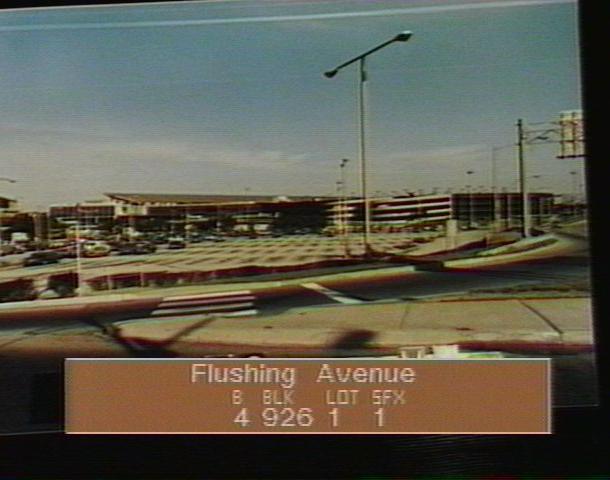
The city photographed every building for its tax records around 1940 and again in the 1980s. NYC Municipal Archives.
Written with AI from the source each entry cites, then fact-checked.
- 1939
William Delano trades his usual classical styles for Art Deco on the seaplane terminal
Delano & Aldrich were known for neo-Renaissance and neo-Federal houses for wealthy clients, but Chester Aldrich had taken leave in 1935 to head the American Academy in Rome, so the airport buildings are credited to William Delano alone. His choice of Art Deco for the terminal, built 1939 to 1940, broke sharply with the firm's habits, apparently because he felt a new kind of building called for a modern style.
“The use of the Art Deco style represents a dramatic departure from the architect's usual approach…”
- 1940
The Yankee Clipper takes off from the new terminal and lands in Lisbon 18 hours later
The first Boeing 314 flight from the Marine Air Terminal, Pan American's Yankee Clipper, left with ten crew, nine passengers and more than 5,000 pounds of mail, reaching Lisbon after 18 hours and 35 minutes. The flying boats had two decks with dining rooms and sleeping sections, and scheduled routes ran to Lisbon and Marseilles and by way of Newfoundland to Southampton.
“The first flight from the Marine Air Terminal by a Boeing 314-- the Yankee Clipper-- departed on March 31, 1940…”
- 1942
James Brooks finishes Flight, a 237-foot mural ringing the rotunda
Painted for the Works Progress Administration, Brooks's Flight is 12 feet high and 237 feet long, the largest mural the WPA produced. Hung just below the rotunda ceiling, it tells the story of flying in two parts: early attempts, including the myth of Icarus and the inventions of Leonardo da Vinci, then modern aviation from the Wright brothers' tests to transatlantic airliners.
Source: Wikipedia
- 1946
The overcrowded seaplane terminal reopens as LaGuardia's International Air Terminal
With LaGuardia then the only major U.S. airport offering regular flights to Europe, 14 airlines crowded into a terminal that could handle one plane at a time, and travelers often waited three to four hours for customs. One airline owner even bought an old ferryboat and moored it beside the building. After new gates and a 1,000-foot covered walkway were added, it reopened under a new name, handling all of LaGuardia's transatlantic flights.
“…the overcrowded conditions had prompted one airline owner to purchase an old ferryboat and moor it next to the Marine Air Terminal…”
Source: Wikipedia
- 1951
The last transatlantic flight leaves the terminal as Idlewild takes over
Traffic fell off after Idlewild opened in 1948, and in 1949 the building was renamed the Overseas Terminal because passengers kept confusing it with Idlewild's formal name, New York International Airport. Most transatlantic flights shifted to the new airport, and Pan Am moved most of its operations out early in 1951. The final transatlantic departure came on April 28; Bermuda flights lingered until February 1952.
“…the last transatlantic flight from the Overseas Terminal departed on April 28, 1951…”
Source: Wikipedia
- 1952
Brooks's Flight mural is painted over, and the artist only learns of it afterward
Around the time service ended, the entire mural was covered with paint, and James Brooks found out only after it was done. The reason was never established: The Wall Street Journal suggested anti-communist feeling, while Anthony Cycovek, LaGuardia's operations chief, blamed the rotunda's increasingly dingy look. The mural stayed hidden until 1973, when Cycovek mentioned it to a Port Authority executive who knew of a program to find lost government-commissioned art.
“Flight was completely painted over in 1952. It is unknown why this was done…”
Source: Wikipedia
- 1980
The restored Flight mural is rededicated after a campaign by historian Geoffrey Arend
Aviation historian Geoffrey Arend pushed from 1976 to bring back the hidden mural. In February 1979 Laurance Rockefeller, a philanthropist, and DeWitt Wallace, a magazine publisher, agreed to help pay for the job, projected at $75,000, and conservator Alan M. Farancz did the restoration. The mural was rededicated in September 1980; New York Times critic Grace Glueck called its covering the worst case of WPA mural censorship in the city.
“Laurance Rockefeller and magazine publisher DeWitt Wallace agreed to partially fund the restoration of the Flight mural…”
Source: Wikipedia
- 1980
The Landmarks Preservation Commission designates the Marine Air Terminal
At the December 1979 hearing three witnesses supported designation and nobody spoke against it, though the Port Authority pointed out that its own jurisdiction took precedence. The commission named the building the last active terminal in the country from the first generation of passenger flying and the place from which the world's first regularly scheduled transatlantic passenger flights had left. Its round central hall, home of the restored Flight mural, was also a designated landmark.
“Three witnesses spoke in favor of designation. There were no speakers in opposition ... The Port Authority of New York and New Jersey made note of its superior jurisdiction.”
Further reading
- Marine Air TerminalWikipedia
Nearby
- Marine Air Terminal shuttle gates83-00 23rd Avenue | 6 entries
- Marine Air Terminal5 Lga Marine Air Terminal | 1 entry
- Lent Homestead78-03 19th Road | 4 entries
- Steinway Mansion18-33 41st Street | 8 entries
- Our Lady of Fatima Roman Catholic Church25-02 80th Street | 3 entries
- Lexington School for the Deaf25-26 75th Street | 3 entries