10 Hubert Street
Tribeca | built 1892
Open on the map5 entries

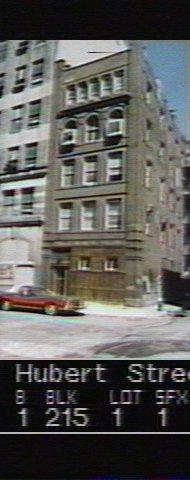
The city photographed every building for its tax records around 1940 and again in the 1980s. NYC Municipal Archives.
Written with AI from the source each entry cites, then fact-checked.
- 1891
Liquor importer Joseph H. Bearns buys two old Trinity Church houses on this corner
An earlier building on this site, a two-and-a-half-story brick house owned by Trinity Church, was home in the 1840s to the Rev. Jonathan M. Wainwright. By the end of the century the neighborhood had turned industrial, and on July 22, 1891 Joseph H. Bearns, head of the liquor importing firm J. H. Bearns & Co., bought the old houses for $25,500.
Source: Daytonian in Manhattan
- 1892
Julius Kastner designs a Romanesque Revival loft with terra cotta masks for Bearns
Bearns hired architect Julius Kastner for a five-story store and loft building, finished in 1892 in beige brick with brownstone and terra cotta trim. Arched fourth-floor windows have terra cotta eyebrows, and a terra cotta cornice ends in two masks, one male and one female. Bearns later hired Kastner for several more Tribeca buildings.
Source: Daytonian in Manhattan
- 1918
Varnish gum importer Otto Isenstein & Co. applies to rename itself Innes & Co. during World War I
Otto Isenstein & Co. leased the building in 1916 to import gums used in varnish. In May 1918, amid anti-German feeling, it applied to change its name to Innes & Co., Inc. Kauri gum was also needed for ships and railroad cars, so the War Trade Board capped imports at 3 million pounds for 1918 and made importers report what came in through Hubert Street.
Source: Daytonian in Manhattan
- 1936
John N. Germack moves his Red-Lip pistachio business into the building
John N. Germack moved his pistachio business into the building in 1936. Six years before, he had purchased the Zeobia Company from Joseph A. Zaloom, its founder, and put his own name on the business. His Red-Lip brand went to retailers both as packaged snacks and to fill penny vending machines. Germack moved to Hudson Street in 1943, but his painted name stayed on 10 Hubert Street for decades.
Source: Daytonian in Manhattan
- 2014
Architects ODA convert the loft into four apartments and restore its lost cornice and storefront
By the early 1990s the brick and terra cotta were damaged, the cornice was gone and the cast-iron storefront had been filled in. In 2014 the firm ODA New York was working on a conversion that it described as a conservation, restoring the terra cotta, reproducing the storefront and fabricating a cornice close to the original. A penthouse not visible from the street brought the building to four large apartments.
Source: Daytonian in Manhattan
Further reading
- Liquor, Pistachios and a Penthouse - Julius Kastner's 1892 10 Hubert StreetDaytonian in Manhattan
Nearby
- 415 Greenwich Street3 entries
- 57 Laight Street6 entries
- American Express Company Stable157 Hudson Street | 5 entries
- 17 Hubert Street2 entries
- 153 Hudson Street2 entries
- 11 Hubert Street3 entries