57 Laight Street
Tribeca | built 1893
Open on the map6 entries

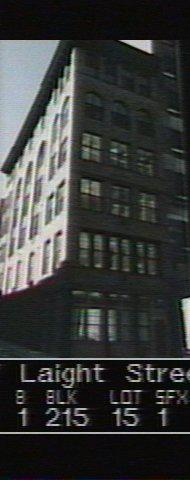
The city photographed every building for its tax records around 1940 and again in the 1980s. NYC Municipal Archives.
Written with AI from the source each entry cites, then fact-checked.
- 1828
The Common Council calls the privy at R. Pattison's house on the site of 57 Laight Street a nuisance
Before the present building, 57 Laight Street held a 25-foot-wide brick house a block from St. John's Park. On December 29, 1828, the Common Council declared the rear-yard privy of its resident, R. Pattison, a nuisance. In the 1830s the widow Hannah Vanriper ran it as a boarding house, and by 1846 the ground floor held a grocery. This was an earlier building on the site.
Source: Daytonian in Manhattan
- 1893
Horgan & Slattery build and develop their own Renaissance Revival loft building
Architects Horgan & Slattery, acting as their own developers, demolished the old house in 1892 and completed a Renaissance Revival factory and store in 1893. Instead of applied ornament they relied on materials: variegated orange ironspot Roman brick, bullnose bricks that soften the corners, and thin brick voussoirs that fan out over the arches. On the Collister Street side the three-story arcades are slightly recessed.
Source: Daytonian in Manhattan
- 1898
The building fills with looking-glass and glassware dealers
Surprisingly for a district of freight warehouses and produce firms, 57 Laight Street filled with glass and mirror dealers. Its 1898 tenants included Schrenk & Co., John Proessl, the United Bavarian Looking Glass Works, plus Tritschler, Winterhalder & Co., a seller of druggists' glassware. Their landlord was Anna Woerishoffer, widow of the stockbroker Charles F. Woerishoffer, who held the building until 1912.
Source: Daytonian in Manhattan
- 1912
Denver Chemical, maker of the Antiphlogistine cream, buys the building
In 1912 Anna Woerishoffer sold the building to the Denver Chemical Manufacturing Company, a New York firm that made a single product, a cream called Antiphlogistine, introduced in 1893. By then it was advertised as an instant cure for boils, sprains, ulcers and many other complaints. The company spent $750 on fireproofing alterations in 1913 and stayed until September 1919.
Source: Daytonian in Manhattan
- 1919
Importer R. U. Delapenha & Co. sells Comet Rice and Myers's rum from Laight Street
In September 1919 the building went to R. U. Delapenha & Co., importers who represented the Seaboard Rice Company and promoted its Comet Rice with free recipe booklets. After Prohibition ended the firm added Myers's dark Jamaica rum, again offering a free recipe book in a 1942 Life magazine ad. It also made glazed pineapple, citron and crystallized ginger at a plant in Jersey City, and kept 57 Laight until it sold in 1951.
Source: Daytonian in Manhattan
- 1972
The Trust, an off-off-Broadway theater run by dancer William Dunas, opens on the ground floor
By 1972 the lower portion of the building held The Trust, an off-off-Broadway theater run by dancer and choreographer William Dunas. His piece "Our Lady of Late" was staged there in May 1972; a New York Times reviewer found it murky in content and lighting. The next year Robert Magginson & Associates performed "I Went With Him And She Came With Me." The building became one loft residence per floor in 1986.
Source: Daytonian in Manhattan
Further reading
- Horgan & Slattery's 1893 No. 57 Laight StreetDaytonian in Manhattan
Nearby
- 415 Greenwich Street3 entries
- 10 Hubert Street5 entries
- American Express Company Stable157 Hudson Street | 5 entries
- 161 Hudson Street2 entries
- Port Warehouse Building54 Laight Street | 5 entries
- 153 Hudson Street2 entries