Loew's Canal Street Theatre
10 Ludlow Street | also 31 Canal Street, 8 Ludlow Street | Chinatown | built 1927
Open on the map7 entries

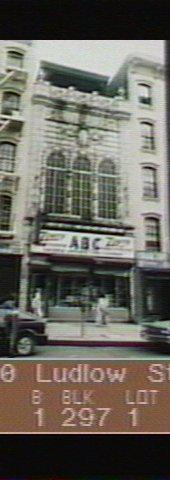
The city photographed every building for its tax records around 1940 and again in the 1980s. NYC Municipal Archives.
Written with AI from the source each entry cites, then fact-checked.
- 1926
Loew's Inc. assembles a lot at Canal and Ludlow and hires Thomas Lamb for a 2,300-seat theater
In January 1926 Loew's Inc. began assembling a large parcel on Canal and Ludlow Streets, then hired Thomas W. Lamb's firm to plan a theater of about 2,300 seats. The contractor M. Shapiro & Son started construction that fall, and the theater opened the following year. Once open, it ranked among the neighborhood's largest movie houses, behind only the Commodore.
“In January of that year the company began to compile a large parcel on Canal and Ludlow Streets and soon hired the firm of Thomas W. Lamb…”
- 1927
Lamb clads the narrow Canal Street front in terra cotta, with griffons and sea monsters along the cornice
Lamb's firm gave the theater a facade about four stories tall and only 22 feet wide, covered almost entirely in ornate terra cotta. Three tall blind windows use rare black terra cotta set in thin white strips to suggest multi-paned casements. Griffons, eagles and sea monsters crowd the cornice among garlands and festoons.
- 1928
Loew's sells the new theater to a local rival, takes it back at foreclosure auction in 1929
By October 1928, barely a year after the theater opened, Loew's had sold it to the Greater M. & S. Circuit, a Lower East Side chain, and had taken control of that chain's Commodore Theatre on Second Avenue. Near the end of 1929 the circuit ran into financial trouble, and the building returned to Loew's at an auction that followed foreclosure proceedings begun by the national company.
“…by October 1928—just over a year after it had opened—Loew's had sold the Canal Street Theatre to the Greater M. & S. Circuit and gained control of the Commodore…”
- 1940
Eddie Cantor's film Forty Little Mothers premieres at the Canal Street Theatre
The Canal Street house rarely got the big first-run pictures that went to Times Square. Instead its mostly local crowds saw B comedies, westerns and serials in the years before television. On April 17, 1940, though, it hosted a premiere of Eddie Cantor's Forty Little Mothers, a comedy from Loew's own MGM studio.
Source: Daytonian in Manhattan
- 1960
The shuttered Loew's Canal Street Theatre is sold and slated for retail and light industry
The theater closed for good in the late 1950s, a few years after Loew's was forced to separate its theaters from MGM, and the building was sold in October 1960. The next year alteration permits were filed to turn the Canal Street lobby into retail space and to put the auditorium to light industrial use.
“…permanently shut its doors in the late 1950s and the building was eventually sold off in October 1960…”
- 1962
Owner Sidney Silberman files to say the building is no longer a theater and puts hardware in the aisles
A November 1962 alteration application from owner Sidney Silberman stated that the building would no longer be a theater and that all the seats were already gone. He proposed storing hardware on the first floor between the aisles, dividing part of it into a retail store and a manufacturing space, and removing the marquee on Canal Street.
Source: archives.nyc
- 2010
The theater is landmarked and owner Thomas Sung backs a study to turn it into an arts center
Long used as an electronics outlet in front and a warehouse behind, the Canal Street Theatre got attention in 2010. Owner Thomas Sung supported a feasibility study for a multipurpose performing arts center, and the group CREATE received $150,000 from the Lower Manhattan Development Corporation to carry it out. The Landmarks Preservation Commission designated the theater a landmark the same year.
Source: Daytonian in Manhattan
Further reading
- The 1927 Loew's Canal Street Theatre -- 31 Canal StreetDaytonian in Manhattan
Nearby
- Metrograph7 Ludlow Street | 10 entries
- Kletzker Brotherly Aid Society and Kobre Bank Building41 Canal Street | 6 entries
- Chinatown Soup51 Canal Street | 3 entries
- Miguel Abreu Gallery36 Orchard Street | 4 entries
- Scarr's Pizza35 Orchard Street | 4 entries
- P.S. 42 Benjamin Altman School71 Hester Street | 4 entries