Kletzker Brotherly Aid Society and Kobre Bank Building
41 Canal Street | also 5 Ludlow Street | Chinatown | built 1900
Open on the map6 entries

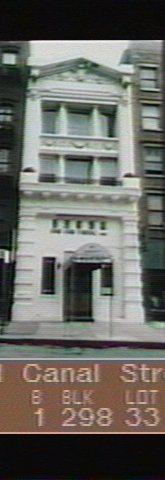
The city photographed every building for its tax records around 1940 and again in the 1980s. NYC Municipal Archives.
Written with AI from the source each entry cites, then fact-checked.
- 1885
A fire destroys the wooden house at 5 Ludlow Street, clearing the lot for a brick tenement
Before the present building, the Ludlow Street half of this corner site held a three-story wooden house. It burned in 1885, and the lot was bought by Patrick McManus of Bayville, New Jersey. With partners Isaac and Emeline Carr he had the ruin torn down and put up a five-story brick tenement in its place.
Source: Daytonian in Manhattan
- 1891
Architect M. Muller joins the tenements at 5 Ludlow and 41 Canal into one L-shaped building
In 1891 the Independent Kletzker Brotherly Aid Society, a mutual-aid group of Polish Jewish immigrants from the town of Kletz, planned its headquarters at 5 Ludlow Street. The Cahen family renovated its neighbor at 41 Canal at the same time, and on October 3 the Real Estate Record reported that architect M. Muller had the commission. He linked the two five-story buildings at the rear and gave them matching Neo-classical and Beaux Arts facades.
Source: Daytonian in Manhattan
- 1895
A pawn ticket from Moses Cahen & Son at 41 Canal Street exposes a son's burglary of his own parents
Moses Cahen & Son, pawnbrokers on the street level at 41 Canal, were drawn into a burglary gang in the spring of 1895. A Polish-born immigrant woman reportedly had as many as 40 boys working for her, among them 20-year-old Bernard Zuckerman. After he robbed his parents' East 109th Street apartment of silver candlesticks and a gold watch, he pawned the candlesticks here. The next day he left his parents a written confession and the pawn ticket, and they had him arrested.
Source: Daytonian in Manhattan
- 1909
Shots fired during an anti-Italian street fight wound a dry goods shopkeeper on Canal Street
On the night of February 22, 1909, four or five Italians walking along Canal Street were trailed by a crowd of men and boys who taunted them with slurs. Near Orchard Street the Italians turned to fight, and part of the crowd pushed into Nathan Goldman's dry goods store at 41 Canal. Three shots struck Goldman in the leg, and more shots outside wounded mail clerk Joseph Lispy. The crowd had dispersed before police arrived, and no arrests were made.
Source: Daytonian in Manhattan
- 1914
State banking officials shut Max Kobre's private bank at 41 Canal Street
Max Kobre bought 41 Canal in 1909 and the Ludlow Street half in 1911, and his private bank used the combined buildings. As World War I rattled finance in 1914, the New York Times reported on August 5 that the State Banking Department had closed the bank, and an examiner called it unsafe to continue. A bankruptcy petition followed on August 18. Tailor Morris Ludmire, who lost $1,500 in savings there, killed himself that December, his wife told police.
Source: Daytonian in Manhattan
- 1930
Zion Funeral Parlors lease two floors, a use that continues under later funeral homes
After the Kobre years the buildings housed apparel firms and, in the late 1920s, the International Bakery and Confectionery Workers Union. In September 1930 Zion Funeral Parlors leased two floors for $3,500 a year. As the Chinese population grew and Jewish residents left, the Hong Kong Funeral Home replaced it by 1993 and Boe Fook Funeral Services took over in 2004. Boe Fook was still operating here in 2015, and the old society's name could be seen under the peeling paint.
Source: Daytonian in Manhattan
Further reading
- Independent Kletzker Brotherly Aid Society-- No. 5 Ludlow StreetDaytonian in Manhattan
Nearby
- Metrograph7 Ludlow Street | 10 entries
- Chinatown Soup51 Canal Street | 3 entries
- Loew's Canal Street Theatre10 Ludlow Street | 7 entries
- Jarmulowsky Bank Building56 Canal Street | 12 entries
- Miguel Abreu Gallery36 Orchard Street | 4 entries
- Knickerbocker Station Post Office128 East Broadway | 4 entries