James A. Bailey House
10 St Nicholas Place | Sugar Hill | built 1888
Open on the map12 entries

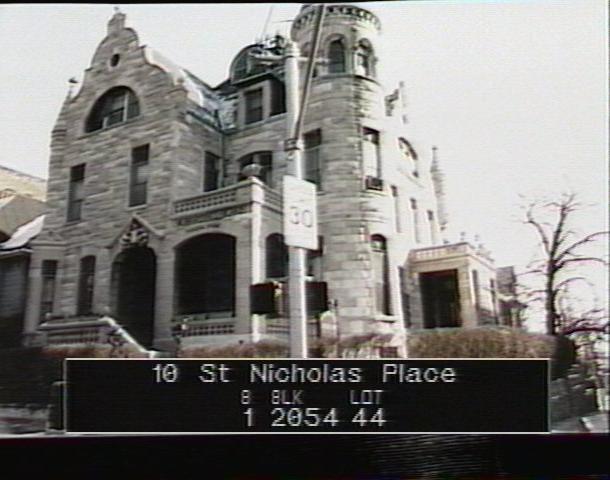
The city photographed every building for its tax records around 1940 and again in the 1980s. NYC Municipal Archives.
Written with AI from the source each entry cites, then fact-checked.
- 1886
Architect Samuel B. Reed unveils plans for Bailey's turreted mansion
The Record & Guide describes plans for a limestone house in "early English style" with a 69-foot corner turret, designed by New Jersey architect Samuel Burrage Reed. Circus owner James A. Bailey hired Joseph Burr Tiffany, cousin of Louis Comfort Tiffany, to design the interiors. Construction of the finished house and stable would run to about $160,000, and the house held 29 rooms across 8,250 square feet.
Source: Daytonian in Manhattan
- 1888
Circus impresario James A. Bailey completes his stone mansion on St. Nicholas Place
James A. Bailey, partner in the Barnum & Bailey Circus, bought the corner lot at 150th Street in 1886 and hired architect Samuel Burrage Reed. The rock-faced Romanesque Revival house, with a tall corner turret and 29 rooms, took two years to build and cost Bailey about $160,000. He owned it for only eleven years, selling in 1899.
Source: Daytonian in Manhattan
- 1888
Henry Belcher's stained glass fills the mansion, including windows no one can see from inside
Upwards of 100 stained glass windows and transoms in the house were made by Henry F. Belcher, who held at least 22 patents for his glass process; his company operated only from 1884 to 1890. The staircase landing carries a window with James Bailey's monogram, its letters reversed so they read correctly from outside. The round windows in the gables sit above the interior ceiling line, so they are hidden from the rooms below.
Source: Daytonian in Manhattan
- 1899
James Bailey sells his St. Nicholas Place mansion to Henry Acker
Barely a decade after completing his limestone castle, circus impresario James A. Bailey sold the house to Henry Acker while traveling in Europe. The mansion changed hands repeatedly in the following years, passing to contractor John C. Rodgers in 1904 and to chemist Dr. Louis Schaefer in 1910, whose estate was valued at more than $1.5 million at his death in 1912.
Source: Daytonian in Manhattan
- 1906
Police trace a fatal New Rochelle hit-and-run to the car of the mansion owner's son
After two elderly sisters were struck by a speeding automobile in New Rochelle on April 1, 1906, and both died, a witness's license number led to a car registered to John C. Rodgers Jr. His father, a millionaire contractor, owned the mansion, and investigators came to the St. Nicholas Place house that evening. The elder Rodgers walked his 20-year-old chauffeur, John Johnston, into the New Rochelle courthouse the next day, and on April 16 both Johnston and Rodgers Jr. were indicted for second-degree manslaughter.
Source: Daytonian in Manhattan
- 1912
Chemist Louis Schaefer dies in the mansion, leaving a will clause that pits two of his children against each other
Dr. Louis Schaefer, a German-born chemist who bought the house in April 1910, died there on November 26, 1912, after separating from his wife Olga in May 1911. His will let his unmarried children lease the home until 1931 for $1,000 a year and buy it for $60,000. His daughter Bertha, since married to Dr. Franz Koempel, said she wanted to buy it, while her brother Ludwig argued her marriage cost her the right to live there. A lawsuit followed.
Source: Daytonian in Manhattan
- 1916
The Koempels buy the mansion after a wartime inheritance dispute is settled
The war complicated settling the Schaefer estate: two heirs' husbands were at the front in the German army, and a large deposit in the London branch of a Berlin bank was seized by the British government. In January 1916 Ludwig and Bertha came to terms, and Bertha and Dr. Franz Koempel bought the mansion from the estate. Koempel kept his medical office on East 86th Street, and the couple remained in the house until 1950.
Source: Daytonian in Manhattan
- 1951
Marguerite Blake buys the "castle" and opens a funeral home
Marguerite Blake, who had wanted to own the mansion since she was a teenager, bought it in 1951 with her husband Warren, a police detective. For decades it housed the M. Marshall Blake Funeral Home. After a fire in 2000 the Blakes moved out, and in 2009 the house was sold for $1.4 million to new owners who began restoring it.
Source: Daytonian in Manhattan
- 1974
The Bailey House becomes a city landmark
The Landmarks Preservation Commission designated the James A. and Ruth M. Bailey House a New York City landmark on February 19, 1974, and it was added to the National Register of Historic Places in 1980. Its interior keeps stained-glass mosaic windows by Henry Belcher and hand-carved wood paneling from the 1880s.
Source: Wikipedia
- 2000
A small fire damages the mansion's upper floors and the Blakes move out
In 2000 a small fire on the upper floors led firefighters to break out several upper windows. By then Marguerite and Warren Blake had retired from the funeral home, and the elderly couple found it impossible to replace the windows or repair the increasingly leaky slate roof of the landmark. Not yet willing to sell, they moved out, and the empty property continued to deteriorate.
Source: Daytonian in Manhattan
- 2008
Marguerite Blake, 87, lists the decaying mansion for $10 million
At age 87, Marguerite Blake put the house on the market in 2008 for $10 million. Water kept seeping in through the roof and plaster had fallen from some ceilings, though much of the cabinetry, hardware and surviving stained glass remained intact. A writer for New York magazine who toured the house compared it to Grey Gardens. No buyer came forward.
Source: Daytonian in Manhattan
- 2009
Physical therapist Martin Spollen buys the mansion for $1.4 million and begins restoring it
On August 9, 2009, Martin Spollen, a physical therapist, and his wife Jenny bought the house for $1.4 million. They repaired the roof first, replacing the slate to match the original pattern, and hired glass conservators Tricia Somers and Victor Rothman to restore the sagging Belcher windows. The Spollens set up a woodworking shop in the basement, where Jenny's cousin Haihua Xu, a carpenter, reproduces missing or damaged wooden elements.
Source: Daytonian in Manhattan
Further reading
- James Bailey HouseWikipedia
- The James Bailey House - 10 St. Nicholas PlaceDaytonian in Manhattan
Nearby
- The Garrison Apartments435 Convent Avenue | 4 entries
- Carriage House Lofts457 West 150th Street | 4 entries
- Dance Theatre of Harlem466 West 152nd Street | 2 entries
- 409 Edgecombe Avenue4 entries
- Bethany Baptist Church303 West 153rd Street | 2 entries
- Jackie Robinson Pool and Recreation Center89 Bradhurst Avenue | 4 entries