409 Edgecombe Avenue
Sugar Hill | built 1917
Open on the map4 entries

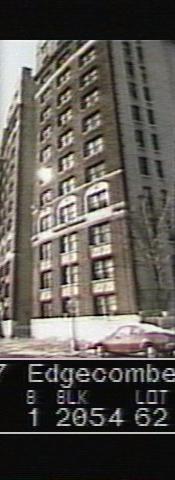
The city photographed every building for its tax records around 1940 and again in the 1980s. NYC Municipal Archives.
Written with AI from the source each entry cites, then fact-checked.
- 1917
Schwartz & Gross complete a 13-story building on Sugar Hill's hilltop
Schwartz & Gross, a firm known for its apartment houses, design 409 Edgecombe Avenue as a thirteen-story building with a curved, three-part facade. From its hilltop site it looks over Colonial Park, now Jackie Robinson Park, and the Harlem River. The building admits its first Black tenants in the late 1920s and is Sugar Hill's most prestigious address from the 1930s on.
Source: hdc.org
- 1944
W. E. B. Du Bois moves into 409 Edgecombe Avenue
The scholar W. E. B. Du Bois lived at 409 Edgecombe from 1944 to 1951. By then the 1917 building was known as the tallest and most exclusive apartment house on Sugar Hill's Edgecombe Avenue. Other residents over the years included NAACP leader Walter White, painter Aaron Douglas, journalist Marvel Cooke, who moved in in 1932, and lawyer Thurgood Marshall.
Source: aaihs.org
- 1951
Residents draft the "We Charge Genocide" petition to the United Nations
In 1951 the petition "We Charge Genocide," addressed to the United Nations, was drafted, edited and revised inside 409 Edgecombe. The same year the group Sojourners for Truth and Justice was founded in the building. The Civil Rights Congress and the Council on African Affairs also met there, and residents backed Benjamin J. Davis Jr.'s City Council campaigns and Du Bois's run for the U.S. Senate.
Source: aaihs.org
- 1993
The city designates 409 Edgecombe Avenue a landmark
The Landmarks Preservation Commission designated 409 Edgecombe an individual landmark on June 15, 1993. The 13-story building, designed by Schwartz & Gross in 1916–17 with a curved, three-part facade overlooking Jackie Robinson Park, opened to Black tenants in the late 1920s and was Sugar Hill's most prestigious address from the 1930s through the 1950s.
Source: hdc.org
Nearby
- Sugar Hill Development400 West 155th Street | 3 entries
- Bethany Baptist Church303 West 153rd Street | 2 entries
- Prince Hall Masonic Temple454 West 155th Street | 3 entries
- James A. Bailey House10 St Nicholas Place | 12 entries
- Dance Theatre of Harlem466 West 152nd Street | 2 entries
- Carriage House Lofts457 West 150th Street | 4 entries