Brooklyn Botanic Garden Laboratory Administration Building
1000 Washington Avenue | also 1000 Flatbush Avenue | Prospect Park | built 1930
Open on the map7 entries

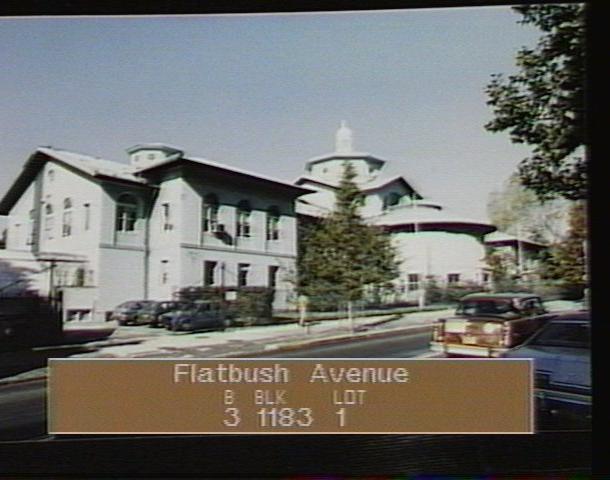
The city photographed every building for its tax records around 1940 and again in the 1980s. NYC Municipal Archives.
Written with AI from the source each entry cites, then fact-checked.
- 1911
Director C. Stuart Gager polls botanists on whose names to carve into the new laboratory
On March 10, 1911, Brooklyn Botanic Garden director C. Stuart Gager wrote to 28 colleagues asking them to vote for distinguished botanists of the past to be honored on the laboratory's exterior. The ballots produced 68 names, inscribed along a frieze and on window tablets, among them De Vries, Strasburger, Knight, Darwin and Linnaeus.
“On March 10, 1911, a letter went out from Gager, asking 28 colleagues to cast ballots for names of distinguished botanists of the past…”
- 1912
A contractor wins the job of building the laboratory's first section, and roof tiles are delayed
On January 18, 1912, Cockerill & Little Company, the lowest bidder, was awarded a $55,800 contract for the Laboratory Building's first section, the plant houses and the heating system. Work began that April, with 150 working days allowed. Floods in Akron, Ohio delayed the specified Spanish roof tiles, and steel was also hard to get, so the job ran behind.
“Cockerill & Little Company ... the lowest bidder on the project, was awarded a contract for $55,800 for the construction of the first section of the Laboratory Building…”
- 1912
William Kendall of McKim, Mead & White designs a Greek-cross laboratory modeled on Lombard churches
The Laboratory Administration Building was designed by William Kendall of McKim, Mead & White, who modeled it on small churches in Italy's Lombardy region. It is a Tuscan Revival building in a Greek cross plan with a cupola at the center. Its structure is concrete and brick, finished in stucco with terra-cotta detailing, and its design appears in the firm's published monograph of its work from 1879 to 1915.
“The building is modeled after small churches in the Lombardy region of Italy and is constructed in a Greek cross design with a cupola at the center of a symmetrical form.”
- 1913
Botanic Garden staff move from the Central Museum into the first section
From September 17 to 20, 1913, the Botanic Garden staff moved into the first section of the new laboratory building from temporary quarters in the Central Museum, which they had used since the fall of 1910. The garden's own journal reported that the section was already outgrown before anyone occupied it, and that a second section was urgently needed.
- 1916
Cornerstone laid for the second section after $100,000 in private money fills a city funding gap
By May 1915 the city's finances had stalled the needed expansion. The chairman of the garden's governing committee secured $100,000 in private funds, on the condition that the city appropriate matching corporate stock, and the city agreed. The cornerstone for the new section was laid on April 20, 1916, with Cockerill & Little again the general contractor, and the building was finished a year later.
“…the corner stone for this section of the Laboratory Building was laid on April 20, 1916.”
- 1942
McKim, Mead & White draw up a Washington Avenue addition that is never built
By 1942 the Laboratory Administration Building had outgrown its space, and McKim, Mead & White was called in again to design an extension on the Washington Avenue facade, estimated at about $200,000. The extension was never built because the city lacked funds.
“…the firm of McKim, Mead &White was again called upon to design an extension to the building on the Washington Avenue façade. ... Lack of City funds was the reason…”
- 2007
The Laboratory Administration Building becomes a New York City landmark
The Landmarks Preservation Commission designated the building a landmark on March 13, 2007, after a November 2006 hearing. Three people spoke in favor: the Botanic Garden's president, a Historic Districts Council representative and a representative of the Society for the Architecture of the City. City Councilmember Letitia James sent a letter of support, and the report notes that the building then held a botanical library, offices, and a visitors center and auditorium.
“Three people spoke in favor of designation including the President of Brooklyn Botanic Garden, and representatives of the Historic Districts Council and the Society for the Architecture of the City.”
Nearby
- Prospect Park Zoo450 Flatbush Avenue | 4 entries
- Lefferts Historic House452 Flatbush Avenue | 8 entries
- Brooklyn Museum200 Eastern Parkway | 8 entries
- Brooklyn Central Office, Bureau of Fire Communications35 Empire Boulevard | 4 entries
- Prospect Park Carousel454 Flatbush Avenue | 3 entries
- Bedford Union Armory1561 Bedford Avenue | 6 entries