Lefferts Historic House
452 Flatbush Avenue | also 95 Prospect Park West | Prospect Park | built 1931
Open on the map8 entries

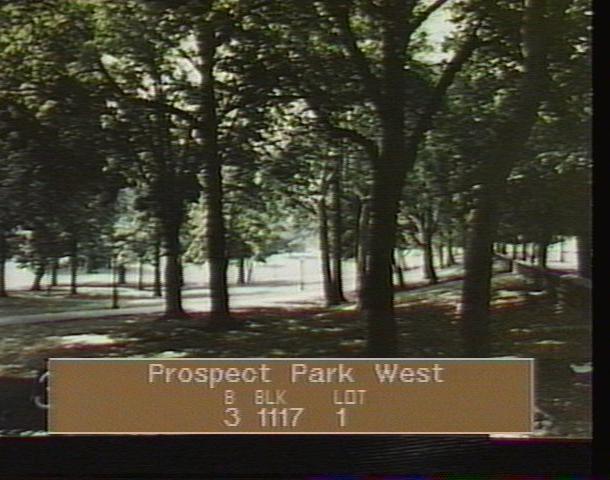
The city photographed every building for its tax records around 1940 and again in the 1980s. NYC Municipal Archives.
Written with AI from the source each entry cites, then fact-checked.
- 1783
Peter Lefferts builds a farmhouse to replace the homestead burned in the Battle of Flatbush
Lieutenant Peter Lefferts built the house between 1777 and 1783 at its original site, 563 Flatbush Avenue. It replaced the Lefferts homestead that the Americans burned in 1776 while fighting the British in the Battle of Flatbush. The builders reused some wood salvaged from the seventeenth-century house.
- 1783
A Dutch Colonial farmhouse with a flared gambrel roof and a door attributed to L'Enfant
The wooden farmhouse has a gambrel roof whose lower slope flares out over a long porch held up by six slender columns. Its back wall is shingled and the other walls clapboard. The landmark report notes a later Federal entrance with a Dutch door, attributed to Major L'Enfant.
- 1800
The census counts twelve enslaved people and eight Lefferts family members in the household
The 1800 census counted twelve enslaved people and eight Lefferts family members living in the household, which made the Leffertses one of the largest slaveholding families in Kings County. Enslaved people commonly lived in the same dwelling as those who enslaved them. Today the house museum hosts exhibits about the enslaved people who worked there.
Source: Wikipedia
- 1813
John Lefferts, who lived in the house, serves in Congress and a state convention
Peter Lefferts's son John lived in the house too. He served in the U.S. House of Representatives from New York in the Thirteenth Congress, which sat in 1813-15, and was a delegate to the New York State Constitutional Convention in 1821.
“John Lefferts, who also lived in this house, was a member of the U.S. House of Representatives from New York in the Thirteenth Congress (1813-15)…”
- 1881
Gertrude Lefferts Vanderbilt, who inherited the house, publishes The Social History of Flatbush
After Pieter Lefferts died, the house went to his son John, who added a large wing at the back in the 1850s. It then passed to John's daughter Gertrude Lefferts Vanderbilt. In 1881 she published The Social History of Flatbush, in which she wrote about her family, her community and the house.
“John's daughter Gertrude Lefferts Vanderbilt, who wrote about her family, her community and the house in her 1881 book, The Social History of Flatbush.”
Source: Wikipedia
- 1918
The house is moved six blocks into Prospect Park and opened as a museum
In 1917 John Lefferts's estate offered the house to the city on condition that it be moved onto city property. It was moved six blocks to Prospect Park in 1918, and preservationists removed the 1850s rear wing to emphasize its post-Revolutionary look. The Daughters of the American Revolution's Fort Greene chapter then opened it as a museum, with a cannon from Governor's Island in the front yard.
“The house was moved six blocks to Prospect Park. ... the Fort Greene chapter of the Daughters of the American Revolution opened the house as a museum…”
Source: Wikipedia
- 1965
A department store's plan for a children's farm beside the house ends up in court for years
In January 1965 Abraham & Straus announced it would fund a children's farm next to the house, to mark the park's centennial. Councilman Paul O'Dwyer sued to block it, and residents filed another suit claiming it was an advertisement for the store. A judge halted the project in 1967 because a Municipal Art Commission member who approved it was a former store employee. The injunction was lifted in early 1968 and the farm was dedicated in August 1971.
Source: Wikipedia
- 2023
A $2.5 million restoration of the house is completed and new exhibits open
By March 2021 the museum was closed while the Prospect Park Alliance restored the house's roof, exterior, drainage and paths. The $2.5 million project began in June 2021 and finished in May 2023. Afterward the museum began hosting exhibits on the area's native inhabitants and on the enslaved people who once worked at the house.
Source: Wikipedia
Further reading
- Lefferts Historic HouseWikipedia
Nearby
- Prospect Park Carousel454 Flatbush Avenue | 3 entries
- Prospect Park Zoo450 Flatbush Avenue | 4 entries
- Willink Entrance Comfort Station8 Ocean Avenue | 1 entry
- Brooklyn Central Office, Bureau of Fire Communications35 Empire Boulevard | 4 entries
- Brooklyn Botanic Garden Laboratory Administration Building1000 Washington Avenue | 7 entries
- Prospect Park Boathouse101 East Drive | 6 entries