Fillmore East
105 2nd Avenue | East Village | built 1926
Open on the map16 entries

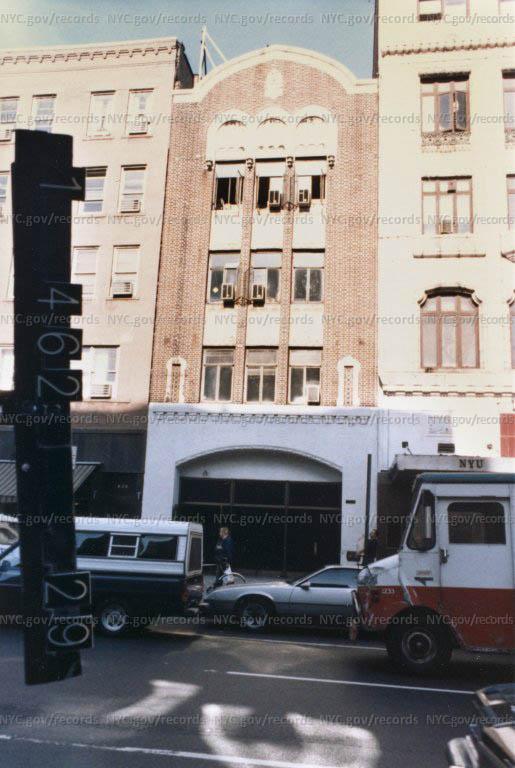
The city photographed every building for its tax records around 1940 and again in the 1980s. NYC Municipal Archives.
Written with AI from the source each entry cites, then fact-checked.
- 1915
A strikers' mob trashes the Crystal Palace Cafe and beats its owner on Second Avenue
Before the theater, a five-story building here held John Mikolaus's Crystal Palace Cafe. When waiters across the city struck in December 1915, his staff stayed loyal, and several hundred strikers pushed in, smashed mirrors, overturned tables and threw bricks through the windows. They beat Mikolaus outside, and his son fought them off until police reserves arrived. Eight men were arrested on grand larceny charges.
Source: Daytonian in Manhattan
- 1926
Harrison Wiseman's Yiddish theater opens on Second Avenue
Architect Harrison G. Wiseman designs a five-story theater and office building for the site, which opens as a 2,830-seat house presenting vaudeville during Second Avenue's years as the 'Jewish Rialto.' It does not last long as a Yiddish playhouse before the Loew's chain takes it over as the Loew's Commodore movie house.
Source: Daytonian in Manhattan
- 1928
Loew's hires two New York Giants ballplayers to draw crowds to the Commodore
Within a few years of opening, the Commodore had been taken over by Loew's, which mixed live acts with movies. In October 1928 the chain hired Giants players Andy Cohen and Shanty Hogan to appear on stage during the off-season. Their first appearances at Loew's Commodore Theatre were set for October 15.
Source: Daytonian in Manhattan
- 1931
Four thousand East Side children rally at the Commodore for unemployment relief
At the depth of the Depression, more than 4,000 East Side children from Jewish schools gathered at the Commodore Theatre for a meeting and a movie show on November 26, 1931. It marked the end of a children's campaign for unemployment relief. According to the New York Times, the children had visited 12,000 stores and 6,000 homes, and their pennies went to the unemployment relief fund.
Source: Daytonian in Manhattan
- 1956
A bomb scare at the Commodore comes amid a citywide wave of hoax threats
During the "Mad Bomber" panic of 1956, hoaxers flooded police with false threats, and on December 18 alone calls named a church, a hospital, Grand Central and many neighborhood movie theaters. A suspicious device sent police racing to the Commodore Theatre on Second Avenue near Sixth Street. The Times reported that it was a dud, and the chief of detectives ordered the bomb squad to stop answering alarms unless a device was found.
Source: Daytonian in Manhattan
- 1967
WOR-FM stages a rock concert at the Village Theatre for its first anniversary
In 1967 the radio station WOR-FM held a live music event at the Village Theatre to mark its first anniversary. The audience heard Janis Ian, the Doors, Richie Havens and the Blues Project, among others. The concert is described as the start of a new musical chapter for the venue, which Bill Graham Presents bought soon afterward and reopened as the Fillmore East in 1968.
Source: Daytonian in Manhattan
- 1968
Bill Graham opens the Fillmore East in a former Yiddish theater
The building went up in 1925–26 as the Commodore, a Yiddish theater designed by Harrison Wiseman, and later ran as a Loew's movie house and the Village Theatre. Promoter Bill Graham reopened it as the Fillmore East on March 8, 1968, with about 2,654 seats. It closed on June 27, 1971. The Allman Brothers Band recorded their breakthrough live album here in March 1971.
Source: Wikipedia
- 1968
Bill Graham lets the Black Panthers hold a controversial bail fundraiser at the Fillmore East
Soon after the Fillmore East opened, Bill Graham allowed it to host a fundraiser for the Black Panthers. The event raised bail money for Panther leader Eldridge Cleaver, who had recently declared himself a presidential candidate on the Peace and Freedom Party line. It was one of several community and political benefits the venue hosted and drew controversy at the time.
- 1969
GAY POWER, the city's first post-Stonewall gay newspaper, works from an office in the building
From September 1969 to June 1970, the newspaper GAY POWER operated from an office at 105 Second Avenue. Edited at first by John Heys and published by Joel Fabricant, it was New York's first gay paper after Stonewall. It ran 24 issues and carried work by Robert Mapplethorpe, Charles Ludlam and Taylor Mead, and by groups such as the Mattachine Society.
- 1970
Jimi Hendrix records Band of Gypsys live on stage
On New Year's Day 1970, Jimi Hendrix performed at the Fillmore East, and the recordings from his shows became the live album Band of Gypsys. The Fillmore East ran for just over three years under Bill Graham before closing in June 1971. In 2015 Village Preservation unveiled a plaque on the building marking its history.
Source: Wikipedia
- 1971
The Fillmore East closes after three years of rock shows
Bill Graham closes the venue with a final concert featuring the Allman Brothers Band, the J. Geils Band and Albert King, plus surprise guests. He cites the concert industry's shift toward big arena and stadium bookings, which his 2,654-seat hall cannot match.
Source: Wikipedia
- 1973
KISS rehearses in the empty hall before its first press event in January 1974
As KISS prepared for its first official show as a signed act, the band rented the former Fillmore East for rehearsals between December 24 and 30, 1973. It came back on January 8, 1974, for a press event to introduce itself. Manager Bill Aucoin said the band wanted to see how the press would react to the new shock-rock act.
“The band KISS, in preparation for their first "official" show as a signed, professional act, rented the Fillmore East for rehearsals from December 24 to December 30, 1973.”
Source: Wikipedia
- 1974
The hall reopens as the NFE Theatre with Bachman-Turner Overdrive
Promoter Barry Stuart reopens the shuttered rock hall as the NFE Theatre, short for 'New Fillmore East.' It is renamed Village East the following year, reportedly after Bill Graham objects to continued use of his venue's old name, and the rock-club revival proves short-lived.
Source: Wikipedia
- 1980
Bruce Mailman opens The Saint, a gay dance club under a planetarium dome
Bruce Mailman turned the old theater into The Saint, which opened on September 20, 1980. Its 4,800-square-foot circular dance floor sat under a planetarium-style dome with nearly 500 hidden speakers, and on a typical night about 4,000 men attended. AIDS devastated its membership, and the club held its final party from April 30 to May 2, 1988. The auditorium was demolished in 1996; the facade and lobby survive.
Source: NYC LGBT Historic Sites Project
- 1988
The Saint closes after a nonstop 48-hour party
Bruce Mailman's gay disco The Saint, with its planetarium dome and elaborate lighting, closed officially on May 2, 1988 after a 48-hour party. The building was used for a couple of years for occasional live events and then sat vacant until 1995, when the auditorium was demolished. Apartments called Hudson East now stand where it was, and a bank occupies the lobby.
- 2012
The former Fillmore East becomes part of a historic district
The building is included in the newly designated East Village/Lower East Side Historic District. The auditorium is later demolished for apartments while the Second Avenue lobby survives as a bank branch.
Source: Wikipedia
Further reading
- Fillmore EastWikipedia
- Remarkable History in an Unremarkable Building -- No. 105 2nd AvenueDaytonian in Manhattan
- 105 Second AvenueVillage Preservation: East Village Building Blocks
- The short life of a 1960s East Village rock venueEphemeral New York
Nearby
- 103 2nd Avenue2 entries
- Saul Birns Building107 2nd Avenue | 5 entries
- 101 2nd Avenue2 entries
- 115 2nd Avenue1 entry
- 238 East 6th Street3 entries
- 46 East 7th Street2 entries