Saul Birns Building
107 2nd Avenue | also 111 2nd Avenue | East Village | built 1928
Open on the map5 entries

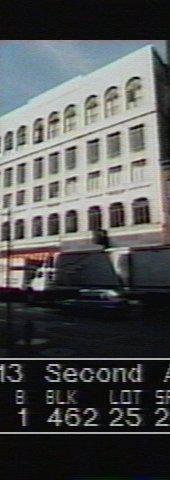
The city photographed every building for its tax records around 1940 and again in the 1980s. NYC Municipal Archives.
Written with AI from the source each entry cites, then fact-checked.
- 1928
Saul Birns builds an Art Deco palazzo for his phonograph business
Phonograph dealer and developer Saul Birns plans a skyscraper of twelve to fifteen stories to replace his Second Avenue headquarters, then scales the project back. The terra-cotta-clad building, designed by Ralph Segal, is begun in 1928 and finished the next year for $300,000, with Birns's name across the parapet. A fifth-floor auditorium with extra-high ceilings is rented out for weddings, dances, and meetings.
Source: Daytonian in Manhattan
- 1930
Depositors line up outside the building's failed bank branch
The Bank of the United States opens a branch at the south end of the ground floor in late 1928, sharing the retail space with Birns's phonograph store. After the 1929 crash the bank fails, and on December 22, 1930, about 500 depositors crowd the sidewalk, some since 4 a.m., after Clearing House banks arrange loans of up to half their balances.
Source: Daytonian in Manhattan
- 1934
Albert Einstein speaks at a Central Plaza Hall benefit
Albert Einstein is guest of honor and main speaker on April 1, 1934, at a meeting of the National Labor Committee for the Jewish Workers in Palestine. The evening of music and drama raises money for the Arlosoroff Memorial Fund, which aids Jewish settlers in Palestine. Through the 1930s the building's auditorium, Central Plaza Hall, also hosts union meetings and strike planning.
Source: Daytonian in Manhattan
- 1940
Central Plaza Hall hosts traditional jazz through the 1940s and 1950s
Through the 1940s and 1950s the building's Central Plaza Hall is a jazz haven. Promoter Jack Crystal, father of actor Billy Crystal, runs Jazz at the Plaza on Friday and Saturday nights with traditional stars such as Sidney Bechet, Wild Bill Davison, and Max Kaminsky. Two films, Jazz at the Plaza and Jazz Dance, are shot in the hall, and its rehearsal rooms later serve television and Broadway productions.
- 1974
Ratner's kosher restaurant closes after decades on the ground floor
Ratner's, a kosher vegetarian restaurant known for its blintzes and onion rolls, closes on May 28, 1974, after decades in the building's former Birns phonograph salesroom. Abraham Harmatz, who had helped manage it for 45 years, dies the next day, one day before his 66th birthday. The New York Times described it as one of the last places where the traditional Jewish waiter survived.
Source: Daytonian in Manhattan
Further reading
- The 1928 Birns Building -- 111 Second AvenueDaytonian in Manhattan
- 107-113 Second AvenueVillage Preservation: East Village Building Blocks
Nearby
- Fillmore East105 2nd Avenue | 16 entries
- 115 2nd Avenue1 entry
- 46 East 7th Street2 entries
- Kiev Restaurant117 2nd Avenue | 3 entries
- 103 2nd Avenue2 entries
- 238 East 6th Street3 entries