Public National Bank of New York Building
106 Avenue C | also 231 East 7th Street | East Village | built 1923
Open on the map7 entries

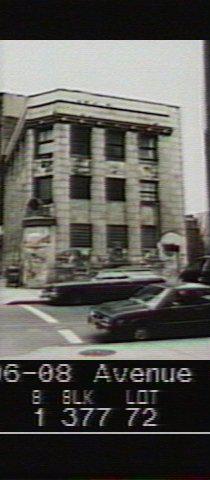
The city photographed every building for its tax records around 1940 and again in the 1980s. NYC Municipal Archives.
Written with AI from the source each entry cites, then fact-checked.
- 1922
The bank buys a three-story business building on the corner, then demolishes it to build anew
In September 1922 the New York Times reported that the Public National Bank had bought a three-story business building on the northeast corner of Avenue C and Seventh Street, to be altered as a branch. That earlier building stood on this lot. Instead of altering it, the bank had Eugene Schoen file plans in May 1923 for a new building costing an estimated $50,000. Demolition was finished in June 1923, and construction began later that month.
- 1923
Eugene Schoen completes a bank branch with Viennese-inspired terra cotta over the corner entrance
The two-story bank, about 23 by 49 feet, was finished in December 1923 by the contractor Leddy & Moore. It was fireproof, with brick walls clad in terra cotta over a steel frame, and light grey granitex above a polished granite base. Schoen's flat fluted pilasters and stylized cornice echo the Viennese architect Josef Hoffmann, and a colorful terra cotta cartouche with an eagle and a wreath, which originally held a clock, crowns the angled corner entrance.
- 1954
Grand Rabbi Isak Leifer's realty company buys the bank and turns it into the Stuyvesant Nursing Home
The bank sold the Avenue C branch in 1954 to the Stuymet Realty Corporation, whose president was Grand Rabbi Isak Leifer and whose vice president was Dr. Bernard Bergman. In 1954-55 the architect Henry G. Harris converted it into the Stuyvesant Nursing Home. He inserted a new floor between the old ground and second stories and added an entrance at the east end of the 7th Street side.
“…converted in 1954-55 into the Stuyvesant Nursing Home.”
- 1975
The former bank is tied to the nursing home scandal of Dr. Bernard Bergman, indicted for Medicare fraud
By 1975 the Stuyvesant Nursing Home had closed, and the building became linked to the scandal around Dr. Bernard Bergman, who with relatives and associates ran at least 70 nursing homes in three states. The most notorious was the Towers Nursing Home on Central Park West. State investigations of profiteering and patient abuse dragged on for years. Bergman was indicted in 1975 and later convicted of Medicare fraud.
“Bergman was indicted in 1975 and convicted of Medicare fraud.”
- 1977
After the blackout looting, the foreclosed former bank serves as a business assistance center
The city foreclosed on the former bank for unpaid taxes in 1977-78. In 1977, after the citywide power blackout that brought looting and vandalism, the building was used as a special business assistance center. The nursing home had by then closed, and the building passed to an artist a few years later.
“…used in 1977 as a special business assistance center after the city’s power blackout…”
- 1980
Artist Richard Artschwager and his wife Catherine Kord acquire the building, later converted to apartments
In 1980 the former bank was conveyed to Richard Artschwager, an artist and furniture craftsman, and his wife Catherine A. Kord. The city had foreclosed on the property for unpaid taxes a few years earlier. It was converted into apartments in the 1980s.
“…conveyed in 1980 to the noted artist and furniture craftsman Richard Artschwager…”
- 2008
The Landmarks Preservation Commission designates the former bank over its owner's opposition
The Landmarks Preservation Commission held its hearing on October 30, 2007, with five speakers in favor. They included City Councilmember Rosie Mendez and spokespeople for the Greenwich Village Society for Historic Preservation and the Historic Districts Council. The owner opposed designation. The commission designated the Public National Bank of New York Building a landmark on September 16, 2008.
Further reading
- 106 Avenue C; 231 East 7th StreetVillage Preservation: East Village Building Blocks
Nearby
- 356 East 8th Street2 entries
- 94 Avenue C2 entries
- Congregation Beth Hamedrash Hagadol Anshe Ungarn242 East 7th Street | 6 entries
- 366 East 8th Street1 entry
- 703 East 6th Street2 entries
- 368 East 8th Street1 entry