Congregation Beth Hamedrash Hagadol Anshe Ungarn
242 East 7th Street | East Village | built 1908
Open on the map6 entries

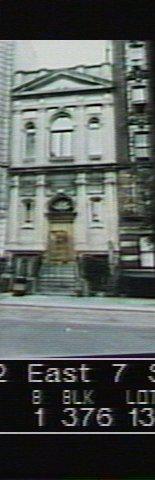
The city photographed every building for its tax records around 1940 and again in the 1980s. NYC Municipal Archives.
Written with AI from the source each entry cites, then fact-checked.
- 1883
Hungarian Jews form the congregation that will build this synagogue, with Rabbi Moses Weinberger as its first leader
Beth Hamedrash Hagadol Anshe Ungarn, a name meaning Great House of Study of the Hungarians, is founded in 1883 as Hungarian Jews arrive in large numbers. Its first rabbi, Moses Weinberger, had come from Hungary in 1880. The group meets at 48 Columbia Street, moves to 67 Ridge Street, and puts up its own building at 70 Willett Street in 1889, long before it reaches East 7th Street.
“…was founded in 1883 with the arrival in New York of large numbers of Hungarian Jews. Its first rabbi was Moses Weinberger (1854-1940)…”
- 1908
The congregation buys a three-story brick house and has Gross & Kleinberger rebuild it as a synagogue
In 1908 the congregation buys the lot from Lena Zeichner, who had purchased it two years earlier. The architects keep the old three-story brick house but strip off its front and rear walls, extending it 4 feet toward the street and 32 feet at the back. The new two-story synagogue, faced in stone, costs $10,000 and seats 500 people, a little fewer than the Willett Street building it replaces.
- 1908
Gross & Kleinberger give a lot under 25 feet wide a three-bay limestone front with Hebrew name plaques
The synagogue fills its narrow lot with a symmetrical three-bay limestone front, two stories over a raised basement. Shallow pilasters, dentil-edged cornices and a low pediment mark it as a place of worship among the rowhouses and tenements of the block. A stained-glass fan transom tops the central doorway, and stone plaques above the main-story openings carry the founding congregation's name and dates in Hebrew.
“Above each opening of the main story is a stone plaque engraved (in Hebrew) with the name and dates of the founding congregation.”
- 1975
The congregation abandons its synagogue after the last service as Hungarians drift away
Hungarians began moving north to Yorkville as the century advanced, and by 1910 about 17,000 lived there against 22,000 on the Lower East Side. Many old synagogues were abandoned or torn down as their members dispersed, but this congregation stayed. It holds its final service in 1975 and locks the doors, leaving the stone building empty for nine years.
Source: Daytonian in Manhattan
- 1984
A developer buys the empty synagogue and strips its interiors for apartments
A developer purchases the vacant building in 1984. Over a three-year renovation every trace of the 1908 interior is destroyed, and the space becomes five residences that a real estate agent would later call intimate. The stone facade, though, is left as built, so the building still reads as a synagogue from the sidewalk.
Source: Daytonian in Manhattan
- 2008
The Landmarks Preservation Commission designates the former synagogue after a hearing with no opposition
At a hearing on October 30, 2007, six speakers urge designation: Councilmember Rosie Mendez, along with representatives of City Lore, the Historic Districts Council, the Landmarks Conservancy and the Greenwich Village Society for Historic Preservation. No one speaks against it. On March 18, 2008, the Commission designates the building an individual landmark as a rare surviving small synagogue of the Lower East Side.
Further reading
- 242 East 7th StreetVillage Preservation: East Village Building Blocks
Nearby
- 703 East 6th Street2 entries
- 260 East 7th Street3 entries
- 94 Avenue C2 entries
- 262 East 7th Street3 entries
- Public National Bank of New York Building106 Avenue C | 7 entries
- 263 East 7th Street4 entries