Former Episcopal Residence
106 Franklin Street | Tribeca | built 1868
Open on the map4 entries

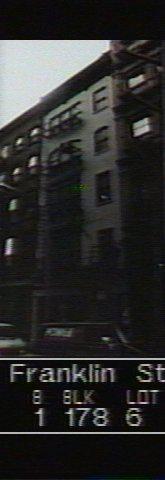
The city photographed every building for its tax records around 1940 and again in the 1980s. NYC Municipal Archives.
Written with AI from the source each entry cites, then fact-checked.
- 1844
Bishop Benjamin Onderdonk's son advertises the Franklin Street house for lease as scandal builds
No. 106 was the residence of Benjamin Treadwell Onderdonk, the Episcopal Bishop of New York. On March 26, 1844 his son William placed one newspaper advertisement offering the three-story house for lease, with its parlor mirrors, and another seeking a country home. The bishop was then at the center of a scandal: after the Arthur Carey ordination dispute, affidavits from women alleging improper advances led to a House of Bishops trial that ended in his suspension.
Source: Daytonian in Manhattan
- 1861
Bishop Onderdonk dies and receives full honors at Trinity Church despite years of disgrace
Benjamin Onderdonk, who had lived at 106 Franklin Street, died on April 30, 1861. Though he had been barred from his duties for over a decade, Trinity Church was draped in black for his funeral and several hundred clergymen attended. His stone sarcophagus there shows him lying with a foot on a serpent labeled "Scandal." His daughter Elizabeth's funeral had been held in the Franklin Street parlor in May 1853.
Source: Daytonian in Manhattan
- 1866
A masonry dwelling becomes an Italianate loft, and an 1888 alteration adds a wide window bay
Between 1866 and 1868 the masonry dwelling owned by Hugh Doherty at 106 Franklin Street was converted into an Italianate store and loft building. In 1888 the architect George Edward Harding altered the facade for Thomas S. Clarkson, adding a three-part window bay at the west side to bring more light into the lofts. Iron lintels above those windows carry rosettes.
“…created a tripartite window bay with iron mullions at the west portion of the facade to increase light in the loft areas…”
- 1935
George Wood, Sons & Co. bids on Army towels, having supplied the Marines in World War I
R. D. Wood & Sons moved into 106 Franklin Street in 1872 and, as George Wood, Sons & Co., had shifted from iron to textiles by the early 20th century. In World War I it won government contracts to supply towels to the Marine Corps. On November 21, 1935 The New York Times reported that it had bid to supply the Army with cotton huck towels and on 394,652 yards of linings, felt and padding for army clothing.
Source: Daytonian in Manhattan
Further reading
- Religious Scandal, Military Towels, and Designer Handbags - 106 Franklin StreetDaytonian in Manhattan
Nearby
- 104 Franklin Street5 entries
- James Talcott Company Building108 Franklin Street | 5 entries
- 102 Franklin Street2 entries
- 98 Franklin Street1 entry
- Franklin Furnace building112 Franklin Street | 6 entries
- 114 Franklin Street5 entries