James Talcott Company Building
108 Franklin Street | also 110 Franklin Street | Tribeca | built 1861
Open on the map5 entries

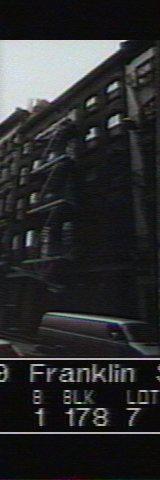
The city photographed every building for its tax records around 1940 and again in the 1980s. NYC Municipal Archives.
Written with AI from the source each entry cites, then fact-checked.
- 1861
Ann Richardson and William Bowne replace two small structures with a brownstone loft
The building at 108-110 Franklin Street, put up in 1861 for the seamstress Ann Richardson and William Bowne, was raised as two structures sharing a central party wall, replacing two smaller ones. Above the cast-iron ground floor, the brownstone facade has six bays of arched windows per story with keystoned lintels and a stone cornice. Address plates are still attached to some of the storefront piers.
“…constructed as two structures with a central party wall in 1861 for Ann Richardson, a seamstress, and William Bowne…”
- 1868
Dry goods merchant James Talcott moves his business into 108-110 Franklin Street
James Talcott entered business in 1854 as the New York selling agent of a knitting mill in New Britain, Connecticut, and became a dry goods merchant in 1859. In 1868 he moved into the building at 108-110 Franklin Street, where the firm remained until 1911. Late in the century he turned to textile factoring and later branched into coal.
Source: Wikipedia
- 1879
Talcott convenes a committee in his Franklin Street office to plan better tenements
In 1879 James Talcott announced a plan for a stock company to build tenement houses on an improved plan, hoping to draw ten or more millionaires as investors. The buildings were to offer better light and air, plus playgrounds and courtyards. A committee met in his Franklin Street office, and it told reporters the idea might be ahead of its time but had the support of tenement residents eager to leave their cramped quarters.
Source: Daytonian in Manhattan
- 1889
Talcott closes his store for a day after the head of his woolen department dies of diphtheria
William H. Allen Jr., aged 40, had run the woolen department of James Talcott's store at 108-110 Franklin Street for several years. He died suddenly of diphtheria on the evening of Monday, December 23, 1889. The next day Talcott closed the business out of respect to his employee's memory.
Source: Daytonian in Manhattan
- 1911
Talcott leaves Franklin Street for Fourth Avenue as the dry goods trade moves uptown
James Talcott, who had occupied 108-110 Franklin Street since 1868, moved to 225 Fourth Avenue in 1911, giving in to the uptown drift of business. The city's landmark report counts him among the dry goods merchants leaving the Tribeca district in the early 20th century, though a 1913 map of the dry goods district still centered on Tribeca.
Further reading
- The James Talcott Co. Bldg -- Nos. 108-110 Franklin StreetDaytonian in Manhattan
Nearby
- Franklin Furnace building112 Franklin Street | 6 entries
- Former Episcopal Residence106 Franklin Street | 4 entries
- 114 Franklin Street5 entries
- 104 Franklin Street5 entries
- 13 White Street3 entries
- 9 White Street2 entries