Church of St. Francis Xavier
1065 Van Nest Avenue | also 1703 Lurting Avenue | Morris Park | built 1955
Open on the map4 entries

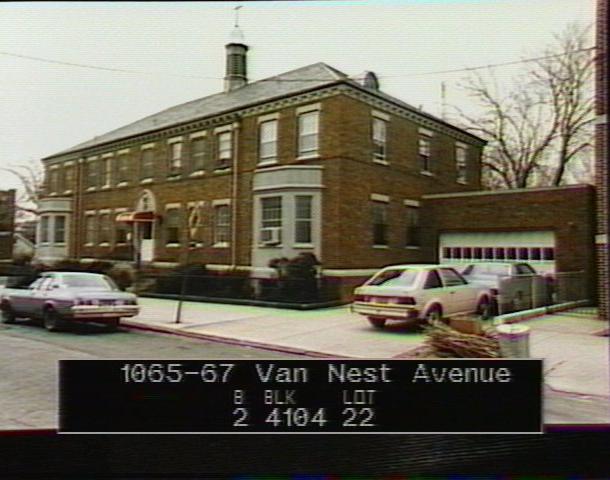
The city photographed every building for its tax records around 1940 and again in the 1980s. NYC Municipal Archives.
Written with AI from the source each entry cites, then fact-checked.
- 1928
Father James E. Kearney founds St. Francis Xavier parish in two portable buildings
The Rev. James Edward Kearney organized the parish in 1928, naming it for the Jesuit missionary Francis Xavier, and started out with two portable structures serving as a makeshift church and auditorium. He led the parish until his 1932 appointment as Bishop of Salt Lake City and was later Bishop of Rochester.
“…founding this parish first "using two portable structures as a temporary church and auditorium.”
Source: Wikipedia
- 1951
Cardinal Spellman blesses the new St. Francis Xavier church before more than 1,000 people
In 1951 the parish put up a new church at the corner of Lurting and Van Nest Avenues in Morris Park. Cardinal Spellman blessed and rededicated the building at a ceremony attended by more than 1,000 people.
“Cardinal Spellman blessed and re-dedicated the church building with more than 1000 people attending the ceremony.”
Source: Wikipedia
- 1951
The new church takes its look from thirteenth-century Italian Gothic, not postwar modernism
Rather than the plain modernist brick boxes typical of postwar churches, St. Francis Xavier was designed after thirteenth-century Italian Gothic models. Its low gabled nave and square tower with a hipped roof have pointed-arch windows and doors, and the red brick walls are trimmed in white limestone. White stone statues stand above the main entrance gable and on the upper stage of the tower.
Source: Wikipedia
- 1951
The Kilgen Organ Company designs its Opus 7529 for the new church
The church's pipe organ was designed in 1951 by the Kilgen Organ Company, the successor to Geo. Kilgen & Sons of St. Louis. Catalogued as Kilgen's Opus 7529, the instrument has two manuals, 18 stops and 16 ranks of pipes.
Source: Wikipedia
Further reading
- St. Francis Xavier's Church (Bronx)Wikipedia
Nearby
- Church of St. Clare of Assisi1025 Rhinelander Avenue | 2 entries
- St. Raymond's Church1759 Castle Hill Avenue | 4 entries
- Calvary Hospital1740 Eastchester Road | 4 entries
- Church of Our Lady of Solace731 Morris Park Avenue | 2 entries
- Huntington Free Library and Reading Room9 Westchester Square | 9 entries
- St. Peter's Chapel (BAAD!)2474 Westchester Avenue | 4 entries