Huntington Free Library and Reading Room
9 Westchester Square | Westchester Square | built 1883
Open on the map9 entries

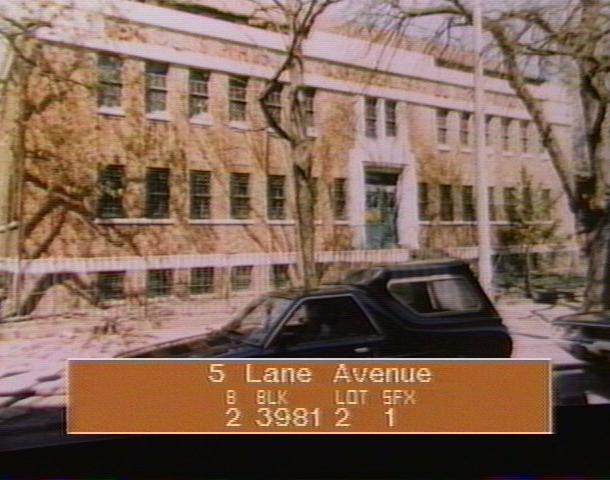
The city photographed every building for its tax records around 1940 and again in the 1980s. NYC Municipal Archives.
Written with AI from the source each entry cites, then fact-checked.
- 1880
Tobacco merchant Peter C. Van Schaick dies and leaves $15,000 for a free reading room in Westchester
The library began with a bequest. Peter C. Van Schaick, a retired Throggs Neck resident who had run the New York tobacco firm Van Schaick, Adams & Company, died on February 24, 1880. His will, mostly generous to Episcopal charities, also reserved $15,000 to put up a free reading room that would be handed to the people of Westchester once it was finished.
“$15 ,000 from his estate was to be set aside for the erection of a free reading room which was to be donated to the citzens of Westchester…”
- 1882
Frederick Clarke Withers designs the red brick Van Schaick Free Reading Room
The reading room went up in 1882-83 to designs by Frederick Clarke Withers, and few of his other works in the city still stand. Withers was best known for showy High Victorian Gothic, but here, late in his career, he returned to the plain one-color brick and off-balance massing of his earlier Gothic Revival designs; meanwhile the simple forms and round-arched tower entrance recall H.H. Richardson. No library had been built in the area before it.
“…designed by the prominent architect, Frederick Clarke Withers, and is one of his few surviving works in New York City…”
- 1885
Westchester voters unanimously turn down the finished library as too costly to run
The building stood complete, but the town's leaders balked at its $1,200 yearly upkeep. On August 27, 1885, the executors made one last offer so they could close the estate, and the townspeople rejected it unanimously. A New York Times editorial days later scolded the town for shortsightedness, and the American Architect and Building News called it a miscarriage of generosity. The building then sat empty for several years.
“…on August 27, 1885, the executors made a final attempt to get the townspeople to accept the building and close the estate, but the gift was rejected unaminously…”
- 1890
Collis P. Huntington takes over the empty library and erases Van Schaick's name from it
When railroad magnate Collis P. Huntington took over the vacant building, the record of Van Schaick's gift was wiped away. The dates on the tower's terra-cotta rondels were changed from 1882 to 1890, and the plaque naming the Van Schaick Free Reading Room was swapped for one reading Huntington Free Library and Reading Room. The dedication's souvenir pamphlet and a Times article even credited the whole building to William Anderson, a little-known local Bronx architect.
- 1891
Huntington dedicates the library, hoping its game room will lure men away from saloons
After adding a two-and-a-half-story rear wing at an estimated $40,000 and endowing its upkeep, Collis P. Huntington dedicated the library on October 7, 1891. In his speech he urged young people to choose the right path early and said he hoped the basement game room would pull some men out of the drinking saloons. He closed by declaring the library open to every creed and nationality alike.
- 1892
Booker T. Washington signs the reading room's visitors register
The library's original visitors register still sits on its own stand in the reading room and is still used. Its first signature dates from 1891, before the library formally opened. Among the names in it is Booker T. Washington, who signed in as a visitor in 1892 and again in 1894.
“Booker T. Washington registered as a visitor in 1892 and 1894.”
Source: Wikipedia
- 1901
A police patrolman carves a wooden model of the library on his lunch breaks
Patrolman John H. Jones spent his lunch breaks in 1901 in the park across the street carving a wooden sculpture of the library. The carving now rests on top of a bookshelf inside, among furnishings that are largely original, including a 1917 Tiffany grandfather clock and an early Woodstock electric typewriter.
“A wood sculpture of the library, carved by Patrolman John H. Jones in 1901, during his lunch breaks in the park across the street…”
Source: Wikipedia
- 1930
Archer M. Huntington builds an annex here for the Museum of the American Indian's library
Collis Huntington's adopted son Archer, founder of the Hispanic Society of America, was a friend of George Heye, whose Museum of the American Indian needed room for its growing book collection. In 1930 Archer built a separate three-story annex, 40 by 82 feet, on the library's Westchester Square property to hold the collection. Its holdings on the native peoples of the Americas became a leading research resource.
- 2012
Boardwalk Empire films scenes in the old reading room
The reading room keeps its turn-of-the-century character, with much original furniture, a map case and card catalog still in use, three disused fireplaces and the piping of the original gas lighting. In July 2012 the television series Boardwalk Empire shot scenes inside it.
“Scenes for the television series Boardwalk Empire were shot in the reading room in July, 2012.”
Source: Wikipedia
Further reading
Nearby
- St. Peter's Church, Westchester2500 Westchester Avenue | 5 entries
- St. Peter's Chapel (BAAD!)2474 Westchester Avenue | 4 entries
- Herbert H. Lehman High School3000 East Tremont Avenue | 4 entries
- St. Raymond's Church1759 Castle Hill Avenue | 4 entries
- Calvary Hospital1740 Eastchester Road | 4 entries
- Church of St. Francis Xavier1065 Van Nest Avenue | 4 entries