Solomon R. Guggenheim Museum
1070 5th Avenue | also 2 East 89th Street, 1072 5th Avenue, 1071 5th Avenue | Carnegie Hill | built 1959
Open on the map20 entries

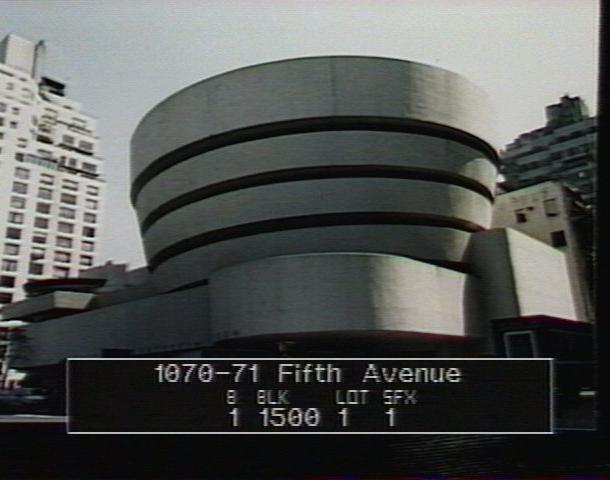
The city photographed every building for its tax records around 1940 and again in the 1980s. NYC Municipal Archives.
Written with AI from the source each entry cites, then fact-checked.
- 1943
Frank Lloyd Wright is hired to design a museum for non-objective art
In 1943 collector Solomon Guggenheim and curator Hilla Rebay commissioned Frank Lloyd Wright to design a permanent home for their collection of non-objective painting. Wright's spiral design was unveiled publicly in 1945, but construction stalled for over a decade amid rising costs and Guggenheim's death in 1949.
Source: Wikipedia
- 1946
Engineer Jaroslav Polivka proposes a structural fix for Wright's spiral ramp
Wright's spiral ramp was based on a trigonometric curve that created structural and cost problems. In 1946 the Czechoslovak-born civil engineer Jaroslav J. Polivka offered a solution, showing in tests on a six-inch section that the ramp's curve gave it the integrity of a shell. The coved inner edge added stiffness, and two interior circular shafts reinforced the ramp. This scheme was eventually dropped in favor of twelve concrete webs spaced thirty degrees apart around the ramp.
“A solution, however, was offered to the architect in 1946 by Jaroslav J. Polivka ... a Czechoslovak-born civil engineer…”
- 1948
The Guggenheim collection moves into a remodeled house at 1071 Fifth Avenue
While the museum waited to be built, Hilla Rebay and the architect William Muschenheim remodeled the six-story building at 1071 Fifth Avenue in 1948 to house the collection. It stood on the future museum site and was one of two buildings left standing there in 1956. Solomon Guggenheim died late in 1949 without seeing Wright's museum.
- 1952
Founding curator Hilla Rebay resigns amid a dispute over the museum's direction
Hilla Rebay, the museum's founding director and a champion of strictly non-objective art, resigned in March 1952 after clashing with the Guggenheim family's trustees over what the museum should exhibit. The institution was renamed the Solomon R. Guggenheim Museum that same year, honoring its late founder.
Source: Wikipedia
- 1953
Wright builds a pavilion and Usonian house on the future museum site for a traveling show
In 1953 Wright erected a pavilion and a Usonian House on the future Guggenheim site for the traveling exhibit 'Sixty Years of Living Architecture: The Work of Frank Lloyd Wright.' The report lists them among his New York projects, with the Hoffman Jaguar showroom on Park Avenue in 1954 and the inflatable Air House at the Coliseum in 1957.
- 1954
Builder George Cohen finds a cheap way to pour and spray Wright's curved walls
No builder wanted the job until Edgar Tafel, a former Wright apprentice, introduced the architect to George N. Cohen of the Euclid Contracting Corporation in August 1954. They settled on pouring the ramp slabs in reinforced concrete and spraying layers of Gunite against plywood forms from inside to make the outer walls. In October 1958 the surface was coated with a vinyl skin called Cocoon, first used in World War II to protect guns and aircraft.
- 1956
Demolition starts on the two buildings that stood on the museum site
In May 1956 crews began tearing down the two buildings still on the site: a vacant 13-story structure at 1070 Fifth Avenue and the six-story building at 1071 that had housed the collection. Construction began in October and drew steady coverage in newspapers and professional journals. The scaffolding came off in August 1958, and the exterior was coated that October.
- 1956
Twenty-one artists, including de Kooning and Motherwell, protest Wright's design
In 1956 twenty-one artists, among them Willem de Kooning and Robert Motherwell, wrote to the foundation's trustees and to director Sweeney. They complained that the design showed little sympathy for displaying painting and sculpture. Urban historian Lewis Mumford later judged the building unfavorably, though many published evaluations were positive.
- 1959
Frank Lloyd Wright's spiral Guggenheim Museum opens on Fifth Avenue
Solomon R. Guggenheim's foundation, which opened its first museum on East 54th Street in 1939, hired Frank Lloyd Wright in June 1943. The design took him 15 years and more than 700 sketches. Wright died in April 1959, six months before the building was formally dedicated on October 21, 1959, a day after a preview for the press.
Source: Wikipedia
- 1962
Director Thomas Messer's first big show wrestles with sloping floors and a Calder mobile
Soon after taking over, Thomas Messer mounted a large 1962 show combining the museum's paintings with sculptures lent from the Hirshhorn collection. The sloping floor and curved walls produced optical illusions around three-dimensional work. A smaller 1961 show had taught him to build plinths at special angles, but that was impossible for an Alexander Calder mobile, whose wire hung at a true vertical.
“…one piece, an Alexander Calder mobile whose wire inevitably hung at a true plumb vertical…”
Source: Wikipedia
- 1965
The Thannhauser Wing opens in the museum's monitor for a loan of 75 paintings
In 1963 Justin K. Thannhauser made a permanent loan of seventy-five Impressionist and Post-Impressionist paintings. Taliesin architect William Wesley Peters remodeled the second floor of the monitor to receive them, and the Thannhauser Wing opened in 1965. Thannhauser's father had sponsored the first Blue Rider show, in Munich in 1911.
- 1966
A two-cent stamp honoring Frank Lloyd Wright shows the Guggenheim in its background
The U.S. Post Office issued a two-cent Frank Lloyd Wright stamp in Spring Green, Wisconsin, on June 8, 1966, with the Guggenheim Museum in the background. Taliesin apprentice Patricia Amarantides designed it, with suggestions from Wright's widow and others. It was the fifth item in the Prominent Americans series.
- 1990
The Landmarks Commission designates the Guggenheim a New York City landmark
The Landmarks Preservation Commission designated the Guggenheim Museum and its site a city landmark on August 14, 1990, after a public hearing on December 12, 1989. Twenty-seven witnesses spoke in favor, including three representatives of the foundation, and none opposed. The report calls it Wright's only major commission in New York City and his most visited building.
“Twenty-seven witnesses ... spoke in favor of designation. No witnesses spoke in opposition to designation.”
- 1992
A ten-story annex tower by Gwathmey Siegel is completed
The institution, first called the Museum of Non-Objective Painting, was renamed the Solomon R. Guggenheim Museum in 1952, three years after its founder's death. In 1992 it completed a major renovation of Wright's building that included a 10-story annex tower designed by Gwathmey Siegel & Associates.
Source: Wikipedia
- 1993
Landmarks Commission refuses a sign for donor LeFrak and the museum loses $8 million
In December 1993 Samuel J. LeFrak announced a $10 million donation, the biggest cash gift the museum had received, and the Fifth Avenue building was to be renamed for him and his wife. The Landmarks Preservation Commission repeatedly refused to let the museum put his name on a sign outside. LeFrak then rescinded $8 million of his gift.
“LPC ... repeatedly refused to allow officials to place a sign with LeFrak's name outside the building. Consequently, LeFrak rescinded $8 million…”
Source: Wikipedia
- 2007
Heirs of a Berlin banker seek restitution of a Picasso in the Guggenheim's collection
In 2007 relatives of the Berlin banker Paul von Mendelssohn-Bartholdy asked the museum to return Picasso's Le Moulin de la Galette (1900), claiming he had been forced to sell it by the Nazis. In 2009 the museum and the heirs settled the lawsuit, and Judge Jed Rakoff criticized the secrecy of the agreement.
Source: Wikipedia
- 2008
Jenny Holzer's tribute marks the end of a $29 million restoration
The museum celebrated the end of a restoration that began in September 2005 by premiering Jenny Holzer's tribute For the Guggenheim on September 22, 2008. The work repaired cracks and leaks and modernized systems while the museum stayed open. The $29 million project was funded by the foundation's trustees, the city, the state and MAPEI Corporation.
“On September 22, 2008, the Guggenheim celebrated the project's completion with the premiere of artist Jenny Holzer's tribute For the Guggenheim.”
Source: Wikipedia
- 2016
Maurizio Cattelan installs a working 18-karat gold toilet in a museum restroom
Maurizio Cattelan's America, a fully functional replica of a toilet cast in 18-karat gold, was installed in the museum's fourth-floor restroom in September 2016. It was the first piece Cattelan had shown since his 2011 retrospective at the Guggenheim. The museum said the work winks at the excesses of the art market while evoking the American dream of opportunity for all.
Source: cbsnews.com
- 2018
The Guggenheim answers a White House Van Gogh request by offering the gold toilet
When the Trump White House asked to borrow a Van Gogh painting, the museum's curator Nancy Spector offered Cattelan's gold toilet instead, as reported in January 2018. In her reply she wrote that the artist would like to lend it to the White House long term.
Source: cbsnews.com
- 2019
UNESCO lists the Guggenheim as a World Heritage Site
The Landmarks Preservation Commission designated the museum a city landmark on August 14, 1990. In 2019 UNESCO added the building to its World Heritage List as part of "The 20th-Century Architecture of Frank Lloyd Wright." It was the last major work Wright designed; he died six months before it opened.
Source: Wikipedia
Further reading
- Solomon R. Guggenheim MuseumWikipedia
Nearby
- Huntington House (former National Academy of Design)3 East 89th Street | 6 entries
- Church of the Heavenly Rest2 East 90th Street | 9 entries
- Cooper Hewitt, Smithsonian Design Museum (Carnegie Mansion)2 East 91st Street | 13 entries
- St. Thomas More Church59 East 89th Street | 8 entries
- Spence School22 East 91st Street | 6 entries
- Neue Galerie1048 5th Avenue | 11 entries