Cooper Hewitt, Smithsonian Design Museum (Carnegie Mansion)
2 East 91st Street | also 1095 5th Avenue | Carnegie Hill | built 1901
Open on the map13 entries

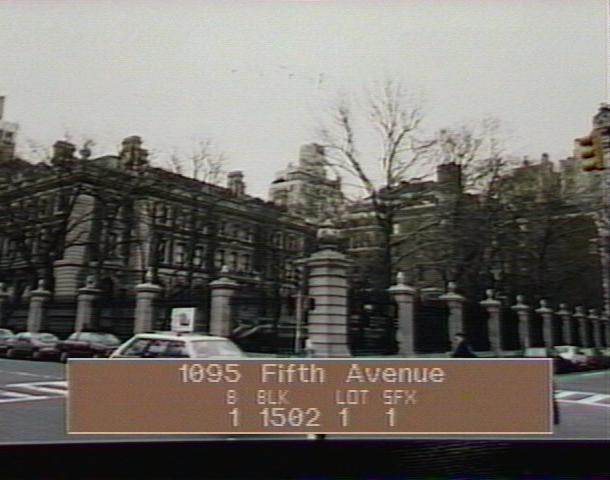
The city photographed every building for its tax records around 1940 and again in the 1980s. NYC Municipal Archives.
Written with AI from the source each entry cites, then fact-checked.
- 1899
Babb, Cook & Willard win the competition to design Carnegie's mansion
In March 1899, Andrew Carnegie chose the firm Babb, Cook & Willard to design his new mansion at Fifth Avenue and 91st Street, opting for a restrained Georgian Revival style with Beaux-Arts touches instead of the ornate French chateaux favored by other Gilded Age tycoons. The finished house, completed in 1902 at an estimated cost of $1.5 to $2.5 million, held a steel superstructure, five electric elevators, and a 3,000-pipe Aeolian-Skinner organ.
Source: Wikipedia
- 1902
Andrew Carnegie moves into his new mansion on Fifth Avenue
Andrew and Louise Carnegie moved into this 64-room Georgian Revival mansion, designed by Babb, Cook & Willard and built from 1899 to 1902, on December 12, 1902, arriving by ocean liner from Skibo Castle. The house was among the first homes with a steel frame and a private Otis elevator. Carnegie died in 1919 and Louise in 1946.
Source: Wikipedia
- 1902
Carnegie's new mansion cleans, warms and humidifies its own air
When the Carnegies settled in, the house carried engineering that was advanced for 1902. A central system drew in outdoor air, filtered it, warmed or cooled it and set its humidity, while a separate filter purified the drinking water. Two large Babcock & Wilcox steam boilers supplied direct heat, smaller boilers served the conservatory and domestic hot water, and the Landmarks Preservation Commission later singled these systems out as especially notable.
“An ingenious heating and ventilating system brought in air from the outside, filtered it, heated or cooled it, and adjusted the humidity to the proper level.”
- 1902
Carnegie orders a spare for every system so the mansion's machinery has a backup
Cooper Hewitt's history of the house describes a residence full of new technology: steel-frame construction, several electric elevators, a fully electrified laundry, and air conditioning able to heat, cool and humidify individual rooms. Carnegie had a duplicate ordered for each system. The twin boilers could each carry 200 pounds of steam pressure, and a separate steam boiler ran the hot-water heater and laundry in summer, because the family was away in Scotland and the main boilers had been shut down for the season.
Source: cooperhewitt.org
- 1902
Carnegie runs his giving, including $60 million for public libraries, from the mansion
Andrew Carnegie was 67 when he moved into the house in 1902, a few months before it was officially complete. He had by then sold his steel holdings to the newly formed U.S. Steel Corporation, and the Landmarks Preservation Commission describes the mansion as the home from which he administered his American philanthropy. The largest part of that giving was the $60 million he gave toward public library buildings.
“He then retired to his new home from which he administered his extensive American philanthropic activities, the largest and most notable being the $60,000,000 that he gave for public library buildings.”
- 1915
An anarchist attempts to bomb the Carnegie mansion
In 1915, an anarchist attempted to plant a bomb at Andrew Carnegie's Fifth Avenue mansion, but a patrolman extinguished its fuse before it could explode. Carnegie continued living in the house until his death in 1919. His widow, Louise Carnegie, remained there until her own death in June 1946, when she bequeathed the mansion to the Carnegie Corporation of New York.
Source: Wikipedia
- 1919
Margaret Carnegie marries Roswell Miller in the house, and her father dies later that year
Margaret Carnegie, the couple's only child, married Roswell Miller at the mansion in 1919. Andrew Carnegie died later that same year, and Louise Carnegie stayed on in the house. In May 1920 she bought the McAlpin house next door at 9 East 90th Street for the couple, and the two homes were joined by an internal passage so that she could see her daughter every day.
Source: Wikipedia
- 1946
Louise Carnegie dies and the Carnegie Corporation offers the house to the United Nations
Louise Carnegie died in June 1946 and left the mansion to the Carnegie Corporation of New York. The Corporation had no use for the house itself, so in late 1946 it proposed leasing it to the United Nations as a clubhouse and as offices for the Secretariat. The offer was still open in 1948, but the UN never moved in.
Source: Wikipedia
- 1949
Columbia University's School of Social Work moves into the mansion
Columbia University's School of Social Work occupied the Carnegie mansion from 1949 to 1971, using the family's former home for classrooms and offices. The Carnegie Corporation of New York, which had inherited the property from Louise Carnegie, then gave the house to the Smithsonian Institution in 1972. The Cooper-Hewitt Museum opened there in 1976, after renovations by Hardy Holzman Pfeiffer Associates.
Source: Wikipedia
- 1974
The city designates the Carnegie Mansion a landmark but not the house at 9 East 90th Street
The Landmarks Preservation Commission designated the mansion a landmark on February 19, 1974, after a 1970 hearing at which eight witnesses spoke in favor of designation and none opposed the mansion's. The Carnegie Corporation objected to also protecting the house at 9 East 90th Street, and the Smithsonian's secretary, S. Dillon Ripley, wrote that he was not persuaded it deserved landmark status. Only the mansion and its site were designated; the Corporation had given the property to the Smithsonian in 1972.
“There were no speakers in opposition to designation of the Carnegie Mansion. The Carnegie Corporation opposed the designation of 9 East 90th Street House…”
- 1976
The Cooper-Hewitt design museum opens in the Carnegie Mansion
Columbia University's School of Social Work used the mansion from 1949 to 1971. The Carnegie Corporation then gave the house to the Smithsonian Institution in 1972, and the Cooper-Hewitt Museum, the Smithsonian's museum of design, opened to the public here on October 7, 1976. After a major renovation it reopened in 2014.
Source: Wikipedia
- 1995
Cooper-Hewitt closes its galleries for a renovation that brings elevators to the mansion
In the early 1990s the mansion was not fully accessible, and its director, Dianne Pilgrim, who used a wheelchair, had to enter through a service entrance. She announced in May 1995 that the galleries would close, and work began that August. Crews rebuilt the 91st Street entrance, added elevators to the mansion and the 90th Street townhouses, and joined the buildings with a two-story connection. The first-floor galleries reopened in September 1996, and the project was finished in 1998.
“Pilgrim, who used a wheelchair, had to use a service entrance. ... The 91st Street entrance was rebuilt, and elevators were installed…”
Source: Wikipedia
- 2014
Cooper Hewitt reopens after a $91 million renovation, 112 years to the day after the Carnegies moved in
The galleries closed in July 2011, and thirteen firms helped redesign the house, with Diller Scofidio + Renfro reworking the exhibition spaces. The project added a freight entrance, a cafe, a larger gift shop and a new third-floor gallery, while a planned restaurant was dropped because digging into the bedrock would have cost $7 million. The budget grew to $91 million, and the museum reopened on December 12, 2014, the anniversary of the Carnegies' move into the house.
“The museum reopened on December 12, 2014, the 112th anniversary of the Carnegies' move into the house.”
Source: Wikipedia
Further reading
- Andrew Carnegie MansionWikipedia
Nearby
- Spence School22 East 91st Street | 6 entries
- James A. Burden House7 East 91st Street | 8 entries
- Otto Kahn House1100 5th Avenue | 12 entries
- John Henry Hammond House9 East 91st Street | 15 entries
- Church of the Heavenly Rest2 East 90th Street | 9 entries
- Nightingale-Bamford School20 East 92nd Street | 5 entries