Washington Murray House
11 East 12th Street | Greenwich Village | built 1900
Open on the map6 entries

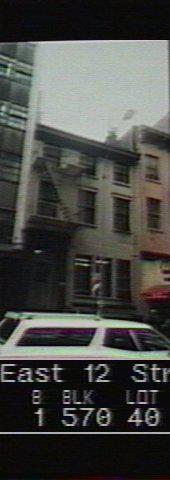
The city photographed every building for its tax records around 1940 and again in the 1980s. NYC Municipal Archives.
Written with AI from the source each entry cites, then fact-checked.
- 1850
A whalebone dealer's family lives in the 25-foot-wide Greek Revival house at 11 East 12th Street
By the early 1850s Emanuel Velleman, who sold whalebone for corsets from an office on William Street, had moved his family into the brick house. It was two and a half stories tall, with a stoop and a doorway framed by Corinthian pilasters and sidelights. The location, half a block from Fifth Avenue and two blocks below Union Square, was a fashionable one, and the doorway still survives largely intact.
Source: Daytonian in Manhattan
- 1865
Lawyer Washington Murray joins a committee to raise money for a Lincoln statue in Union Square
Washington Murray, a Harvard-trained lawyer, lived here with his wife Eliza from about 1857. In April 1865, a week after Abraham Lincoln was assassinated, he sat on the finance committee formed to pay for a statue of the president in nearby Union Square. Murray had also been named a commissioner of the city's Board of Education the year before. He died in September 1867 at age 39.
Source: Daytonian in Manhattan
- 1873
Two women who live at 11 East 12th Street serve as delegates to a missionary league
In 1873 and 1874 two residents, a Mrs. Mills and a Miss E. McVickar, were active in the Niobrara League of New York, a branch of the Episcopal Church's Woman's Auxiliary that raised money for missions among Native Americans. The league met monthly at the Church of the Transfiguration and had 27 member churches that year. Village Preservation notes that its aims included pressing European-American ways on Native women.
Source: Village Preservation
- 1886
Painter J. Alden Weir buys the house for $27,500
Julian Alden Weir and his wife Anna bought the house in September 1886 for $27,500. Weir, born in 1852 and trained at the National Academy of Design and in Paris, kept a studio six blocks south at The Benedick on Washington Square. In 1910 he had the house updated and leased it to a tenant, and his daughter sold it in 1921.
Source: Daytonian in Manhattan
- 1933
The painter Reginald Marsh lives on the upper floors while a patent-medicine firm works below
In the early 1930s the lower levels were in business use, with the Dr. Cheeseman Medicine Co. here by 1931, while the painter Reginald Marsh lived on the upper floors. Marsh was born in Paris to artist parents and came to New York in the early 1920s. His subjects were everyday people at places like Coney Island and the Bowery.
Source: Daytonian in Manhattan
- 1933
The Federal Trade Commission charges the Dr. Cheeseman Medicine Co. with fraudulent pill advertising
E. R. Siering ran the Dr. Cheeseman Medicine Co. from the house by 1931 and advertised Dr. Cheeseman's Pills in a farm magazine as a relief for women with delayed periods. In 1933 the Federal Trade Commission filed a complaint over the ads. The complaint charged that the pills were not harmless, lacked any health-giving powers, and carried no guarantee under the Pure Food and Drugs Act, contrary to what the ads claimed.
Source: Daytonian in Manhattan
Further reading
- The Washington Murray House - 11 East 12th StreetDaytonian in Manhattan
Nearby
- Strip House13 East 12th Street | 4 entries
- Jonathan L. Hyde House22 East 13th Street | 6 entries
- G. Gennert Building24 East 13th Street | 6 entries
- Fairchild Publishing Building10 East 13th Street | 6 entries
- 55 Fifth Avenue (Brookdale Center)55 5th Avenue | 8 entries
- Peter R. Bonnett House6 East 12th Street | 5 entries