G. Gennert Building
24 East 13th Street | also 26 East 13th Street | Greenwich Village | built 1910
Open on the map6 entries

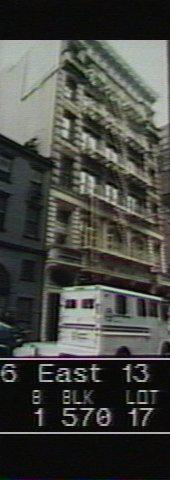
The city photographed every building for its tax records around 1940 and again in the 1980s. NYC Municipal Archives.
Written with AI from the source each entry cites, then fact-checked.
- 1889
A bartender playing with a revolver shoots a man who lives at 24 East 13th Street
Francis Doyle, 22, lived in the house at No. 24 and stopped at a saloon at 58 University Place before 9 a.m. on August 26, 1889. The bartender, Ernest Schultz, was snapping the hammer of a .38 revolver, and on the third snap it fired, hitting Doyle in the chest. Schultz was arrested, and Doyle recovered at New-York Hospital.
Source: Daytonian in Manhattan
- 1893
The photographic supplier G. Gennert builds a six-story Beaux Arts store-and-loft building
Gottlieb Gennert and his brother came from Germany and in 1854 set up one of America's first photographic supply houses, on Maiden Lane. By 1892 the firm, run by Gottlieb Gennert's sons Maurice and Gustav, had outgrown its East 10th Street space and bought Doyle's house and No. 26. The new building had polished granite columns, two electric elevators and buff brick with terra cotta, and a trade journal called it a model of its kind.
Source: Daytonian in Manhattan
- 1896
Gennert's Montauk camera is offered as a prize in an architectural-drawing competition
Gennert not only sold photographic goods but invented some, among them a line of Montauk cameras. In May 1896 The Brochure Series of Architectural Illustration noted that its Architectural Montauk Photographic Camera was third prize in a competition. The model for serious photographers cost $65, or about $1,500 today.
Source: Daytonian in Manhattan
- 1905
Strong vibrations on the sixth floor are traced to printing presses in a building 190 feet away
In spring 1905 tenants threatened to leave over vibrations. After investigation the cause turned out to be the presses of the Carey Printing Company, 190 feet to the west, shaking the three- and four-story houses between. A court order made Carey adjust its machinery, and an engineer's inspection found Gennert's building sound, which the Engineering Record credited to its mill-type construction.
Source: Daytonian in Manhattan
- 1905
The Architectural Record praises leaded glass by Heinigke and Bowen, a stained-glass firm with an office upstairs
One of Gennert's upstairs tenants was Heinigke and Bowen, whose leaded-glass windows made for George Gould's Lakewood, New Jersey, summer home won praise from The Architectural Record in July 1905. The firm was formed in 1890 by Otto Heinigke and Owen J. Bowen, who had worked with Tiffany and La Farge. According to the article, the firm supplied all of the stained glass for both the Library of Congress and the Woolworth Building.
Source: Daytonian in Manhattan
- 1914
Gustave Gennert testifies for the government that Eastman Kodak controls 80 percent of the photographic business
As the government pursued Kodak, Gustave Gennert appeared as a witness on June 25, 1914. He said Kodak held 80 percent of the nation's photographic business, and that European firms refused to sell him paper materials because he was not tied to Eastman. In August 1921 his company filed a treble-damage suit for $6,000,000 against Kodak.
Source: Daytonian in Manhattan
Further reading
- The 1893 G. Gennert Bldg -- Nos. 24-26 East 13th StreetDaytonian in Manhattan
Nearby
- Jonathan L. Hyde House22 East 13th Street | 6 entries
- Strip House13 East 12th Street | 4 entries
- Washington Murray House11 East 12th Street | 6 entries
- Erskine Press Building17 East 13th Street | 4 entries
- 15 East 13th Street5 entries
- Baumann Brothers Furniture and Carpets Store22 East 14th Street | 12 entries