Milbank House
11 West 10th Street | also 13 West 10th Street | Greenwich Village | built 1900
Open on the map4 entries

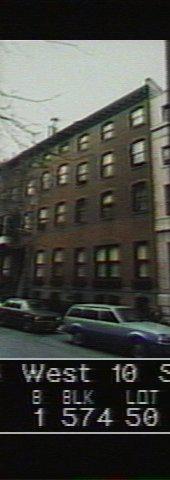
The city photographed every building for its tax records around 1940 and again in the 1980s. NYC Municipal Archives.
Written with AI from the source each entry cites, then fact-checked.
- 1847
Broker Richard Henry Winslow builds a Greek Revival house at what is now 11 West 10th Street
Winslow, a Wall Street broker who helped originate the railroad bond business with partner James F. D. Lanier, built the 28-foot-wide, brick-faced house in 1847 and bought the vacant lot beside it for a garden. By 1852 his firm was negotiating $1.6 million in sales in a single day. He died in 1861 at age 55.
Source: Daytonian in Manhattan
- 1888
Architect Ernest Flagg remodels the house and adds a one-story wing
Flagg gave the Greek Revival house a more Italianate doorway, new ironwork, and segmentally arched openings, and attached a one-story addition. The family living there then began using the address 11 West 10th Street in place of 13. The addition was raised to full height in 1919, with the detailing matched to the original.
Source: Daytonian in Manhattan
- 1918
The house opens as a Red Cross nurses' home during World War I
Joseph Smith Auerbach and his wife, Catharine, offered their home to the Red Cross during the war. A Nurses Home opened there with music and speeches, and The Sun described a big dancing room and a separate reading and writing room. The Junior League was to serve tea every afternoon.
Source: Daytonian in Manhattan
- 1919
Jeremiah Milbank buys the house for the Ladies' Christian Union
The Sun reported on January 3, 1919 that Jeremiah Milbank had bought the house from the Auerbachs as a gift to the Ladies' Christian Union, which planned a home for young women as a memorial to his wife. Known as Milbank House, it was run by the union as housing for unmarried women until 1994. By then, according to the New York Times, $130 a week covered a small room and two meals a day.
Source: Daytonian in Manhattan
Further reading
- Milbank House - 11-13 West 10th StreetDaytonian in Manhattan
- Then & Now photos: Milbank HouseVillage Preservation: Greenwich Village Then & Now
Nearby
- Arthur J. Peabody House15 West 10th Street | 4 entries
- Milbank House11A West 10th Street | 3 entries
- Rectory of the Church of the Ascension7 West 10th Street | 2 entries
- 18 West 11th Street5 entries
- Joseph H. Coates House16 West 11th Street | 4 entries
- Jacob R. Pentz House14 West 11th Street | 3 entries