Arthur J. Peabody House
15 West 10th Street | Greenwich Village | built 1846
Open on the map4 entries

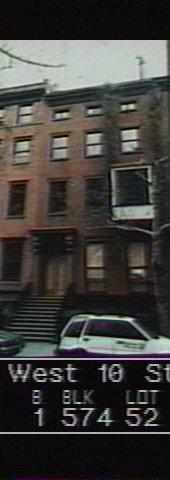
The city photographed every building for its tax records around 1940 and again in the 1980s. NYC Municipal Archives.
Written with AI from the source each entry cites, then fact-checked.
- 1847
Morris Ketham completes a row of Greek Revival houses on West 10th Street
Ketham, a Wall Street broker who also owned a New Jersey iron works, began a row of four houses on West 10th Street in 1846 and finished them in 1847. The house then numbered 61, now 15, was sold to the Fairfield County Bank, while James Grosvenor bought the other three. It stood three and a half stories tall and 26 feet wide, with a brownstone-framed entrance and squat attic windows.
Source: Daytonian in Manhattan
- 1871
Arthur J. Peabody marries and probably moves into the house
Arthur John Peabody, a member of the publishing firm Charles Scribner & Co., married Eleanor Elliot Russell on May 9, 1871. The couple may have moved into No. 15 soon after, and they had four children. The house most likely got its Italianate newels, fencing, cornice, and hooded entrance under the Peabodys.
Source: Daytonian in Manhattan
- 1912
Beech-Nut founder Bartlett Arkell buys the house
Arkell, founder and president of the Beech-Nut Company, bought the house from the Peabody heirs in December 1912 for $38,000. He was credited with revolutionizing the packing of fruit and vegetables by moving from glass jars to vacuum-packed cans, and the firm added chewing gum in 1909. His widow, Louise, stayed in the house until her death in 1970.
Source: Daytonian in Manhattan
- 1914
Architect Clarence Sefert adds a copper-clad bay window
In summer 1914 Arkell and his wife hired architect Clarence Sefert to change the windows and add, at the second floor, a copper-clad bay. Inside, a window seat was formed by long panels of diamond-paned windows. The facade today remains essentially as it was after that bay went in.
Source: Daytonian in Manhattan
Further reading
- The Arthur J. Peabody House - 15 West 10th StreetDaytonian in Manhattan
- Then & Now photos: 15 West 10th StreetVillage Preservation: Greenwich Village Then & Now
Nearby
- Milbank House11 West 10th Street | 4 entries
- Milbank House11A West 10th Street | 3 entries
- 18 West 11th Street5 entries
- Rectory of the Church of the Ascension7 West 10th Street | 2 entries
- Joseph H. Coates House16 West 11th Street | 4 entries
- Jacob R. Pentz House14 West 11th Street | 3 entries