Judge Building
110 5th Avenue | also 1 West 16th Street | Flatiron | built 1890
Open on the map4 entries

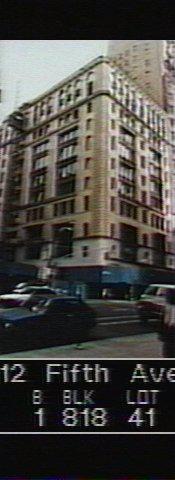
The city photographed every building for its tax records around 1940 and again in the 1980s. NYC Municipal Archives.
Written with AI from the source each entry cites, then fact-checked.
- 1890
McKim, Mead & White design the Goelet family's Judge Building
McKim, Mead & White designed the eight-story building for the Goelet family, completed in 1890 in an arcaded Renaissance Revival style with a two-story granite base and buff brick upper floors. Enormous carved lions' heads glowered from the cornice above Fifth Avenue. The building took its lasting name from Judge magazine, which was printed inside.
Source: Daytonian in Manhattan
- 1891
Recording pioneer Gianni Bettini sells early phonograph cylinders from the top floor
By the early 1890s, Gianni Bettini occupied the Judge Building's top floor, selling serious musical recordings featuring performers such as Sarah Bernhardt and Mark Twain. His specialized cylinder business declined after 1902, once mass-produced recordings from larger manufacturers took over the market.
Source: Wikipedia
- 1898
Publisher William Arkell folds three magazines into the Arkell Publishing Company here
Judge magazine, founded in 1881, moved into the purpose-built Fifth Avenue building after publisher William J. Arkell and the Goelet brothers assembled the site. In 1898, Arkell merged Judge with Leslie's Weekly and Demorest's Family Magazine to form the Arkell Publishing Company, which ran roughly 100,000 circulating copies from the building's upper floors.
Source: Daytonian in Manhattan
- 1985
The New York Times Company buys the Judge Building and restores its facade
The New York Times Company acquired the Judge Building in 1985 and later leased space to Family Circle magazine. A mid-1980s restoration replaced the deteriorated metal cornice with fiberglass and rebuilt third-floor arches that had been lost decades earlier.
Source: Wikipedia
Further reading
- Judge BuildingWikipedia
- The 1890 Judge Building - 110-112 Fifth AvenueDaytonian in Manhattan
Nearby
- 87 5th Avenue3 entries
- Corn Building91 5th Avenue | 4 entries
- Annin Building85 5th Avenue | 5 entries
- 95 5th Avenue2 entries
- Margaret Sanger Clinic17 West 16th Street | 4 entries
- 75 5th Avenue1 entry