Vivian Beaumont Theater and Library for the Performing Arts
111 Amsterdam Avenue | also 150 West 65th Street, 40 Lincoln Center Plaza, 119 Amsterdam Avenue | Lincoln Square | built 1964
Open on the map11 entries

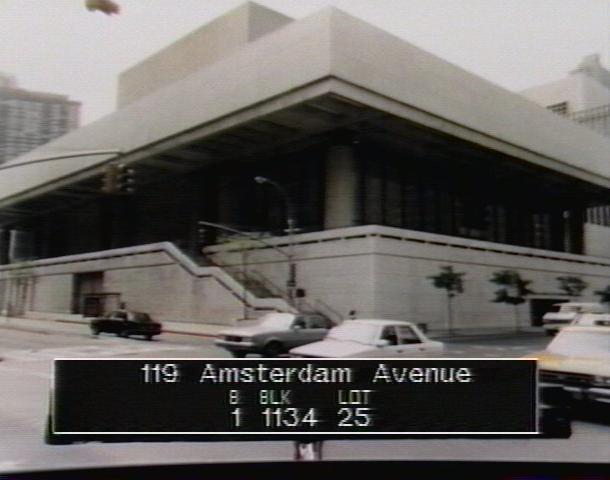
The city photographed every building for its tax records around 1940 and again in the 1980s. NYC Municipal Archives.
Written with AI from the source each entry cites, then fact-checked.
- 1958
Eero Saarinen is chosen to design the Vivian Beaumont Theater
Lincoln Center selects architect Eero Saarinen in November 1958 to design its repertory theater, with Gordon Bunshaft designing the adjoining library and Jo Mielziner brought on for the interiors. Vivian Beaumont Allen's $3 million gift that May helps fund construction, though she dies in late 1962 before the building is finished.
Source: Wikipedia
- 1965
The Vivian Beaumont Theater opens with Danton's Death
Eero Saarinen designed the building, with Broadway designer Jo Mielziner shaping the interior around a flexible thrust stage. Heiress and former actress Vivian Beaumont Allen gave $3 million in 1958 but died before the theater opened on October 21, 1965, with Georg Büchner's Danton's Death. Lincoln Center Theater has run it since 1985, with hits including Anything Goes (1987), South Pacific (2008) and The King and I (2015).
Source: Wikipedia
- 1965
The New York Public Library for the Performing Arts opens
Sharing the building with the Beaumont, the library opened on November 30, 1965, the fourth building at Lincoln Center to open. Its research divisions cover music, dance, theater and recorded sound, including the Billy Rose Theatre Division and the Rodgers and Hammerstein Archives of Recorded Sound, founded at the opening, and it holds about 4.5 million photographs. A $38 million renovation in 1998–2001 merged its reading rooms.
Source: Wikipedia
- 1967
A basement stage opens, later renamed for Mitzi Newhouse
A second, smaller stage opens in the Beaumont building's basement as the Forum Theater on November 10, 1967. It is renamed the Mitzi E. Newhouse Theater in 1972 in honor of the patron who helped fund it.
Source: Wikipedia
- 1977
Joseph Papp announces he will stop running the Beaumont, citing its costs
In June 1977 Joseph Papp said he would no longer operate the Beaumont, pointing to rising costs and limits on artistic freedom. The Cherry Orchard had to close early in August. The prior season had produced $6.2 million in operating debt against only $3.9 million in ticket sales, even though many shows reached 97 percent of capacity. Lincoln Center's directors warned that the theater could stay dark for two years.
Source: Wikipedia
- 1982
I. M. Pei quits the Beaumont renovation over an acoustics dispute
A planned $6.5 million renovation of the Beaumont's stage and seating fell apart in early 1982. Architect I. M. Pei and acoustician Cyril Harris could not agree on the proscenium opening's acoustic and aesthetic features, and Pei resigned in February. Frederick Koch then withdrew his $1 million pledge, and in November the Fan Fox and Leslie R. Samuels Foundation pulled its $4 million as the estimate rose to $8 million.
“Pei resigned from the project in February 1982 after he was unable to propose a design with which Harris agreed.”
Source: Wikipedia
- 1985
Lincoln Center Theater announces its return after four dark years, starting small in the Newhouse
Gregory Mosher, head of the new Lincoln Center Theater Company, announced that plays would return on December 20 with two David Mamet one-acts, The Shawl and Prairie du Chien, in the small downstairs Newhouse. John Guare's The House of Blue Leaves was to follow in February. The 1,140-seat Beaumont would not reopen until fall 1986.
Source: The New York Times
- 1987
A revised Anything Goes opens at the Beaumont and runs 804 performances
Lincoln Center Theater's revised version of Cole Porter's Anything Goes premiered at the Beaumont in October 1987 and played 804 times across roughly two years. The run lasted so long that the company housed its whole 1988-89 season at the Lyceum Theatre instead. The Beaumont's 1989-90 season consisted of just two shows, a revival of Paddy Chayefsky's The Tenth Man and a transfer of Some Americans Abroad.
“…a revision of Cole Porter's musical Anything Goes, opened in October 1987 and ran for 804 performances over the next two years.”
Source: Wikipedia
- 1995
A $500,000 sound system with 88 ceiling speakers goes in after Arcadia's actors go unintelligible
Tom Stoppard's Arcadia had left its performers at times unintelligible, thanks to dead spots and odd echoes in the hall. About two months before the Times report of December 1995, and before David Hare's Racing Demon, the theater installed a $500,000 computerized sound system. It combines a cluster of microphones with 88 speakers in the ceiling.
Source: The New York Times
- 1995
The Beaumont announces its biggest makeover, a $4.7 million overhaul of air, lighting and ramps
In December 1995 Lincoln Center Theater said it would close the Beaumont at the end of the month for six to eight months of work estimated at $4.7 million, the biggest single project since the house opened 30 years earlier. Plans covered new heating, ventilation and air-conditioning, lighting grids, catwalks and ramps for handicapped access. The difficult sightlines and thrust-and-proscenium stage were left alone; Joseph Papp had once called the house one of the great fiascoes of theater construction.
Source: The New York Times
- 2012
The Claire Tow Theater opens as a fourth stage above the Beaumont
Lincoln Center Theater adds a 112-seat theater, the Claire Tow Theater, on the Vivian Beaumont building's roof in June 2012, giving the company a stage dedicated to work by emerging playwrights, directors, and designers.
Source: Wikipedia
Further reading
- Vivian Beaumont TheaterWikipedia
Nearby
- Metropolitan Opera House80 Columbus Avenue | 11 entries
- Samuel B. and David Rose Building160 West 66th Street | 3 entries
- Juilliard School and Alice Tully Hall1941 Broadway | 9 entries
- David Geffen Hall100 Columbus Avenue | 11 entries
- Fiorello H. LaGuardia High School100 Amsterdam Avenue | 12 entries
- David H. Koch Theater20 Lincoln Center Plaza | 11 entries