David H. Koch Theater
20 Lincoln Center Plaza | also 105 West 62nd Street | Lincoln Square | built 1964
Open on the map11 entries

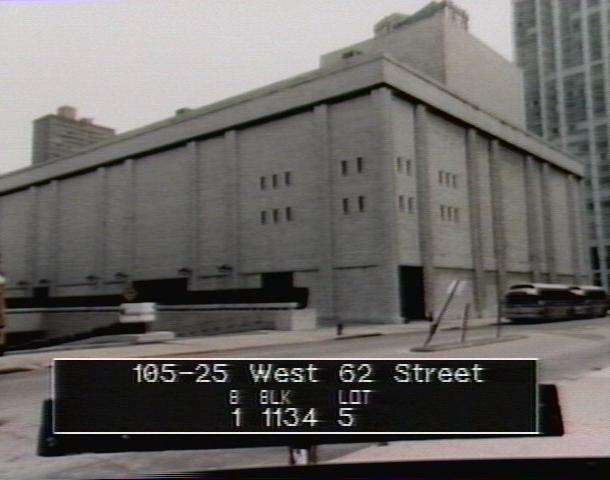
The city photographed every building for its tax records around 1940 and again in the 1980s. NYC Municipal Archives.
Written with AI from the source each entry cites, then fact-checked.
- 1964
Construction workers and their wives are the first audience, at a dress rehearsal
Building the theater took two years, 51 subcontractors, 1,000 construction workers and $19.3 million, and it finished on time and on budget. The crews and their wives were invited to the New York City Ballet's first dress rehearsal in the new house on Saturday, April 18, 1964, five days before the opening gala, so they were the first to see a performance there. The all-Balanchine bill featured Raymonda Variations, Agon and Western Symphony.
Source: nycballet.com
- 1964
Jasper Johns's monumental Numbers hangs in the east lobby, its panels sized by a choreographer's foot
The east lobby holds Jasper Johns's "Numbers, 1964," a monumental work of Sculpmetal panels bolted together. It is the largest of his Numbers series and his only public work of art. Each panel's size followed the foot of his friend, the choreographer Merce Cunningham, and a footprint is visible toward the upper right.
Source: NYC LGBT Historic Sites Project
- 1964
The New York State Theater opens as the home of New York City Ballet
Designed by Philip Johnson and John Burgee and paid for by New York State as part of its cultural contribution to the 1964–65 World's Fair, the theater opened on April 23, 1964. New York City Ballet has performed here since the opening, and New York City Opera did so from 1964 to 2011. The 2,586-seat hall is known for its gold latticed ceiling and large spherical chandelier.
Source: Wikipedia
- 1966
New York City Opera leaves City Center for the State Theater
The company, which had performed at City Center from 1944 to 1966, moved to Lincoln Center's State Theater, designed by Philip Johnson for the New York City Ballet. As at City Center, it staged operas by significant twentieth-century gay composers, among them Britten, Hoiby, Bernstein, Thomson and Barber.
Source: NYC LGBT Historic Sites Project
- 1966
Irving Berlin revises Annie Get Your Gun for Ethel Merman at the Music Theater of Lincoln Center
For Annie Get Your Gun, Irving Berlin revised the show in 1966 for Ethel Merman, its original star, in a production by the Music Theater of Lincoln Center. Led by composer Richard Rodgers, this early tenant of the theater staged full productions of Broadway classics in the mid-1960s, among them The King and I, Carousel with its original star John Raitt, Show Boat and South Pacific.
“Annie Get Your Gun (revised in 1966 by Irving Berlin for its original star, Ethel Merman)…”
Source: Wikipedia
- 1967
Balanchine's Jewels premieres and goes on to be called the first full-length abstract ballet
George Balanchine's three-act Jewels premiered on April 13, 1967, with sets by Peter Harvey, lighting by Ronald Bates and costumes by Karinska. Its acts, Emeralds, Rubies and Diamonds, were set to Fauré, Stravinsky and Tchaikovsky. The idea of a ballet about gems came from Claude Arpels of Van Cleef & Arpels, and critic Clive Barnes praised its invention the next day.
Source: Wikipedia
- 1969
Jerome Robbins's Dances at a Gathering premieres after Balanchine tells him to make more
Robbins's first ballet for the company in years began as a pas de deux, created for the pair Patricia McBride and Edward Villella, and was expanded to five couples. After seeing 25 minutes of it, Balanchine told him to make more, and Robbins enlarged it to about an hour. A gala preview came on May 8, and the premiere on May 22, 1969, was dedicated to Jean Rosenthal, the lighting designer, who died on May 1.
“The ballet premiered on May 22, 1969, at the New York State Theater, performed by the New York City Ballet.”
Source: Wikipedia
- 1982
City Opera stages Bernstein's Candide in its Opera House version
In 1982 New York City Opera presented the Opera House Version of Leonard Bernstein's Candide. The year also began Christopher Keene's tenure as the company's music director, which lasted until 1986. Keene later returned as general manager and died of AIDS in 1995.
Source: NYC LGBT Historic Sites Project
- 2008
The New York State Theater is renamed for David H. Koch
After billionaire David Koch pledged $100 million for renovations, the theater took his name in November 2008, with naming rights for at least 50 years. Some patrons still use the old name because of controversy over the Koch family's political activities.
Source: Wikipedia
- 2009
A $100 million gift funds a modernizing renovation
Following David Koch's 2008 pledge of $100 million, JCJ Architecture completes a renovation that reconfigures seating, upgrades restrooms, installs new stage lighting, expands the orchestra pit, and adds a mechanical lift system for scene changes, updating the 1964 theater for contemporary productions.
Source: Wikipedia
- 2011
New York City Opera moves out after decades sharing the theater
New York City Opera, which had shared the theater with New York City Ballet since it opened in 1964, moves out in 2011, ending a residency of nearly five decades. New York City Ballet continues as the theater's resident dance company.
Source: Wikipedia
Further reading
- David H. Koch TheaterWikipedia
Nearby
- Empire Hotel1889 Broadway | 8 entries
- David Geffen Hall100 Columbus Avenue | 11 entries
- The Sofia (Kent Automatic Garage)45 Columbus Avenue | 7 entries
- Metropolitan Opera House80 Columbus Avenue | 11 entries
- Vivian Beaumont Theater and Library for the Performing Arts111 Amsterdam Avenue | 11 entries
- Lincoln Plaza Cinemas30 West 63rd Street | 1 entry