De Raismes Building
111 Reade Street | Tribeca | built 1886
Open on the map4 entries

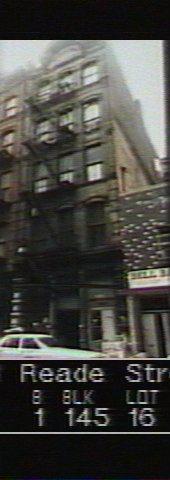
The city photographed every building for its tax records around 1940 and again in the 1980s. NYC Municipal Archives.
Written with AI from the source each entry cites, then fact-checked.
- 1885
Maria L. Combes replaces her grandfather's house with the De Raismes Building
Maria L. Combes inherited 111 Reade Street in 1885 from her grandfather, John F. Q. De Raismes. She commissioned Berger & Baylies to replace his house with a five-story neo-Grec store and loft building, built in 1885-86. It is nearly identical to 109 Reade Street, which the same architects designed in 1885 for Patrick Ryan. Raised lettering on the pediment gives the building's original name.
- 1890
The Salvation Army runs its American headquarters and printing operation here
The Salvation Army leased the new building, with a large assembly room on the ground floor and offices and meeting rooms above. It printed periodicals including All the World and a Swedish-language weekly, plus sheet music. In her 1890 book Maud Ballington Booth wrote that the headquarters had sixteen thousand square feet of offices and that the War Cry was set and printed on the premises. The group moved to a new building on West 14th Street in 1895.
Source: Daytonian in Manhattan
- 1943
The American Pistachio Corporation, an importer of long standing, is based here
By 1943 the American Pistachio Corporation, run by Syrian-born Fathallah Coussa, was at 111 Reade Street, and a newspaper that year called it one of the oldest pistachio importers in the country. In 1959 a shipment of its nuts bound for Hawaii was found contaminated and destroyed there. The firm nonetheless stayed in the building for more than two decades afterward.
Source: Daytonian in Manhattan
- 1997
The upper floors become apartments and the ground floor a theater, later a bar
In 1997 the upper floors were turned into residences, with one on each floor. The ground level became the Tribeca Playhouse, a theater that operated into the early 2000s. The space then housed the bar Ward Three, which was replaced in 2022 by Winston's, created by Sage Laforte.
Source: Daytonian in Manhattan
Further reading
- The 1886 De Raismes Building - 111 Reade StreetDaytonian in Manhattan
Nearby
- P. Ryan Packing Box Building109 Reade Street | 5 entries
- 113 Reade Street2 entries
- 105 Reade Street3 entries
- Cosmopolitan Hotel125 Chambers Street | 9 entries
- 121 Chambers Street5 entries
- 123 Chambers Street3 entries