Cosmopolitan Hotel
125 Chambers Street | also 95 West Broadway | Tribeca | built 1920
Open on the map9 entries

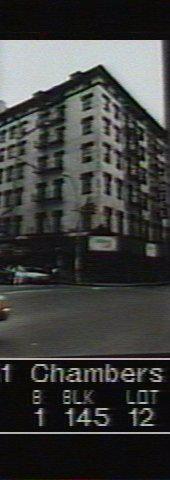
The city photographed every building for its tax records around 1940 and again in the 1980s. NYC Municipal Archives.
Written with AI from the source each entry cites, then fact-checked.
- 1844
Merchant James Boorman builds a four-story building across from the planned Hudson River Railroad depot
In 1844 James Boorman, a partner in the trading firm Boorman & Johnston and a founder of the Hudson River Railroad, bought a 75-by-75-foot lot at Chambers Street and West Broadway. It faced the site where the railroad planned a depot. His four-story building had shops on the ground floor, and Ann Andrews ran a boarding house above for merchants who worked downtown and on the South Street waterfront.
- 1853
Boorman demolishes a brick house once occupied by jeweler Charles L. Tiffany to enlarge the hotel
Next door at 125 Chambers Street stood a brick dwelling that the jeweler Charles L. Tiffany had occupied in the 1840s. Boorman took over the lease on the lot, which belonged to St. George's Church in Flushing, and tore the house down. In its place he built a five-and-a-half-story addition to his hotel, and in December 1853 he subleased it to the hotelkeeper John A. Davis. This entry describes an earlier building on the site.
- 1853
The Girard House opens as a hotel with a restaurant, a bar and oil paintings in the lobby
After the railroad opened its Chambers Street depot in 1852, Boorman leased the building to hotelkeeper John A. Davis, and by early 1853 it was open as the Girard House. It was smaller and less fashionable than the Astor House or the Metropolitan Hotel, but guests found Brussels carpets and black walnut furniture. The house also had a restaurant and a bar, and oil paintings hung in the lobby.
“By early 1853, the hotel had opened as the Girard House.”
- 1860
A persistent story puts Abraham Lincoln at the Girard House, but the city says he stayed at the Astor House
Popular tradition holds that Abraham Lincoln slept at the Girard House. The Landmarks Preservation Commission's research says otherwise: on his trips to New York in 1860 and 1861 he stayed at the Astor House on Broadway, not at this hotel at Chambers Street and West Broadway.
“Contrary to popular tradition, Abraham Lincoln stayed at the Astor House, not the Girard House, during his visits to New York in 1860 and 1861.”
- 1868
Vanderbilt moves the railroad depot to St. John's Park and the hotel loses its neighbor
In 1864 Cornelius Vanderbilt gained control of the Hudson River Railroad. In 1867-68 he closed the small Chambers Street depot and put up a big freight station at St. John's Park, where the Holland Tunnel exit plaza now stands. Dry goods merchants followed the railroad north, and the hotel lost its advantage of facing the depot. It still sat on a horsecar route and was a short walk from the Hudson River steamboat docks.
- 1869
The Huggins brothers lease the Girard House, rename it the Cosmopolitan and add a rear wing
In 1869 the experienced hoteliers N. and S.J. Huggins leased the hotel from Boorman's heirs, built a new wing in the rear courtyard and renamed it the Cosmopolitan, promising good rooms at moderate rates. They ran it until the 1890s. Charles Wildey, who had once tended bar on a Mississippi riverboat, was among the later proprietors, and under him the hotel became known for fine Southern cooking.
- 1913
Democratic stalwart Joseph M. Weintraub renovates the Cosmopolitan and makes it a meeting place for judges and lawyers
In 1913-14 the realtor and Democratic Party figure Joseph M. Weintraub had the Cosmopolitan Hotel completely renovated. He made it a meeting place for leading judges, lawyers and politicians. The landmark report notes that no new construction occurred in the surrounding district between 1904 and the 1920s, though this renovation took place in those years.
- 1940
By the 1940s the old hotel houses sailors, market workers and shoe salesmen who like its big rooms
According to the New Yorker in the 1940s, the hotel's regular guests were sailors, Washington Market workers and shoe salesmen, who liked the big old-fashioned rooms for showing their goods. The hotel was later renamed the Bond Hotel, and by the 1980s it was a single room occupancy hotel.
- 1987
A 1987-89 renovation rebuilds the western bays and raises the roofline of a possibly very old Manhattan hotel building
The original Gothic Revival section was built in 1844-45 as four stories and raised to six and a half in 1867-68, with an Italianate wing added in 1852-53 and a rear wing in 1869. Between 1987 and 1989 the six western bays on Chambers Street were rebuilt and the building was made taller along Chambers Street and part of West Broadway. The landmark report suggests it may be among the oldest hotel buildings still standing in Manhattan.
Further reading
- Cosmopolitan Hotel TribecaWikipedia
Nearby
- P. Ryan Packing Box Building109 Reade Street | 5 entries
- De Raismes Building111 Reade Street | 4 entries
- 123 Chambers Street3 entries
- 105 Reade Street3 entries
- 113 Reade Street2 entries
- 121 Chambers Street5 entries